—has the particular gift of being completely honest without being unkind.
She and I had grown up close, close enough that she was one of the only people I’d told about the farmhouse.
When she picked up, she sounded surprised to hear from me on a weekday morning.
“You okay?” she asked.
“Did you get a Thanksgiving message from my parents?”
A pause, then a short exhale.
“Yeah. Keeping it small. Hope you understand. I was going to call you about it.”
“So, you’re not invited either.”
“Nobody is. I talked to Aunt Donna this morning. She and Uncle Hank got the same message.”
And Jules stopped.
“Grandma didn’t even get a message. She had to hear about it from my mom.”
I pressed my hand flat against the counter. My grandmother is 81. She has driven down from Albany to the family Thanksgiving every single year for as long as I can remember. She makes a sweet potato casserole from a recipe that was her own mother’s.
She hadn’t received an invitation because Aaron wanted his fiance’s parents to feel comfortable.
“Jewels,” I said, “do you want to spend Thanksgiving at my place upstate?”
“I’ve been waiting for you to invite me there for 4 years,” she said.
I spent the next 2 days making calls. Jules brought in Aunt Donna and Uncle Hank without any convincing. Donna laughed so hard when I described the farmhouse that I had to wait for her to settle before I could give her the address.
My old friend Priscilla from Cornell, who’d spent three Thanksgivings alone in the city because her own family situation was complicated, said yes before I even finished the question.
Two colleagues from my firm who had nowhere to go. A neighbor from my Brooklyn building who baked pies the way other people breathed, slow and with total attention.
And then I called my grandmother.
She picked up on the second ring, which she always does because she keeps the phone on the side table next to her chair.
“Grandma,” I said, “I want you to come to my place for Thanksgiving. I have room. I have beds, and I’ll come pick you up myself if you want.”
She was quiet for a moment. When she spoke, her voice was careful, the way it gets when she’s feeling something she doesn’t want to show.
“Your place upstate.”
“Yes. 28 acres. A real farmhouse. A big table. I should have done this years ago.”
She said, “Tell me when to be ready.”
I drove up to the farmhouse the Sunday before Thanksgiving to open it up and begin. Greta, the contractor’s wife—
Phân cảnh 5: A table of one’s own
—from the town three miles over, who had fed me lunch nearly every weekend during the renovation, offered to help cook in exchange for being included.
I took her up on it without hesitation. She knew that kitchen like I knew a blueprint.
I put a 16-lb turkey in brine Monday night. Tuesday, I drove to the farm stand for squash, apples, and dried corn to decorate the mantelpiece.
Wednesday, I baked two pies, one pecan, one apple, while Greta made her sausage stuffing and a corn pudding that made the whole house smell like something from a different century.
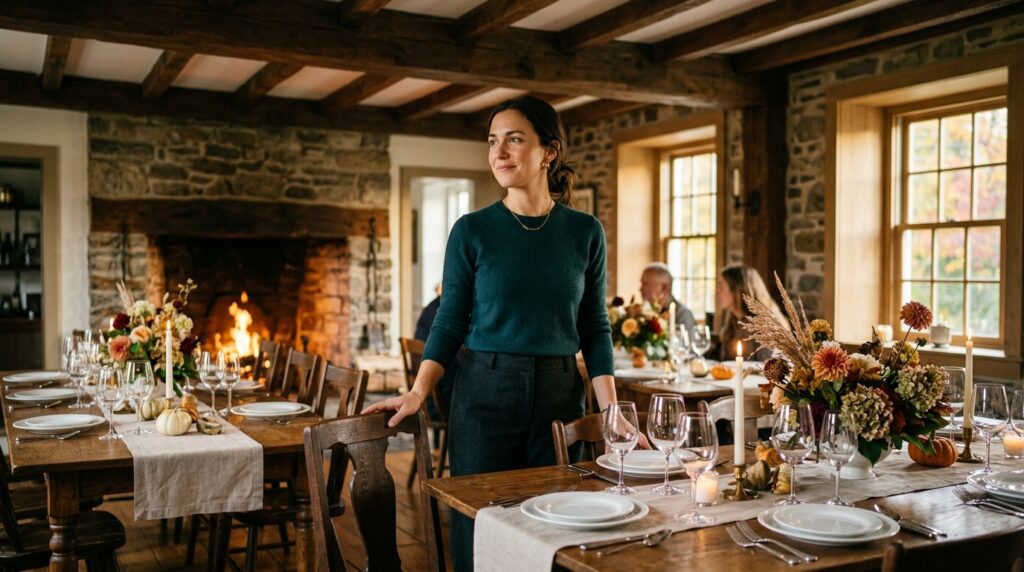
I set the long table in the main room with the pale cream china, not my grandmother’s bathroom, but the same one with a simple blue border, which I had been collecting piece by piece at estate sales over 2 years because I knew she’d recognize it.
I put a small gift at each place. A jar of local honey for Aunt Donna, who had been talking for years about cutting refined sugar but never found a substitute she loved. A pair of thick wool socks for Uncle Hank, who complained about cold feet every winter and never bought himself decent ones.
For Jules, a memoir by a hospital administrator who had rebuilt a failing rural clinic in Vermont. The kind of book she’d mentioned once in passing and would never prioritize buying for herself.
For Priscilla, a bottle of the Fingerlakes Reeseling we’d split on our last night before graduation, one neither of us could really afford at the time. I’d spent three months tracking down the same vintage.
For my grandmother, I left a small framed print of the meadow in summer taken from the porch. The photographer was a woman from the village who sold prints at the Saturday farmers market. I had bought it in August and been waiting to give it to someone who would love it.
There was no kids table. I had brought in two long benches from the barn so everyone could sit together, adults and children side by side with room to pass dishes without reaching across anyone.
They came through the afternoon in waves.
Jules pulled in with her boyfriend at noon, stood in the driveway looking up at the stone facade for a long moment, and then just said, “Celeste.”
My name. Nothing else. But the way she said it told me everything.
Aunt Donna walked in the front door, stopped in the entry, and burst into tears. Not sad ones.
Uncle Hank clapped me on the shoulder and said he hadn’t driven this far for Thanksgiving since 1987, and he was glad he had.
When my grandmother’s car came up the gravel lane, Jules’s boyfriend had gone to get her. I walked out to meet her.
She stepped out slowly, looked at the farmhouse for a long moment, and then looked at me.
“You built this,” she said.
It wasn’t a question.
“I designed every inch.”
She took my arm and we walked up the porch steps together.
