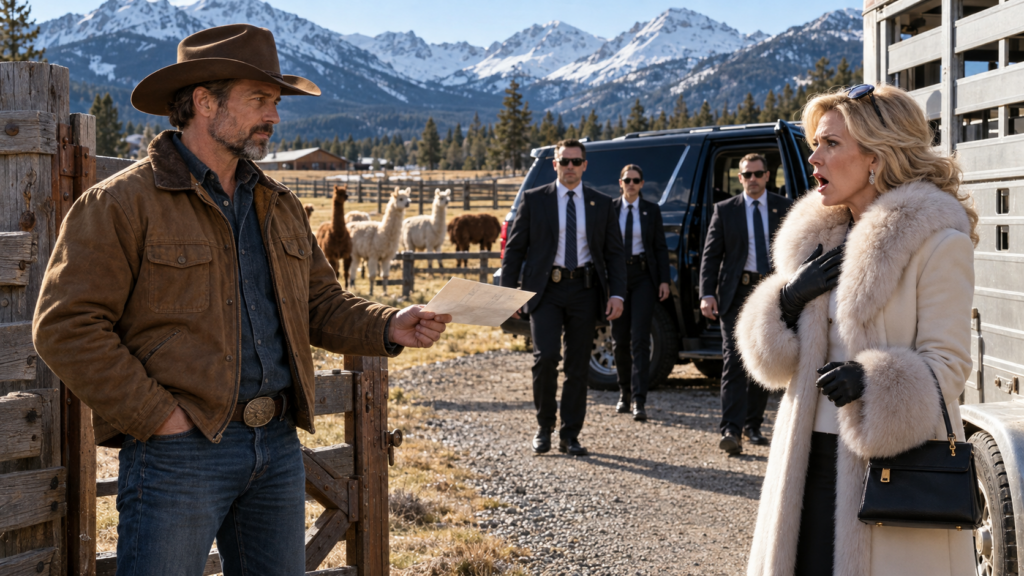
“Get those animals off this ridge by noon, Mr. Dalton.”
The woman at my front gate held up a sheet of paper like it was a weapon.
Behind her sat a livestock trailer.
Two hired men waited beside it.
Forty-eight alpacas watched from the pasture.
And the document in HOA president Victoria Crane’s hand claimed a county judge had authorized her to remove every animal from my ranch.
I read it once.
Then again.
“Where did you get this?”
“Our attorney.”
“This judge retired three years ago.”
Victoria’s expression barely changed.
“The order is valid.”
“No, it isn’t.”
She pointed at the trailer.
“I didn’t come here to debate with you. I came here to enforce it.”
One of the workers reached for my pasture gate.
“Don’t touch that latch,” I said.
He stopped.
Victoria snapped, “Keep going.”
The worker looked from her to me.
I held up the document.
“This is a forged court order. Every camera on this property is recording. If you enter that pasture or load one animal, you may be participating in criminal trespass and livestock theft.”
That got his attention.
Victoria’s composure cracked.
She stepped toward the gate herself.
“You think you can hide behind paperwork forever?”
I almost laughed.
Because paperwork was exactly what had brought her to this moment.
And paperwork was already bringing something else up my driveway.
But to understand that, you have to go back nineteen months.
My name is Michael Dalton.
Before inheriting Dalton Creek Ranch outside Fort Collins, Colorado, I spent twelve years in corporate finance.
Then my grandmother Ruth died.
She left me 318 acres, a spring-fed creek, two old barns, and forty-eight registered Huacaya alpacas descended from the four females she bought in 1993.
She also left a note.
Michael—
The ranch stays.
The herd stays.
Keep records.
Love, Ruth.
I moved in.
A year later, I married Erin Shaw, a large-animal veterinarian who had treated Ruth’s herd long before she treated me like marriage material.
For a while, life was simple.
Then Aspen Crest Estates appeared along our eastern boundary.
Ninety-two luxury homes.
Stone entrance.
Clubhouse.
Mountain-view lots marketed to buyers who wanted “authentic Colorado living” without the dust, tractors, coyotes, or livestock that made Colorado living authentic.
Victoria Crane had sold many of those homes before becoming HOA president.
She introduced herself one spring morning wearing a camel coat and shoes that sank into my gravel.
“Several residents are concerned about your animals.”
“What about them?”
“The smell. The appearance. The effect on values.”
I looked toward the alpacas.
“They were here first.”
“That doesn’t mean the area can’t evolve.”
Two weeks later, the first HOA violation arrived.
Livestock prohibited within five hundred feet of Aspen Crest residences.
My ranch wasn’t in Aspen Crest.
I ignored it.
Then came another.
Then another.
Animal Control investigated allegations that the herd was malnourished.
The officer found forty-eight healthy alpacas and wrote that the ranch exceeded welfare standards.
The county health department tested our creek after an anonymous complaint about manure contamination.
Clean.
Victoria petitioned the county for a zoning restriction aimed at livestock operations beside newer subdivisions.
Denied.
Then her HOA hired a Denver law firm to threaten us with a nuisance lawsuit claiming our alpacas had reduced neighborhood property values by $2.7 million.
My attorney, Gabriel Soto, responded with agricultural zoning records, Colorado right-to-farm protections, animal-control findings, water tests, and six decades of continuous ranch use.
The law firm disappeared.
Victoria didn’t.
A retired forensic accountant named Harold Greene finally explained why.
Harold lived inside Aspen Crest and served on its finance committee.
He came to my ranch one Saturday carrying two binders.
“Victoria doesn’t hate alpacas,” he said. “She needs your land.”
Inside the first binder were HOA payments.
Nearly $1.5 million over five years had gone to two vendors controlled by Victoria’s relatives.
Property management.
Landscaping.
Consulting.
Invoices described work Harold couldn’t verify.
Inside the second binder was something worse.
A confidential development plan.
Forty-two new luxury lots.
Roads.
A private pond.
A second clubhouse.
All of it drawn across Dalton Creek Ranch.
Projected sales:
More than $19 million.
Victoria’s projected real-estate commissions:
Over $1 million.
“She needs the expansion,” Harold said. “And she needs the expansion before somebody audits the HOA deeply enough to find the missing money.”
That explained everything.
The complaints.
The lawyers.
The zoning petitions.
The property-value scare.
The alpacas were never the target.
They were leverage.
Harold had already contacted federal investigators.
My job was simpler.
Protect the ranch.
We installed cameras along every boundary.
Within two weeks, someone cut our fence at 2:17 a.m.
Three alpacas wandered onto Aspen Crest common property.
Victoria immediately reported “dangerous loose livestock.”
Unfortunately for her, the camera showed a person with bolt cutters.
Animal Control documented deliberate tampering.
Then I posted formal trespass notices.
Victoria was running out of ways to pressure me.
That’s when she made the mistake that ended everything.
At 8:45 on a Tuesday morning, she arrived with a thirty-foot livestock trailer and two hired handlers.
She handed me the fake court order.
I read the case number.
Wrong format.
The statute.
Wrong subject.
The judge.
Retired.
I looked up.
“This is fabricated.”
Victoria’s eyes hardened.
“You’re not qualified to interpret court documents.”
“I spent twelve years reviewing financial and legal documents for a living.”
She gave a cold laugh.
“That doesn’t make you a lawyer.”
“No.”
I folded the paper.
“But Gabriel is.”
The workers stopped moving.
Victoria marched toward the gate herself.
Then headlights appeared at the end of my ranch road.
Black government SUV.
Another vehicle behind it.
Victoria turned.
Her face changed instantly.
Because the people stepping out weren’t from Animal Control.
And they weren’t from the HOA.
The woman in the dark suit held federal credentials in one hand.
In the other was an arrest warrant.
The SUV stopped behind Victoria’s Range Rover.
Special Agent Lena Ortiz stepped onto the gravel with another federal agent beside her.
“Victoria Crane?”
