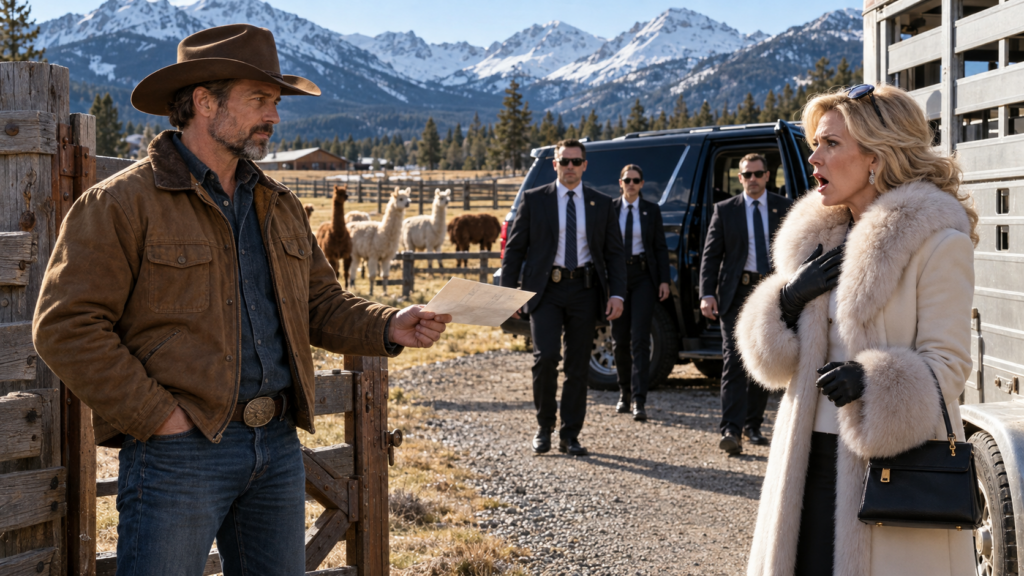
Victoria lowered the fake court order.
“What is this?”
“Federal Bureau of Investigation. We have a warrant for your arrest related to wire fraud, mail fraud, conspiracy, and misappropriation of association funds.”
For the first time since I’d met her, Victoria said nothing.
The two livestock handlers backed away from the trailer. One of them quietly handed me his business card.
“She told us this was a lawful county seizure,” he said.
“I believe you.”
Agent Ortiz looked at the document Victoria had brought.
“Is that the order she presented?”
“Yes.”
Gabriel arrived minutes later and supplied the sheriff’s office with a copy. The case number, signature block, and judicial authorization were all wrong.
The forged order became additional evidence.
Then Harold called.
Federal agents were simultaneously executing a search warrant at the Aspen Crest HOA office.
Investigators had obtained bank records showing HOA money flowing through family-controlled vendors and then into accounts linked to Victoria.
But the financial fraud wasn’t the only thing they found.
Inside a locked file cabinet sat copies of the Dalton Creek development plan.
One folder was labeled:
ACQUISITION PRESSURE STRATEGY.
Inside were timelines matching the complaints against my ranch.
Animal Control.
Health Department.
Zoning petition.
Nuisance threat.
The documents transformed nineteen months of harassment into something organized.
Then one email surfaced.
It was from Victoria to the developer financing Aspen Crest Phase Two.
The message contained only one sentence:
Once he loses the herd, he’ll sell the land.
Agent Ortiz read it at my kitchen table that afternoon.
Then she looked toward the pasture.
“Mr. Dalton, she never expected you to keep everything.”
I thought about Ruth’s note. Keep records.
“No,” I said.
“She really didn’t.”
Victoria’s arrest didn’t end the case.
It started the part nobody posts dramatic videos about.
Subpoenas.
Audits.
Bank records.
Witness interviews.
Electronic searches.
Board minutes.
Invoices.
Real investigations move slowly because every accusation eventually has to survive contact with evidence.
Harold Greene became one of the government’s most important witnesses.
For five years, he had watched Aspen Crest spend money in ways that never made sense.
The HOA collected more than $200,000 annually in dues.
Yet reserves were constantly described as “temporarily constrained.”
Special assessments appeared for landscaping, drainage, entrance repairs, legal expenses, and community-management costs.
Victoria always had an explanation.
Until Harold started comparing invoices.
Ridgeline Residential Services billed Aspen Crest $17,500 every month.
The company had no employees and no office.
Its registered agent was Victoria’s sister.
Crane Landscape Group received hundreds of thousands more.
That company existed, but invoices claimed work nobody could find.
Forty thousand dollars for wildflower installation where no wildflower beds existed.
Twenty-three thousand for erosion control on level ground.
Twelve thousand for “stormwater optimization” that county records showed had never been permitted or inspected.
Federal investigators traced a portion of those funds through family accounts and into investment assets controlled by Victoria.
The expansion project explained why she had suddenly become aggressive.
Harold’s questions were getting closer to the missing money.
Victoria needed cash.
A Phase Two development could generate millions in commissions and business opportunities.
But Phase Two required my ranch.
The developer working with her was Nathan Cole, owner of Highmark Communities.
Nathan denied knowing about the harassment campaign.
Then investigators recovered his emails.
One message to Victoria read:
Need Dalton softened before Q3. Investors won’t wait forever.
Her response:
Working multiple pressure channels. Livestock is easiest because residents already dislike the optics.
Another:
County route failed. Legal nuisance route next.
The language was cold.
Not angry.
Strategic.
That bothered me more.
Victoria hadn’t lost control and started lashing out.
She had been running a plan.
Animal Control was a pressure channel.
The groundwater complaint was a pressure channel.
The zoning petition.
The nuisance letter.
Even the staged loose-alpaca incident.
Each failed individually.
Together, she hoped they would make keeping the ranch expensive enough, exhausting enough, humiliating enough that I would eventually accept an offer.
The fence footage became important.
Investigators enhanced the video.
The person cutting the wire wore a jacket connected to Crane Landscape Group.
License-plate footage from a camera near Aspen Crest’s service entrance showed one of the company trucks leaving shortly before the fence was cut.
Then an employee cooperated.
His name was Justin Pike.
He admitted Victoria paid him $1,500 cash to create “a temporary opening.”
“She said nobody would get hurt,” he told investigators.
“What did she want?” Gabriel later asked.
“Pictures of the animals outside the ranch.”
That explained the speed of Victoria’s complaint the next morning.
She didn’t discover loose alpacas.
She was waiting for them.
The fake court order was worse.
Its metadata showed it had been created on a laptop registered to the HOA office.
A draft version included notes in the margin.
Need official-looking caption.
Find old judge signature.
Use county noise citation?
Someone had copied the signature block from an unrelated public filing signed by retired Judge Henry Lawson years earlier.
Victoria apparently believed that if the document looked official and arrived with a trailer and two workers, I would panic.
She had spent so long watching people accept her authority that she forgot authority can be checked.
The two livestock handlers became strong witnesses because neither had known the order was fake.
Victoria had told their company they were executing a court-authorized emergency livestock removal.
She paid them cash.
One worker testified later that when I challenged the document, Victoria ordered them to proceed anyway.
He refused.
That decision probably saved him from becoming entangled far more deeply.
Aspen Crest’s board removed Victoria within forty-eight hours of her arrest.
Harold became interim president.
He hated the job.
That was encouraging.
His first email to the neighborhood contained no logo, no photographs, no phrases about “elevated living.”
It said:
We have serious financial and legal problems. We will publish what we know, admit what we do not know, and stop pretending otherwise.
Residents responded better to that than anyone expected.
