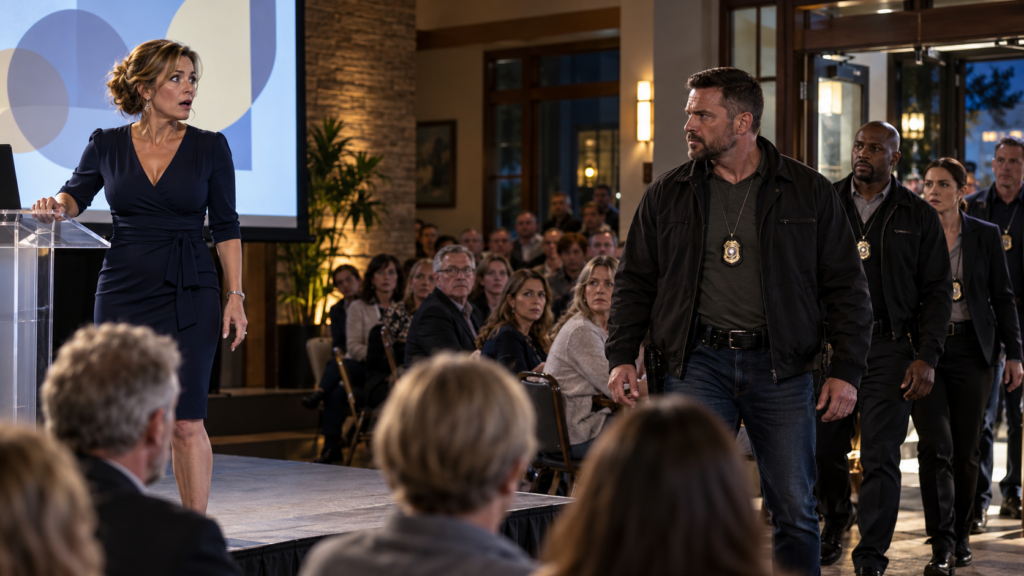
The HOA president had my ugly Jeep towed from my own driveway while I was at work.
Then she posed beside the tow truck and posted the pictures online.
Forty-three likes.
Twenty-six comments.
“Finally.”
“Best HOA president ever.”
“This is why we pay dues.”
Her caption said:
THE EYESORE ON MAGNOLIA COURT IS OFFICIALLY GONE. THIS IS WHAT LEADERSHIP LOOKS LIKE.
She had no idea she’d just ordered the removal of a government surveillance vehicle containing sealed evidence from an active narcotics investigation.
Or that, six hours later, someone at the tow yard would try to pry open the reinforced evidence compartment underneath the cargo floor.
My name is Jake Callaway.
I’m thirty-six years old.
Former Marine.
Former county patrol deputy.
And for the last several years, I’ve worked with a regional narcotics task force investigating drug-trafficking organizations operating across central North Carolina.
The Jeep was part of that work.
To Diane Prescott, though, it was just ugly.
A faded 2005 Wrangler.
Olive paint.
Dented quarter panel.
Mismatched tires.
Mud on the fenders.
Steel brush guard.
Roof rack.
It looked exactly like the kind of vehicle nobody would remember five minutes after seeing it.
Which was the point.
I moved into Brierwood Station in March.
Four-bedroom colonial.
Quiet cul-de-sac.
Crepe myrtles.
Neat lawns.
Neighbors who pressure-washed driveways on Saturday mornings.
Diane appeared on my fourth day.
Pearl earrings.
Cream blazer.
Expensive handbag.
Leather folder.
She handed me a bottle of wine with a custom HOA label and introduced herself as president.
Then her eyes landed on the Jeep.
“Is that yours?”
“Yes, ma’am.”
She tilted her head.
“It’s very… outdoorsy.”
I almost laughed.
“That’s one description.”
“Most Brierwood residents keep recreational vehicles inside their garages.”
“It’s not a recreational vehicle.”
She smiled.
“The previous homeowner parked a silver BMW there. Much nicer visually.”
Then she walked away.
Three weeks later, the first violation notice appeared.
UNSIGHTLY VEHICLE VISIBLE FROM STREET.
Corrective action:
Remove it or place it inside the garage.
The garage wasn’t an option because the vehicle’s operational protocols required it to remain accessible.
I couldn’t explain that to Diane.
So I ignored the notice.
That was my first mistake.
Not because she was right.
Because Diane treated silence like surrender.
Another notice arrived.
Then another.
By late April, she’d begun photographing the Jeep twice a day.
Mud accumulation.
Body damage.
Aftermarket equipment.
Even the sticker on the tailgate.
One notice included twelve color photographs.
My neighbor Marcus Hayes looked through them.
Marcus was sixty-one, retired Army, and possessed the rare ability to detect nonsense before anyone finished explaining it.
“She took close-ups of your tires?”
“Apparently.”
He shook his head.
“This woman needs a hobby.”
“Seems like I’m the hobby.”
Then Diane presented the Jeep at an HOA board meeting.
Slide seven of a twelve-slide presentation was dedicated entirely to my driveway.
The previous owner’s BMW on the left.
My Wrangler on the right.
She called the section:
NEIGHBORHOOD STANDARDS — WHERE WE ARE AND WHERE WE NEED TO BE.
Marcus attended.
I didn’t.
I was sitting in an unmarked vehicle outside a storage facility watching a suspect tied to an interstate narcotics case.
The board passed a new vehicle-appearance policy four to one.
Marcus was the one.
A month later, Diane sent me a certified ultimatum.
Seventy-two hours.
Remove the Jeep.
Or the HOA would remove it “at the owner’s expense.”
That got my attention.
I read the letter at three in the morning after a fourteen-hour shift.
I knew an HOA’s private covenant enforcement powers were not the same thing as a court order or law-enforcement seizure authority.
But I was exhausted.
And I made the stupid assumption that nobody would actually send a tow truck into a homeowner’s private driveway over a muddy Wrangler.
I was wrong.
On Thursday morning, June 27, I was sixty miles away helping with surveillance tied to a major drug shipment.
At 7:15, a flatbed entered Magnolia Court.
Marcus watched from his porch.
Then he saw Diane.
She stood in my driveway wearing white pants, pearl earrings, and the expression of a woman attending a ribbon cutting.
Marcus walked over.
“Diane, what are you doing?”
“Enforcing the board’s resolution.”
“You can’t tow his Jeep while he’s gone.”
“The compliance period expired.”
“This is private property.”
She looked at him.
“Marcus, leadership requires difficult decisions.”
The tow driver hesitated.
Diane told him:
“Get it loaded.”
The Jeep disappeared down Magnolia Court.
At 7:31, her Facebook post went live.
She even included a before-and-after photo.
Jeep.
Empty driveway.
Problem solved.
At least that’s what she thought.
I didn’t check my phone until that evening.
We’d spent the day executing warrants connected to a fentanyl distribution investigation.
When I finally looked, I had fourteen missed calls.
Nine from Marcus.
Two from our operations center.
I called Marcus first.
“Jake, she towed your Jeep.”
Everything in me went still.
“Where?”
“Wilks Towing. Her brother-in-law’s place.”
Then I called our analyst.
He gave me the information that transformed an HOA dispute into something much more serious.
The Jeep’s tracking system showed it had been taken to the tow yard.
That was bad enough.
Then an integrity sensor on the locked evidence compartment registered a tamper event at 1:22 p.m.
“Was the compartment breached?”
“No.”
“Evidence seals?”
“Still intact.”
“What triggered it?”
“Physical force against the lock system.”
I closed my eyes.
The compartment contained sealed materials whose chain of custody mattered to an ongoing criminal investigation.
If those materials had been compromised, defense attorneys would’ve had every reason to challenge them.
I called my task-force supervisor.
She listened.
Then said:
“Nobody touches that Jeep again until we recover it properly.”
The next morning, investigators went to Wilks Towing with legal process for the vehicle.
Gary Wilks, the owner, cooperated immediately.
He looked at the paperwork.
Then at the Jeep.
Then sat down.
“She told me it was abandoned.”
“Who?”
“Diane.”
“Did you contact the registered owner?”
“No.”
“Why?”
His face changed.
“She specifically told me not to.”
