Then he handed investigators his phone.
The messages were still there.
Diane:
Thursday morning. Early. Get it done.
Gary:
You sure? Owner may make trouble.
Diane:
He won’t. He’s nobody. I have authority. Don’t call him.
A nobody.
That was what she’d decided I was because of an old Jeep and muddy tires.
Then investigators asked about the evidence-compartment tamper alert.
One of Gary’s young employees admitted he’d seen the reinforced box during inventory and tried briefly to pry it open because he didn’t know what it was.
He failed.
The tamper seal held.
Every evidence package remained intact.
For the first time in twenty-four hours, I could breathe.
Then Gary gave investigators the HOA authorization Diane had handed him.
And that document created a second problem for her.
The more we reviewed how she’d been using HOA authority, the more financial questions began surfacing.
Contracts awarded to relatives.
Management fees paid to a company associated with Diane.
Vendor invoices that didn’t match ordinary market costs.
I hadn’t been investigating her.
Not officially.
But once records connected to the tow had to be preserved, the association’s own paperwork started raising questions.
My supervisor looked at me.
“You stay out of the financial side.”
“Gladly.”
“Conflict problem.”
“I understand.”
Independent investigators and accountants took it from there.
Meanwhile, Diane had no idea any of this was happening.
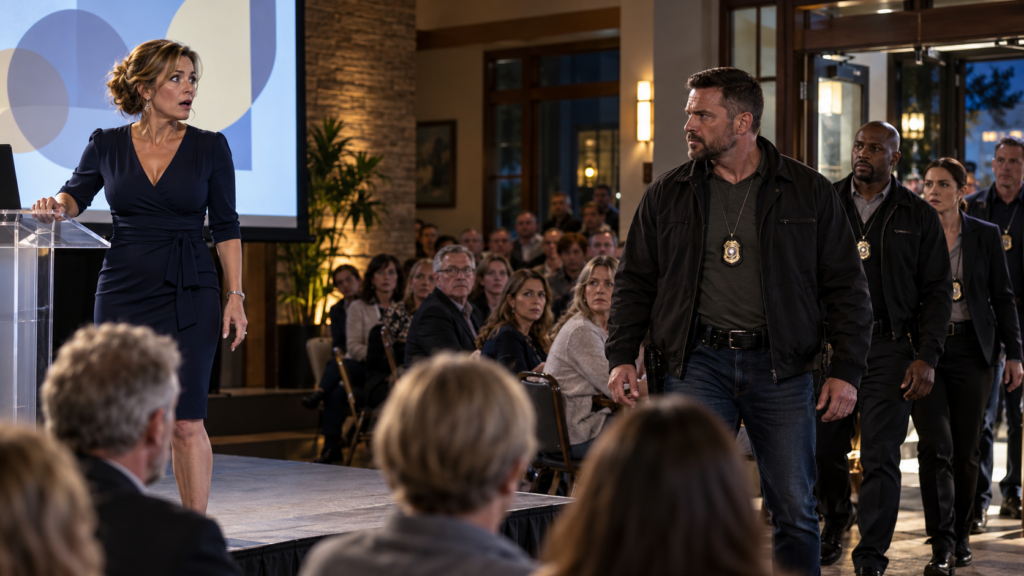
A week after the tow, she stood in the Brierwood clubhouse beneath a projector screen showing the empty space where my Jeep had been.
Her slide said:
RESULTS.
She proposed giving herself broader authority to order future vehicle removals.
Marcus raised his hand.
“Did Jake authorize the tow?”
“No.”
“Did you have a court order?”
Diane’s smile tightened.
“The board had enforcement authority.”
“Did an attorney tell you that?”
She paused.
“That’s a board matter.”
Marcus called me afterward.
“She’s doubling down.”
“Good.”
“Good?”
“Let her keep talking.”
Two weeks later, Brierwood held its largest HOA meeting in years.
Eighty-three residents showed up.
Diane had titled the presentation:
BRIERWOOD 2025 — RAISING THE STANDARD.
The first accomplishment on her screen was my Jeep.
At 7:02 p.m., she pointed at the before-and-after photograph and said:
“This is what happens when leadership isn’t afraid to act.”
Then the clubhouse doors opened.
I walked in wearing my badge.
Behind me came my task-force commander.
Two investigators.
And a forensic accountant carrying a box of records.
Diane stopped speaking.
Her laser pointer lowered.
She stared at the badge on my belt.
Then at the officials behind me.
For the first time since I’d moved to Magnolia Court, Diane Prescott looked at me without seeing an ugly Jeep.
And I said:
“It’s Detective Callaway, ma’am.”
The room went silent.
I explained only what I was authorized to disclose.
The Jeep Diane had ordered removed was a government-controlled vehicle used in a multi-agency narcotics investigation. The reinforced compartment beneath its cargo floor contained sealed evidentiary material, and someone at the tow yard had attempted to force it open.
“The evidence was not compromised,” I said. “But it could have been.”
Diane gripped the podium.
“This is retaliation over an HOA violation.”
My commander answered.
“No, ma’am. The HOA dispute and any criminal or financial investigation are separate matters.”
Then the forensic accountant opened her file.
A review of association records had identified questionable payments requiring explanation: administrative fees to a company connected to Diane, inflated landscaping contracts involving a relative, and a security invoice that investigators had been unable to reconcile with the work performed.
Nobody called it embezzlement that night.
Not yet.
Facts first.
Labels later.
Marcus stood.
“Did the board know about those payments?”
Three directors looked at one another.
One finally said:
“I didn’t.”
Another shook his head.
Diane turned toward them.
“This is being twisted.”
Then investigators produced the tow-yard messages.
DON’T CALL HIM.
HE’S NOBODY.
I HAVE AUTHORITY.
The board went into emergency executive session.
Twenty-three minutes later, they returned.
One director made a motion to remove Diane as president pending investigation.
Marcus seconded it.
The vote was unanimous.
Diane’s own allies voted against her.
She left the clubhouse without her clipboard.
Without her laptop.
And without the handbag she’d placed beside the podium.
For several minutes, the projector continued displaying the photo she’d been so proud of:
My muddy Jeep on a tow truck.
The picture she thought proved she had won.
Now it was part of the evidence showing exactly how far she’d been willing to go…
The night Diane lost the presidency wasn’t the end.
It was the point where everyone stopped being afraid to ask questions.
That mattered more.
The following morning, Brierwood’s remaining directors hired independent counsel.
Then they retained an outside accounting firm.
Not one suggested by Diane.
Not one connected to her vendors.
Independent.
For the first time in years, association expenses were examined line by line.
Landscaping.
Security.
Administrative consulting.
Clubhouse purchases.
Legal bills.
Contractor reimbursements.
What emerged wasn’t some cinematic secret ledger with “STEALING MONEY” written across the top.
Real financial misconduct rarely looks that convenient.
It looked like ordinary invoices.
Recurring charges.
Vague descriptions.
Related companies.
Contracts that hadn’t been competitively reviewed.
One payment at a time.
That was why nobody had questioned them earlier.
A thousand dollars here.
Four thousand there.
A little extra every month.
Over several years, small numbers stopped being small.
The outside review identified tens of thousands of dollars in payments that the board could not initially justify under normal association business.
Some were eventually explained.
Others weren’t.
Those records were referred to the appropriate authorities.
I stayed out of that process.
I had to.
The second I learned the review might become criminal, I wanted distance.
My job had been narcotics enforcement.
I wasn’t going to turn a personal dispute into my own investigation.
That would’ve contaminated everything.
Diane had made enough mistakes without me making one too.
The Jeep came home two days after recovery.
Still muddy.
Still dented.
Still ugly.
Marcus stood in his driveway watching while another task-force officer dropped it off.
