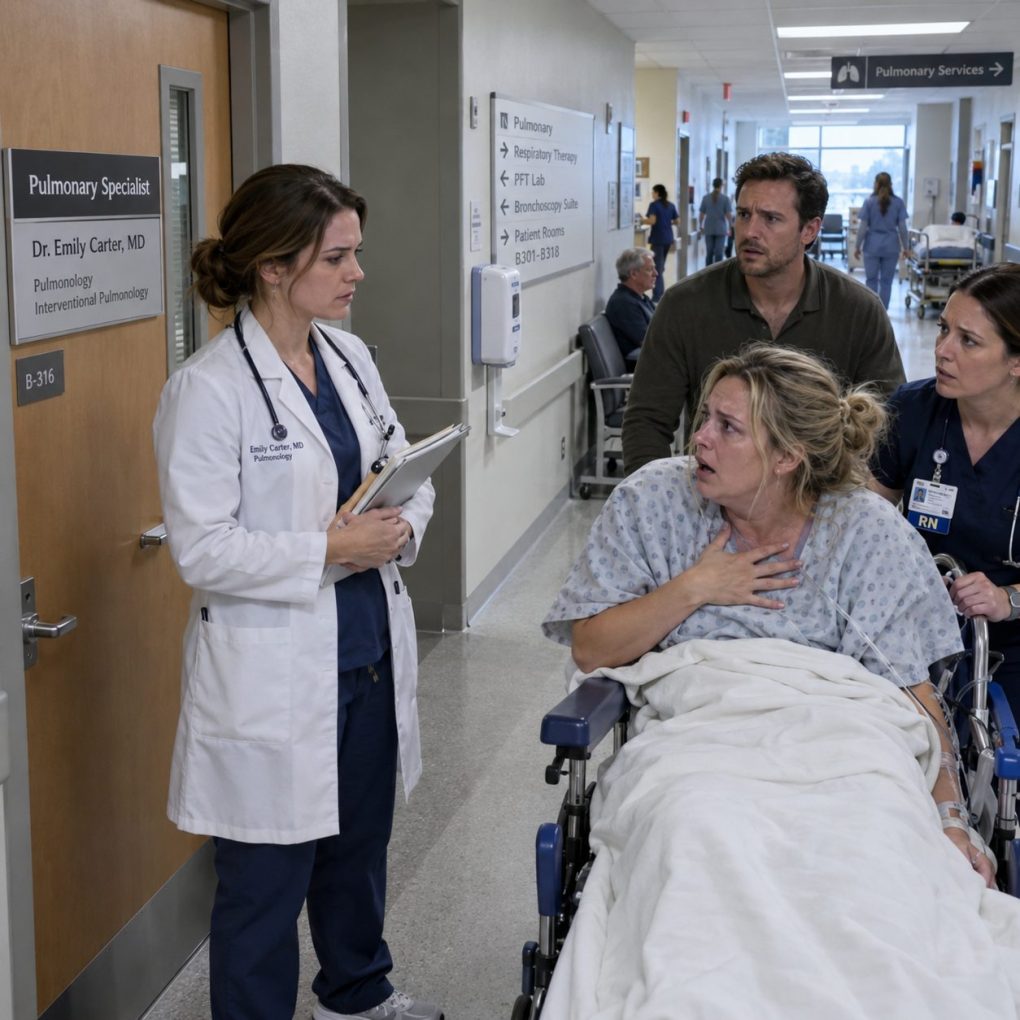
At Thanksgiving dinner, my sister joked about the night she told hospital staff I was only pretending to suffocate. Everyone laughed except me. Years later, her husband called from the ICU, begging for the hospital’s best lung specialist. He had no idea who would answer.
The last time my sister saw me struggling to breathe, she laughed and told the emergency room nurse I was doing it for attention.
Seventeen years later, she arrived at my hospital in a wheelchair, gasping for air, and demanded the best lung specialist available.
She had no idea the name on the office door was mine.
I was nineteen the night it happened. I remember the cold metal railing beside the emergency room bed, the smell of disinfectant, and the terrible realization that no matter how hard I tried, I couldn’t pull enough air into my lungs.
“She’s always dramatic,” my older sister, Vanessa, told the triage nurse. “She gets like this whenever someone else is getting attention.”
I’d been wheezing for hours. My rescue inhaler hadn’t helped. Every breath made a thin, frightened sound.
“Vanessa,” I whispered.
She rolled her eyes.
“See? She’s talking. She’s fine.”
The nurse clipped a pulse oximeter onto my finger. Her expression changed immediately. Within moments, I was being moved into a treatment room.
My oxygen level was dangerously low. I had developed a life-threatening asthma attack that progressed to respiratory failure. I spent three days on a ventilator and woke in intensive care with a sore throat and bruises where the IVs had been taped.
When I opened my eyes, Mom was sitting beside my bed.
“Vanessa said you frightened everyone,” she murmured. “You really need to learn not to panic.”
I couldn’t speak yet.
So I turned my face toward the window.
My sister never apologized. At Thanksgiving that year, she joked about the night I’d “performed for an entire emergency department.” Dad laughed. Mom told me not to be so sensitive.
I stopped going home for holidays after that.
What nobody in my family knew was that the experience had changed what I wanted to do with my life.
I had already started college. After recovering, I changed my plans, finished my degree, went to medical school, and eventually trained in pulmonary and critical care medicine. There were years of overnight shifts, exams, and apartments with barely enough space for a bed.
I rarely spoke to Vanessa.
Now, at thirty-six, I worked as a pulmonologist at a large hospital outside Boston.
That Tuesday morning, I was reviewing a patient’s lung scans when my colleague, Dr. Bennett, appeared at my office door.
“Emily, we have a patient asking specifically for you.”
I looked up.
“Who?”
He hesitated.
“Vanessa Morgan. She says she’s your sister.”
Then he handed me her emergency department summary.
I read the first line.
And felt my fingers tighten around the paper….Pick up the story here.
Vanessa’s oxygen saturation had fallen into the eighties despite supplemental oxygen. The emergency team was evaluating several possible causes, including a serious infection and a blood clot in her lungs.
Her husband, Daniel, had brought her in after three days of worsening shortness of breath.
“She kept saying it was nothing,” he told Dr. Bennett. “She didn’t want anyone thinking she was overreacting.”
I stood beside the consultation room window, reading the chart again.
I knew that sentence.
For seventeen years, I’d heard variations of it whenever I remembered the night I almost died.
Dr. Bennett looked at me.
“You don’t have to take her case, Emily.”
“She’s frightened.”
“I know. But she needs a physician who can make decisions without this history between you.”
He was right.
I wasn’t the attending physician assigned to her, and I asked him to remain responsible for her treatment. I could offer information about our family history if necessary, but I wouldn’t become the person deciding her care.
Before he returned to the emergency department, he asked whether I wanted him to tell Vanessa I worked here.
“She’ll find out,” I said.
Twenty minutes later, Daniel appeared outside my office.
He looked older than I remembered, with gray around his temples and a jacket he’d buttoned incorrectly.
“Emily?”
I stood.
He held out his hand, then lowered it when he saw my face.
“Vanessa told me what happened when you were younger,” he said quietly.
I waited.
“She said you had an asthma attack. She didn’t tell me she laughed at you.”
I looked down at the wedding ring on his finger. He was twisting it around and around.
“She’s been sick for days,” he continued. “I wanted to bring her in Sunday. She told me I was being ridiculous.”
“She’s being evaluated now. That’s what matters.”
He swallowed.
Then he pulled a folded piece of paper from his pocket.
It was a handwritten list of symptoms Vanessa had been keeping: shortness of breath, chest pain, dizziness, and a cough that had worsened throughout the week.
At the bottom, she’d written:
Don’t make a scene. Don’t be like Emily.
Daniel looked at me.
“She wrote that yesterday.”
For a moment, I couldn’t move.
Vanessa hadn’t just dismissed my suffering seventeen years earlier.
She’d carried those same words into her own illness.
A nurse approached and told Daniel the team needed to speak with him. Vanessa’s condition had worsened, and they were preparing to move her to intensive care.
He hurried away.
I stayed where I was, holding the folded paper.
Then Dr. Bennett called.
“Emily, we have the imaging results. There’s something important you should know about your sister.”
“She’s got blood clots in both lungs,” Dr. Bennett said. “A pulmonary embolism. We’re treating her now.”
I sat down slowly.
Vanessa had been complaining about chest pain and breathlessness for three days. She’d also taken a long flight the previous week and had mentioned swelling in one leg, details that became important once her doctors reviewed her history.
