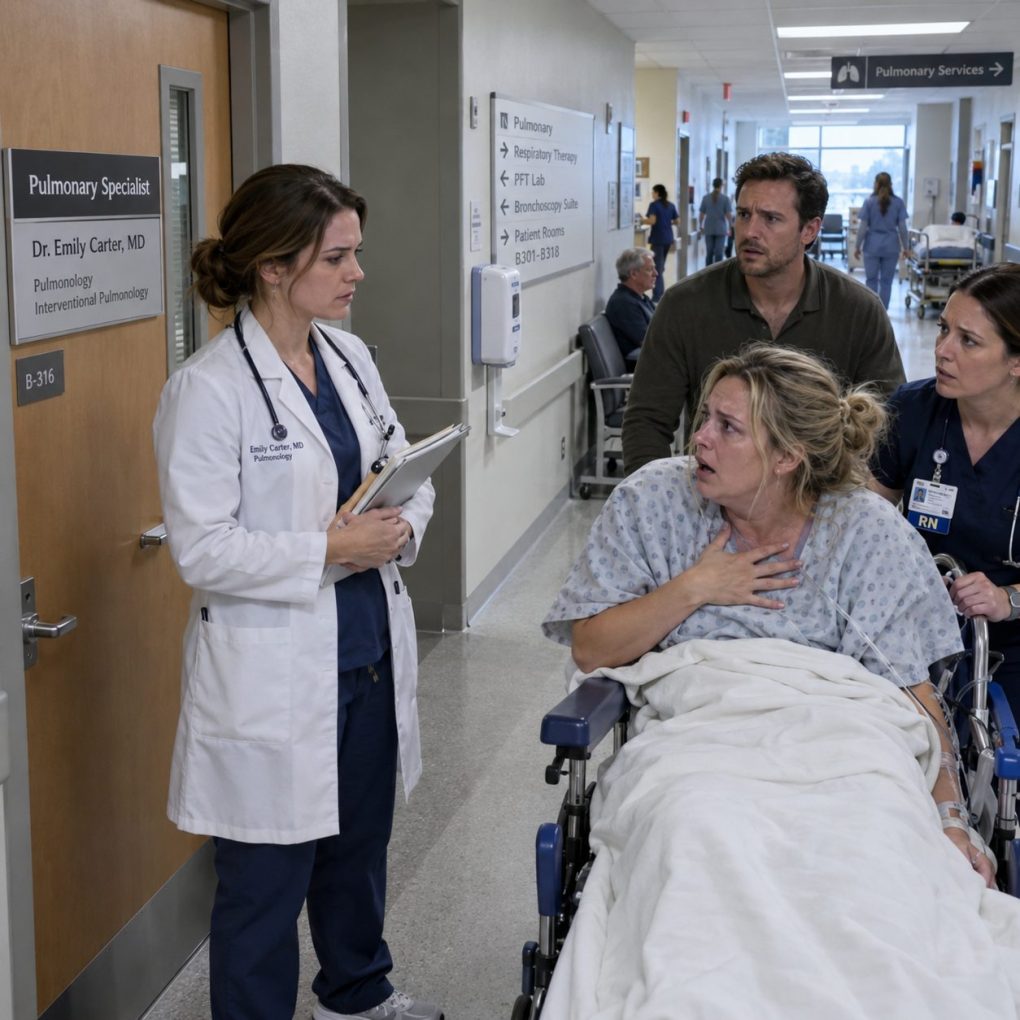
The clinical team started anticoagulation and closely monitored her heart and breathing. When her blood pressure began dropping, the intensive care physicians evaluated her for additional treatment.
I wasn’t part of those decisions.
For the first time in my career, I understood how different it felt to stand outside the room instead of inside it.
Daniel found me that evening near the vending machines.
“They think she’s going to make it,” he said, gripping an untouched bottle of water. “But they’re watching her closely.”
I nodded.
He sat beside me.
“She told me you two weren’t close because you never forgave her for a joke.”
I stared at the machine’s glowing buttons.
“It wasn’t the joke,” I said. “It was that she watched me struggle to breathe and told people I was pretending.”
Daniel looked at his hands.
“I wish I’d known.”
I thought about telling him how many nights I’d spent listening to my own breathing afterward, afraid the next one wouldn’t come. Instead, I asked whether he’d eaten.
He shook his head.
I bought him a sandwich.
Vanessa remained in the ICU for two days before her condition stabilized. On the third morning, a nurse told me she’d asked whether I would visit.
I waited until my shift ended.
When I entered her room, Vanessa was sitting upright with oxygen tubing beneath her nose. Her hair was tangled against the pillow. The woman who used to straighten every picture frame in Mom’s living room couldn’t even manage the loose blanket around her knees.
She looked at my white coat.
Then at my name badge.
“Emily Carter, MD,” she read quietly.
Her eyes filled.
“I didn’t know.”
“I know.”
She looked toward the doorway.
“Daniel told me you’re a lung specialist.”
I nodded.
“Did you treat me?”
“No. Dr. Bennett and the critical care team are taking care of you.”
Vanessa rubbed her thumb along the hospital bracelet on her wrist.
“I was terrified,” she whispered. “I kept trying to breathe, and nothing felt right.”
I pulled a chair closer.
She stared at me for a long moment.
Then she said, “That’s what happened to you, wasn’t it?”
“Yes.”
Her mouth trembled.
“And I laughed.”
I didn’t answer.
“I remember telling the nurse you were pretending. I remember Mom saying you always wanted attention.” She wiped her cheek with the edge of the blanket. “When your oxygen number dropped, everyone started moving so fast. I thought you’d die.”
I looked at her.
“You never told me that.”
“I was ashamed.”
For seventeen years, I’d imagined what it would feel like to hear her finally admit it.
Now, sitting beside her hospital bed, I didn’t feel victorious. I noticed the bruises on her arms from blood draws and the way she watched the oxygen monitor between sentences.
“You were scared,” I said. “But I was the one who couldn’t breathe.”
She began crying.
“I’m sorry, Emily.”
I let the words remain between us.
There was no sudden embrace. I didn’t tell her everything was forgiven. She didn’t ask me to.
Over the following months, Vanessa recovered with medical follow-up and continued anticoagulation as directed by her doctors. She also began counseling. We spoke occasionally, first in short messages, then over coffee.
Mom called to say it was wonderful that the experience had finally brought us together.
I told her something I’d never said aloud before.
“Mom, I needed you that night too.”
She went quiet.
It took her several weeks to call back and apologize.
The following Thanksgiving, Vanessa invited me to dinner. I told her I wasn’t ready for a family gathering, but offered to meet her the next morning.
We sat in a small bakery near the hospital.
She arrived carrying two coffees.
“I wasn’t sure how you take yours,” she admitted.
“Two sugars.”
She smiled faintly and pushed the right cup toward me.
For a while, we watched people passing the window.
Then Vanessa reached across the table.
“I’m learning to believe people when they say they’re hurting,” she said.
I looked at her outstretched hand.
Seventeen years earlier, I’d reached for that same hand in an emergency room, and she’d turned away.
This time, I took it.
Not because everything had been repaired.
But because, for the first time, she was finally listening.
