“Prayer is better than medicine,” my mother-in-law said, dropping my prescription bottle into the kitchen trash. Six days earlier, I’d been in a hospital bed struggling to say my daughter’s name. Now I stood in my own kitchen, one hand gripping the counter, while Evelyn decided which parts of my recovery she believed in.
“Please,” I said. The word came out slowly. “I need those.”
“You need faith, Sarah. Not a shelf full of chemicals.”
I was thirty-four, living outside Columbus, Ohio, with my husband, Daniel, and our ten-month-old daughter, Lily. The stroke had left my left hand weak and my speech uneven. My doctors had sent me home with a treatment plan, medication, and strict instructions for follow-up appointments.
Evelyn had volunteered to stay while Daniel worked. At first, I was grateful. She washed bottles, folded Lily’s pajamas, and left cut fruit beside my chair. Then she began correcting the exercises my therapist gave me and telling relatives I was “making myself helpless.”
That Thursday afternoon, I caught her holding my pill organizer over the trash.
“I’m clearing away the fear,” she said.
I reached for it. My fingers wouldn’t cooperate. She lifted it beyond my hand as easily as she used to take sweets away from Lily.
“Daniel,” I called, but he was upstairs putting the baby down.
Evelyn emptied the organizer into the trash and pushed the lid closed with her foot. “Don’t make a scene.”
Something about the small click of that lid stayed with me. In the hospital, Daniel had held a cup to my mouth while I learned how to swallow safely again. At home, I couldn’t even protect the medicines meant to keep me well.
When Daniel came downstairs, Evelyn said I’d become confused about my doses. I tried to explain, but my words jammed together. He took my hand.
“I believe you,” he said. Then he called my care team about the missed medication and arranged replacement doses.
That evening, Evelyn insisted the argument was over. She kissed Lily’s forehead and went into the guest room.
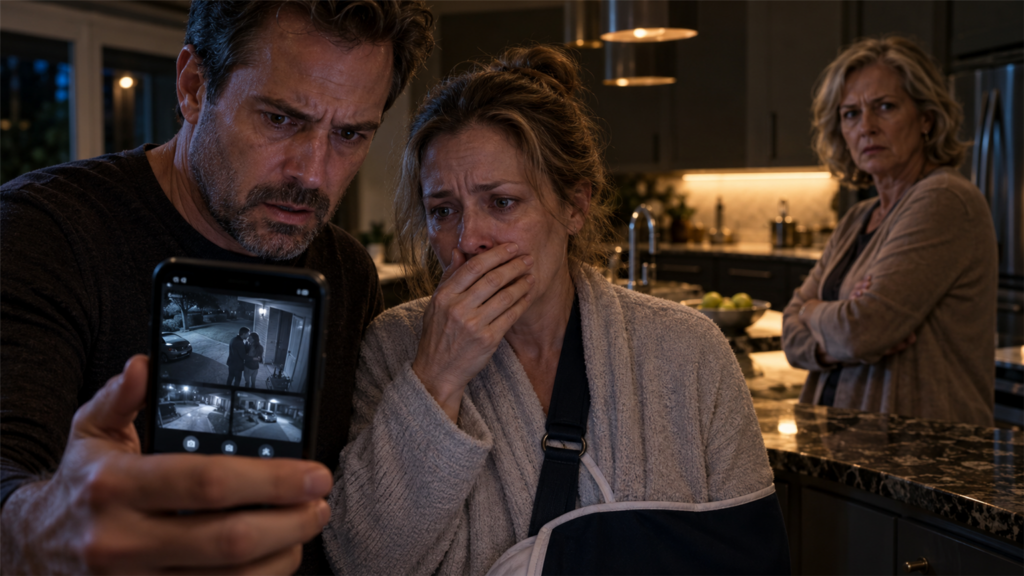
At 10:42, Daniel opened the baby-monitor app. We had moved its camera to the kitchen play area so we could watch Lily while preparing her bottles. It saved motion-triggered clips.
He tapped a recording from that evening. Evelyn appeared beside the trash can, speaking into her phone.
Then Daniel turned the volume up.
And I heard my mother-in-law say, “Once Sarah looks incapable of caring for herself, getting Lily out of that house will be easy.
Daniel replayed the clip three times. Evelyn stood under the kitchen light with my remaining prescription bottles in a grocery bag. She was speaking to her sister, Marjorie.
“She can barely pick the baby up,” Evelyn whispered. “If she keeps missing her medicine, Daniel will finally understand Lily needs to live with me.”
The video showed her carrying the bag to the outside trash bin. Daniel paused it there. His hand stayed on the phone long after the screen went dark.
“She told me you’d forgotten your pills twice,” he said.
I shook my head. Speaking was still work. “I told you.”
“I know.” He sat beside me. “I’m sorry I didn’t stop her sooner.”
He retrieved the bag without opening the bottles, photographed it, and called the police nonemergency line. An officer arrived that night, took statements, and advised us to preserve the video and medication. Daniel also confirmed the replacement prescriptions with the on-call medical team. The officer made no promises about charges.
Evelyn came downstairs in her robe while he was still there. “Are you seriously calling the police on your own mother?”
“You threw away Sarah’s prescribed medication.”
“I was saving her from becoming dependent on it.”
“You were trying to take our daughter,” Daniel said.
Her eyes flicked toward me. “Sarah isn’t capable of taking care of a baby right now.”
I had needed help buttoning my cardigan that morning. I had also spent twenty minutes on the living-room rug, making Lily giggle by rolling a cloth ball toward her. Evelyn had watched from the doorway without smiling.
“Needing help,” I said slowly, “isn’t the same as being unsafe.”
Daniel asked her to leave. She packed an overnight bag and went to Marjorie’s house, but by breakfast our relatives had received a different story: I was confused after my stroke, Daniel was being controlled, and Evelyn had been punished for praying.
My phone filled with messages. I stopped reading after the fifth.
For weeks, I’d practiced saying Lily’s name aloud, shaping each syllable until it sounded like mine. Evelyn had turned those pauses into evidence against me. I looked toward the empty high chair and kept my fingers flat on the table.
At nine the next morning, I was practicing speech exercises when Daniel’s phone rang. It was Lily’s daycare director, her voice tight.
“Your mother is here,” she said. “We haven’t released Lily. She says you’ve authorized her to take the baby for several weeks.”
Daniel stood up. “We have not.”
“There’s something else,” the director said. “She brought a signed authorization form. Daniel, it has Sarah’s name on it.”
I looked at my left hand, resting open on the table.
I hadn’t signed anything since leaving the hospital.
By the time we reached the daycare, Lily was still in her classroom. I could see her through the window, sitting on the rug with a plastic yellow cup. She was safe. I had to grip Daniel’s arm before my knees would stop trembling.
Evelyn was in the director’s office, holding a folded sheet of paper.
“I’m her grandmother,” she insisted. “Her mother isn’t well. Someone has to make decisions.”
The director, Ms. Ortiz, laid the paper flat. It was a temporary caregiver authorization downloaded from the internet, with my name written at the bottom. Above it, someone had printed that I was medically unable to care for Lily.
“That isn’t my signature,” I said.
Evelyn looked at Daniel. “You know she has trouble remembering things.”
