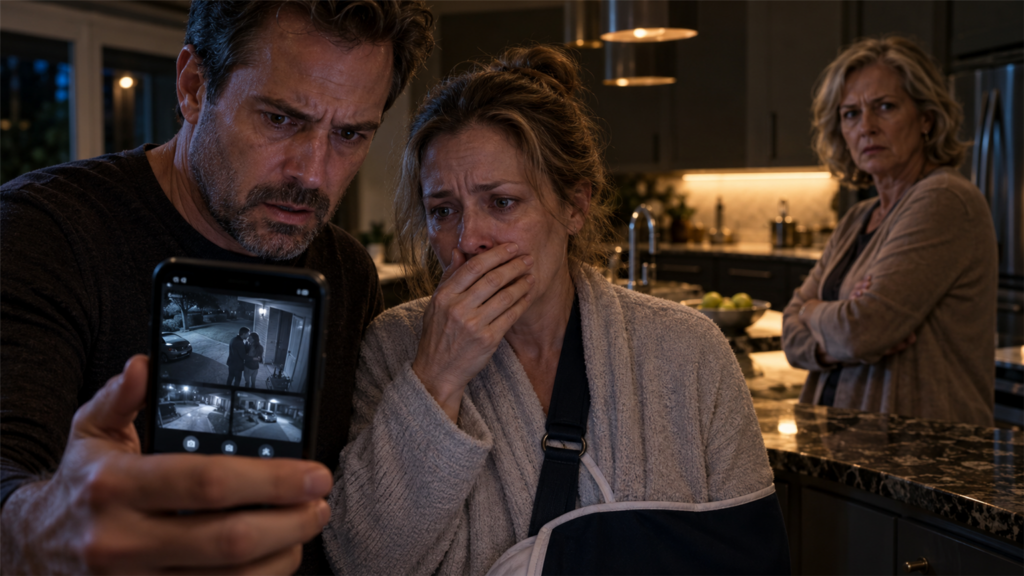
He pulled out his phone. “Mom, we have the recording.”
For one second, her face went still. Then she reached for the paper, but Ms. Ortiz had already moved it into a folder.
“I was trying to help,” Evelyn whispered.
“You weren’t helping me,” I said. The words came slowly, but I didn’t look away. “You were trying to make me disappear from my own daughter’s life.”
Daniel asked the director to preserve the document and the lobby security footage. We updated Lily’s pickup list and gave the detective the new information. The officer who had taken our report added the attempted pickup and the form to the investigation.
That afternoon, the neurologist’s office checked my replacement medications and confirmed the plan for restarting my usual schedule. I hadn’t suffered another stroke. Still, whenever I opened the pill organizer, I remembered the trash lid closing under Evelyn’s foot.
Evelyn stayed with her sister. She told relatives we had called the police because she prayed. Daniel sent one message to the family group: “This isn’t about prayer. My mother discarded Sarah’s prescribed medication and tried to take Lily from daycare using a document Sarah never signed.” He attached no private medical information. He simply asked them to stop repeating Evelyn’s version.
Some apologized. Others went quiet.
The prosecutor reviewed the video, the recovered medication, and the daycare paperwork. Months later, Evelyn accepted a plea agreement on charges arising from the medication theft and false authorization. She received probation, restitution, and conditions restricting contact. It didn’t make the months of therapy easier, but it meant there was finally a record that didn’t depend on how quickly I could get words out.
I continued speech therapy twice a week. I learned to button Lily’s sweater again, then to lift her from her crib with Daniel close by. My left hand never became quite as strong as before, but she learned to wait while I adjusted my grip.
One afternoon, Lily brought me her toy medical kit. She pressed the plastic stethoscope against my chest, frowned in concentration, and announced, “Better.”
Daniel laughed from the doorway. I laughed too, and neither of us hurried me when I needed another second to speak.
The baby monitor still sits on the kitchen shelf. Most nights it records nothing more dramatic than Daniel warming a bottle or me dropping a spoon.
I used to think the hardest part of recovery would be learning to say my daughter’s name again. It wasn’t. It was learning that I deserved to be believed even when I couldn’t say it clearly.
