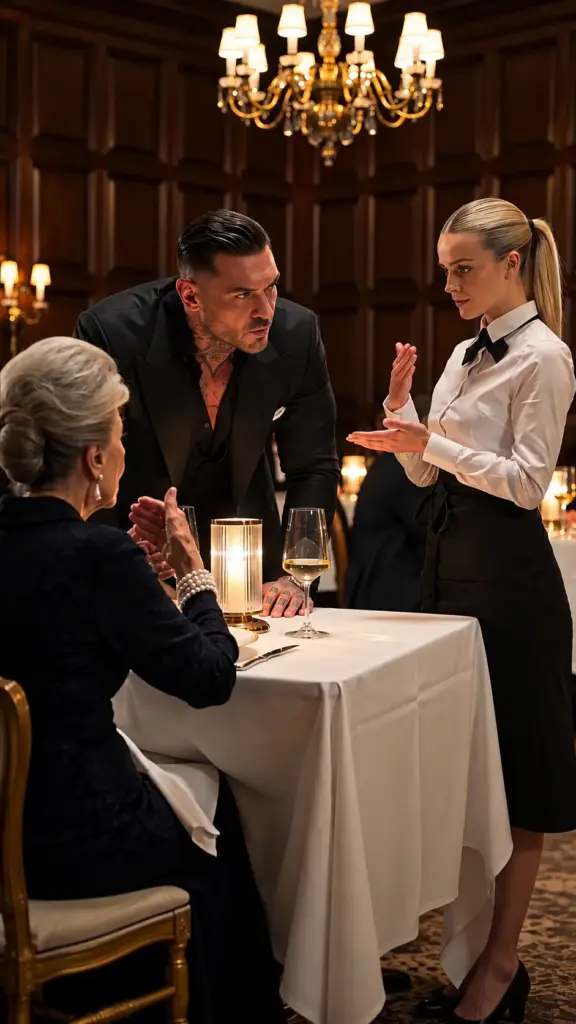
Chapter 1 – THE SENTENCE NO ONE WOULD TRANSLATE
“Take your hands away from my mother.”
Dante Moretti did not raise his voice. He didn’t need to. Every man at the table went still, and I felt the old reflex rise in my stomach: apologize, retreat, keep the job. My hands hovered between us, palms visible, caught in the middle of a sentence that was not mine to finish.
The silver-haired woman beside him watched his mouth. Then she looked at me and signed, with the patient weariness of someone accustomed to being interrupted, “Did he tell you to stop?”
I nodded. “He thinks I’m bothering you,” I signed back.
Her eyebrows rose. “Are you?”
“No, ma’am.”
“Then keep going.”
I should explain that American Sign Language isn’t pantomime. My sister Ruby and I grew up using it every day. It has grammar, humor, arguments, poetry, and the capacity to express things a spoken language can only approach awkwardly. Ruby would have corrected half my signing that night. I was rusty from exhausting shifts, and there were ways of expressing respect my hands had forgotten. But the woman across from me understood.
I turned toward Dante. “Your mother asked about dinner. She wants the mushroom ravioli without cream. She doesn’t want the fish.”
His eyes narrowed. “She always orders fish.”
“Tonight she doesn’t.”
One of the men to his right gave a small, almost soundless laugh. He wore a blue tie and a wedding ring that he kept turning with his thumb. “Emma, is it? Mrs. Moretti can be particular. I’ll explain to her.”
The silver-haired woman leaned forward abruptly and signed one word I understood very well.
“No.”
The man didn’t look at her. “It’s all right, Dante. Your mother’s had a long day.”
I recognized the tone. I’d heard it at medical appointments when a receptionist spoke to me instead of Ruby, even while Ruby stood directly beside her. The words sounded helpful. The meaning was simple: this person doesn’t count.
“My mother?” Dante asked.
“Lucia Moretti,” the woman signed to me. “And his name is Gianni Rinaldi. Please tell him I do not need him to speak for me.”
I relayed the message as closely as I could.
The man in the blue tie stopped turning his ring.
Dante studied me. “You work here?”
“Yes. Four nights a week.”
“You know sign language?”
“My sister’s Deaf. We grew up signing.”
Lucia reached over and gently touched the white sleeve of my uniform. When I looked at her, she signed, “Ask him why he sold my house.”
My throat tightened.
I interpreted the question, careful not to embellish it. I didn’t say she was upset, although she was. I didn’t say she looked confused, because she didn’t. I said exactly what she’d asked.
Dante set down his water glass. “What house?”
Lucia’s hands moved, sharp and precise. “Anchor House. The building my husband and I put into trust for the residents. I refused the sale. Gianni told everyone I agreed.”
I spoke slowly. By the time I’d finished, Gianni had risen halfway from his chair.
“This isn’t appropriate,” he said. “Not in front of business guests.”
Dante’s gaze stayed on me. “Did my mother say she refused?”
“Yes.”
“Those words?”
“As clearly as she could.”
“You’re not a professional interpreter.”
“No, sir. That’s true.” I swallowed. “And she shouldn’t have to rely on a waitress to be understood. Please arrange someone qualified. But she is asking a question now.”
Silence settled across the private room. I heard a chair creak. Seven diners, twelve candles, a heavy carved door, and one woman whose son had somehow forgotten that she could still speak.
Gianni finally smiled. “A family misunderstanding. Lucia signed off on an improvement plan three months ago. I have the paperwork.”
Lucia saw him smiling and looked straight at me. “He is lying.”
My manager, Tony, appeared at the door. “Emma? Could I have a word?”
I knew exactly what the word would be. Dismissed. Fired. Gone. Ninety-three dollars until payday, a landlord who claimed my rent hadn’t arrived even though the bank showed the transfer, and a bakery dream folded into a notebook beneath my mattress. I had a choice, which felt unfair. Lucia had been denied choices for far longer.
“I can step outside,” I told Dante, “but please don’t let them tell you your mother is finished speaking.”
Lucia caught the change in the room. She looked at Dante, then signed directly to him, slowly enough for a beginner to follow. “I. Said. No.”
His face shifted. A memory seemed to find him. He lifted one hand, fingers awkward, and made a sign I recognized as a child’s version of sorry.
Lucia didn’t smile.
“I’m going to ask the others to leave,” he said.

