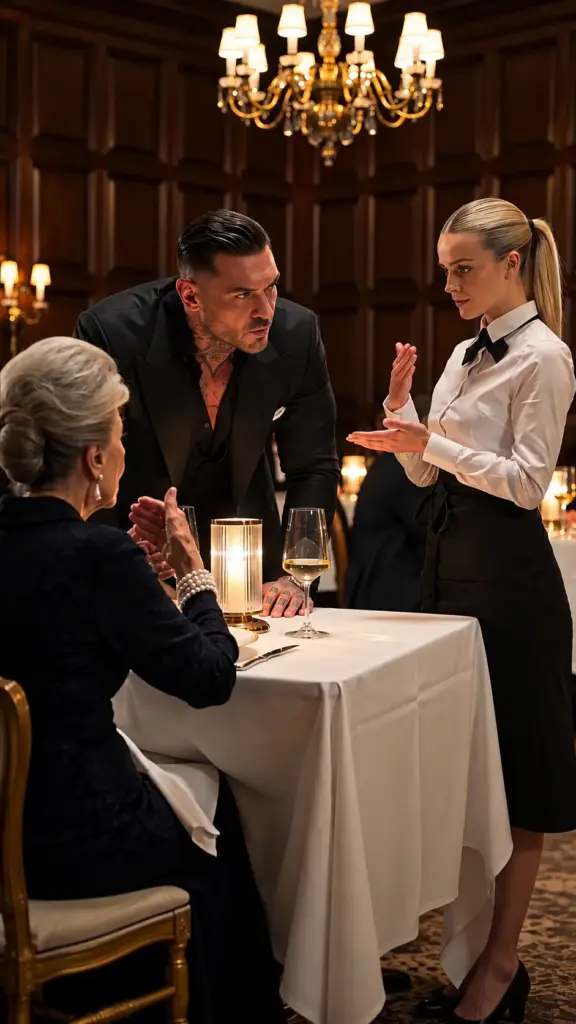
Dante closed his eyes briefly.
That night, Celia introduced us to the building’s upstairs apartments and the workshop where children made sculptures every Saturday. One tenant, Mrs. Alvarez, was hard of hearing and used both spoken language and captions. Another communicated through tactile signing with a visiting support worker. Lucia stopped me before I tried to address everyone together.
“Different people,” she signed. “Different needs. Ask.”
The simplicity of it embarrassed me. I’d arrived with the confidence of someone who knew ASL, yet I still had a great deal to learn about people whose lives didn’t match Ruby’s.
Celia led Dante to the elevator. Its repair certificate was eight months overdue. Through the glass door we could see a handwritten notice: USE AT YOUR OWN RISK. A seventy-two-year-old tenant named Mrs. Park lived on the third floor and had missed medical appointments because she was afraid to ride it.
“Why weren’t the repairs done?” Dante demanded.
Celia opened a folder. “They were paid for,” she said aloud, with a voice made rough by years of little use. Then she signed the rest. A repair grant had been approved, but the contractor never came. The contractor’s name—Westbridge Facilities—was connected to the same company that had sent the moving trucks.
She showed Dante a bank statement for a transfer larger than the actual repair estimate. He studied it and said, “I’ll have my accountant look into that.”
Lucia touched his sleeve. “Not Gianni’s accountant.”
He nodded. “An independent one.”
An hour later, a certified interpreter named Renée Park joined us by secure video call. She introduced herself to Lucia, asked about language preferences, and explained what she could and could not do. With Lucia’s consent, she began interpreting our discussion. My shoulders loosened for the first time all night. I wasn’t responsible for carrying every word accurately on tired hands. Lucia was able to speak at full speed.
Through Renée, she said, “I have repeatedly refused the sale of Anchor House. I asked for this meeting through my son’s office. Each time, Gianni told me Dante was unavailable or that I had misunderstood the contract. I do not misunderstand ownership. I helped write the trust.”
Dante looked stricken. “Ma, I thought you wanted out of the business.”
“I wanted out of your security meetings,” she replied. “Not out of my building. Not out of my life.”
It was the sort of distinction that should have been obvious long before a stranger in a waitress uniform needed to stand beside them.
Dante stepped away to call his attorney. While we waited, I helped Celia carry bottled water into the dining room. The residents had gathered around tables, watching the news of the attempted removal spread through signed conversations and messages. No one wanted Dante’s protection if it meant surrendering control to another powerful man. Lucia made that clear when he returned.
“This building is not yours to save by giving orders,” she said through Renée. “It is governed by the trust and its residents. Help us recover the records. Then listen to what we decide.”
Dante accepted the correction, although the effort showed in his face. He had spent years solving problems by entering rooms in which everyone waited for his instructions. Here, no one had appointed him leader.
Later, I found him staring at a faded photograph of his father, Paolo, standing beneath the same mural when it was newly painted. Beside Paolo stood Lucia, younger and fierce-eyed, and a boy of about twelve with his fingers raised in an awkward sign.
“That’s you,” I said.
“Yeah.” He smiled without humor. “I used to know more.”
“Did you forget?”
“I learned enough to ask for cookies, tell her I was late, say sorry when I’d done something stupid. When I went away to school, Gianni started handling her calls and meetings. He told me that was easier for her.”
“Did she tell you it was?”
Dante didn’t answer. He kept looking at the photograph.
Near midnight, a building inspector whose credentials we verified arrived to assess immediate safety. He confirmed the elevator should remain out of service pending repairs but saw no authority for the private relocation order. He documented the condition of the west stairwell and arranged an official follow-up. It was imperfect progress. Mrs. Park would still need transportation down three flights of stairs, and someone had to coordinate it properly. Yet for the first time that evening, the residents knew they weren’t being loaded into vans without an explanation.
I stepped outside to call Ruby. She answered through a video connection, her face bright on my screen. I signed a compressed account of the evening. Ruby watched, then said something that made me laugh despite my exhaustion.
“You don’t get to quit being careful just because somebody rich looks grateful.”

