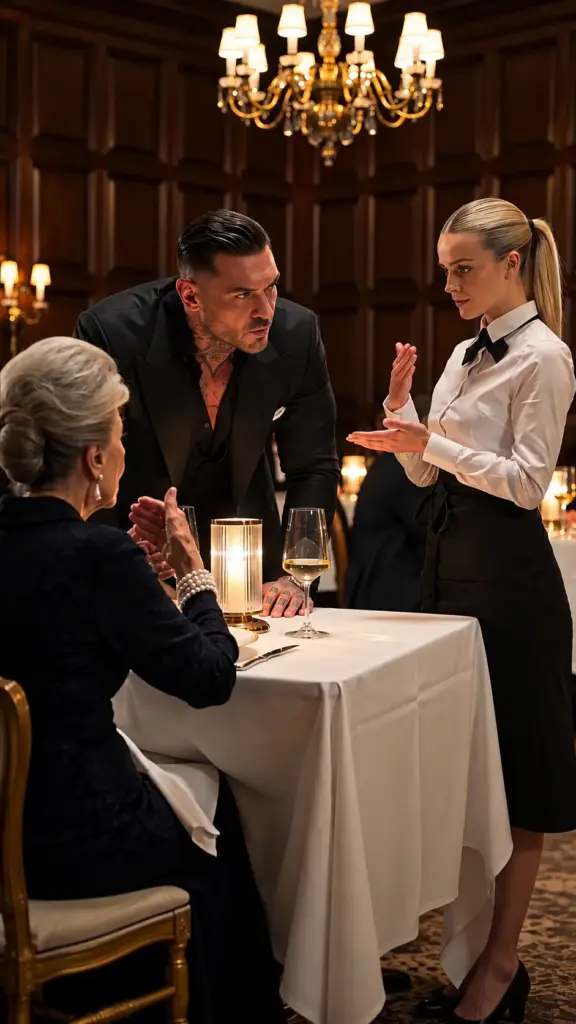
“An internal administrator acting on a request attached to your electronic approval,” Mara said.
“I didn’t approve it.”
“You may not have. But your office needs to explain how someone could submit it under your name.”
Dante flinched at that. Mara let the silence stand.
Next came the video. Gianni had sent a twelve-second clip to members of the Anchor House trust, portraying Lucia as supporting a redevelopment plan. On the screen, Lucia appeared seated at a table, signing a brief phrase. English captions along the bottom read: I APPROVE THE PROPERTY TRANSFER AND ALL RELATED ACTIONS.
I was no certified interpreter, but even I could see something was wrong. Her hands were moving differently from the caption’s cadence. Renée, asked by Lucia to review it, warned that a short excerpt stripped of its preceding question could not establish what Lucia had agreed to. When Mara played the soundless clip more slowly, Lucia visibly recoiled.
“That’s the meeting I attended to request repairs,” she said through Renée. “I was answering the question about authorizing a contractor to replace the elevator motor. They have attached words to me that I did not say.”
Mara requested the entire original recording. Gianni’s office replied that a routine storage failure had corrupted the file.
Celia laughed once, a hard, incredulous sound. “Every time we ask for a record, somebody loses it.”
“Not every record,” Lucia replied.
She unlocked her tablet and opened an archive of emails. There were forty-seven messages to Dante’s office and another twenty-three to Gianni over eleven months. Some were written in English, some included ASL video attachments. Several requested interpreters. Others disputed board minutes. A few asked why repairs had been approved on paper but never completed.
“Did you read these?” Lucia asked Dante.
He looked at the list of dates. “I didn’t see them.”
“Did you ask to see them?”
“I thought Gianni was handling them.”
Lucia sat very straight. “That is not the same answer.”
I saw something break in his expression, something more painful than embarrassment. For years, his mother had continued communicating; he’d simply accepted a gatekeeper who found silence convenient.
When we took a break, Dante approached the coffee urn. “I wasn’t trying to shut her out,” he said quietly.
“I believe you,” I replied. “But you did.”
He looked at me with an expression people usually saved for employees who had forgotten where they stood. Then he nodded. “Yeah.”
Across the room, Lucia and Celia were checking financial records with Mara. Emma the waitress was becoming irrelevant to the actual work. It was a relief. I wanted Lucia to be the center of her own fight.
Around lunch, a small envelope appeared beneath the conference-room door. No one heard it delivered. Inside was a photograph of Lucia and Paolo outside Anchor House fifteen years earlier. A red circle had been drawn around Paolo’s face. On the back, someone had written: ASK WHAT HAPPENED TO THE FIRST DEED.
Lucia stared at it. She didn’t look frightened. She looked furious.
Mara asked if she recognized the handwriting. Lucia shook her head, then indicated that the photograph was one of several missing from her old office after Gianni arranged a renovation years ago. Paolo had died of a sudden heart attack thirteen years earlier. His memory was tied to the building more intimately than any document.
“What first deed?” Dante asked.
Lucia reached for her notebook and opened it to a page containing a hand-drawn timeline. “When Paolo and I bought this building,” she explained, “we placed it in a trust. The income from the workshop would maintain accessible apartments. The original deed and trust instructions were in a locked cabinet. After Paolo died, Gianni told me the papers had been moved to your legal office for safety.”
“I never saw them,” Dante said.
“I know.”
Mara leaned forward. “We can obtain recorded instruments through the county and request the trust’s historic filings. A missing paper isn’t the same as a missing legal interest.”
Lucia nodded. “Do that. Please.”
The next hour brought something unexpected. Tony, my manager, called to tell me I had been suspended for walking out. A guest had complained I’d made an inappropriate scene, and the restaurant’s owners were considering a disciplinary review. He sounded uncomfortable, but discomfort didn’t pay my rent.
“Who complained?” I asked.
“I’m not supposed to say.”
“Gianni Rinaldi?”
Tony was silent.
“That tells me enough,” I said.
I hung up and stared at the phone. I’d expected consequences. Expecting them did not make losing wages easier. I went into the hallway and cried for exactly three minutes, then washed my face and called a workers’ rights clinic Ruby had once recommended. The attorney who answered didn’t promise a miracle. She asked for my schedule, pay records, and the messages I’d received.

