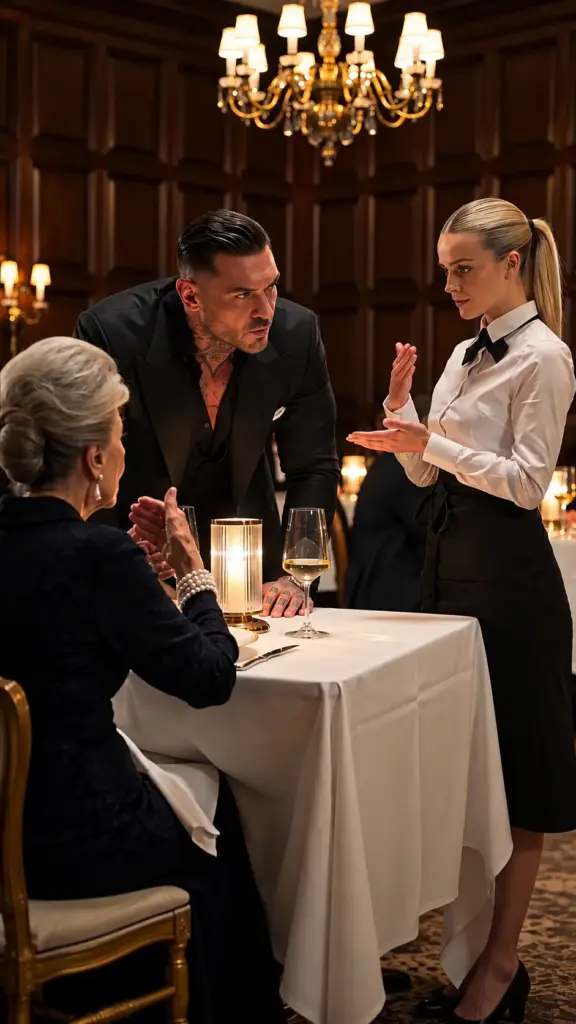
Gianni took a step forward. “Dante, that would be a mistake.”
“Then I’ll make it.”
The guests filed out in uncomfortable silence, followed by Tony, who mouthed a promise that we’d discuss this later. Gianni lingered until Dante pointed toward the door. Only then did he leave, looking not at his employer but at Lucia’s handbag.
When the door closed, I realized I was alone with the most feared man in lower Manhattan and his mother. Lucia slid a small notebook from her bag. Its corners were worn and its blue cover had been repaired with transparent tape. She opened it to a drawing of a brick building with green doors, a roof garden, and a ramp rising toward the entrance.
“Anchor House,” she signed. “My husband Paolo built the first workshop there. I opened apartments upstairs. Deaf seniors lived there when nobody else would rent to them. Some still do.”
I interpreted. Dante frowned. “The property needs repairs. Gianni said the tenants agreed to relocate for renovation.”
Lucia turned a page. Beneath a photograph of a smiling older man holding a paint roller were three dates and three lines of careful handwriting.
APRIL 12 — I ASKED FOR AN INDEPENDENT INTERPRETER.
MAY 3 — THEY FILMED ME WITHOUT THE QUESTION.
JUNE 19 — THE BOARD WAS TOLD I APPROVED A SALE.
Dante read the lines once, then again. “Why didn’t you show me this?”
Lucia signed, and this time her hands shook only with anger. “I did. You put it in Gianni’s hands and told me he’d take care of it.”
I let a beat pass before interpreting. He needed to hear the damage without having it softened for him.
Dante leaned back as though the chair had suddenly become uncomfortable. “I thought he was helping.”
“Helping whom?” Lucia asked.
He didn’t answer.
I looked at the old photograph. Paolo Moretti had broad shoulders and a crooked grin. For a strange second I could see the boy Dante had once been in his father’s face. Lucia turned another page. A list of names followed, each with an apartment number and a colored mark. Beside two names she’d drawn small stars.
“These two are sick,” she signed. “They cannot climb stairs. Gianni canceled the elevator repair. Tell Dante.”
I did.
Dante was already reaching for his phone. “I’ll call the building manager.”
Lucia shook her head fiercely. “Not the manager. He’s Gianni’s cousin. Call Celia Dunn. She keeps copies.”
“Celia?” Dante repeated. “The architect?”
Lucia nodded. Her phone buzzed on the table, and when she saw the message, her face changed. She turned the screen toward us. A video showed a green front door and a moving truck parked outside a narrow brick building. A handwritten caption beneath it read: THEY HAVE COME EARLY.
I signed, “Who sent that?”
“Celia,” she answered. “She said no one gave permission. The tenants are still inside.”
Dante rose so quickly that the table shook. He picked up his coat and reached toward Lucia, then stopped when she shook her head at him. She wasn’t asking to be escorted like a child. She was asking to be included.
“Tell her I’m taking her there,” he said.
I signed it. Lucia looked at his mouth, then at his hands, and pointed to the notebook. On its last page, underlined twice, was a sentence she had written again and again across several weeks.
THEY KEEP TELLING YOU I SAID YES.
Dante read it in silence.
“Are you coming?” he asked me.
I glanced at my serving apron. I wasn’t a trained interpreter, an investigator, or a hero. I was a waitress who wanted the world to stop making her sister explain why language mattered. It would be easy to confuse that anger with permission to speak for Lucia. I looked directly at her instead and signed, “Do you want me there?”
“Yes,” Lucia answered. “As a witness. Not my voice.”
I understood the difference.
“Then I’ll come,” I told Dante. “But we need a qualified interpreter as soon as possible.”
He nodded and made a call to his driver. When we reached the service corridor, Tony blocked my path.
“You realize you’re walking out in the middle of a shift?”
“I do.”
“You’ll be lucky to keep this job.”
I looked down at my name tag. I needed the work; that hadn’t changed. But when I looked back through the glass door, Lucia was waiting at Dante’s side, her blue notebook held against her chest.
“I’ll return for my check,” I said.
Outside, the city wind carried the smell of rain and hot pavement. Dante’s black sedan idled at the curb. His mother entered first, choosing her own seat. Then my phone buzzed.
A message from a number I didn’t know.
YOU SHOULD HAVE SERVED THE FISH.

