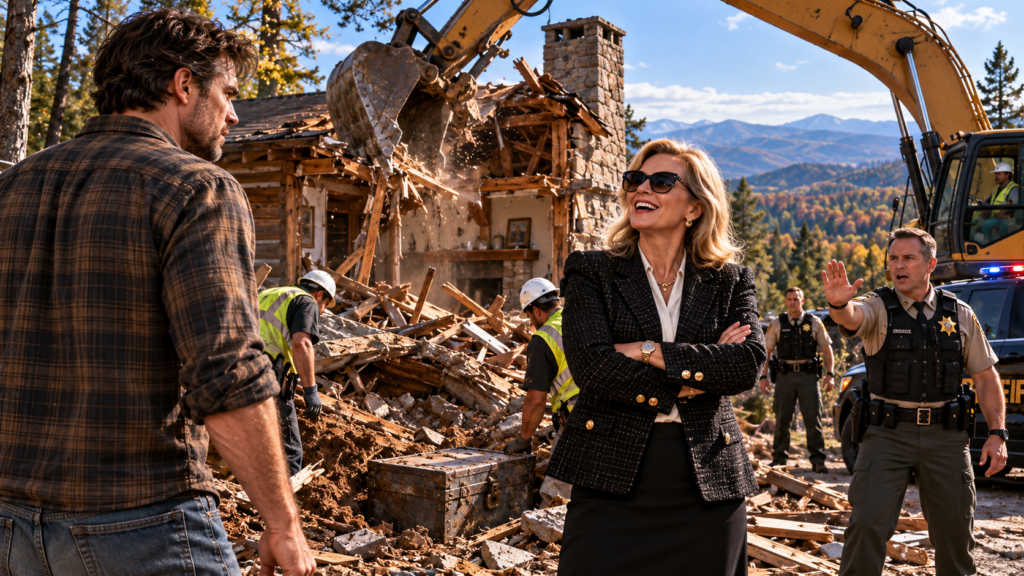
That was the end of Roxanne’s control over the room.
The board suspended her signing authority under its bylaws.
A formal removal vote was scheduled.
Financial records were preserved.
Development agreements were frozen.
April turned everything she was legally entitled to provide over to independent auditors and investigators.
Two weeks later, Roxanne was removed as HOA president.
Not one homeowner voted to keep her.
Federal investigators continued quietly.
Preservation orders.
Subpoenas.
Bank records.
Emails.
Corporate filings.
Sabrina received no investigative updates.
Elliot had no enforcement role.
I learned more from my own lawyer and public court filings than from either sibling.
That was exactly how it should have been.
Eventually, Landon hired criminal counsel.
Then he began cooperating.
His records included an internal planning memo stating that my cabin needed to be removed before an investor site visit.
Another document promised Roxanne an additional payment if the road was delivered on schedule.
Investigators also found a draft access agreement carrying what appeared to be my signature.
I had never seen it.
Forensic review later concluded it was not authentically signed by me.
The fraud theory was no longer dependent on one angry homeowner’s accusation.
There were bank records.
Contracts.
Emails.
Witnesses.
Maps.
Altered representations.
And money.
Lots of money.
A federal grand jury eventually returned charges against Roxanne and others connected to the scheme.
The allegations included conspiracy and wire-fraud-related offenses arising from representations made to investors and the movement of funds.
The arrest happened months after the demolition.
Not at my cabin.
Not with Sabrina.
Not with Elliot.
An independent warrant team carried it out after a federal court issued the warrant.
By coincidence, I was at Stonegate Summit that morning with my attorney for a civil matter.
Roxanne was inside the administration building.
When officers led her outside, she saw me.
Then she saw Sabrina and Elliot, who had come with me as family.
“You did this!” she shouted. “You used them to destroy me!”
I didn’t smile.
I didn’t need to.
“You destroyed my cabin because I wouldn’t sign your papers.”
She kept staring at me.
“Your own documents did the rest.”
That was the last conversation we had outside a courtroom.
The criminal proceedings took time.
So did the civil case.
People wanted simple numbers.
Nine million lost here.
Millions frozen there.
A huge damages claim somewhere else.
But the legal reality was messier.
Investor money in escrow was not automatically mine.
Investigated funds were not automatically forfeited.
My civil claim was separate from federal criminal charges.
Insurance disputes had their own process.
The HOA had its own responsibility.
Contractors had theirs.
Eventually, Roxanne entered a guilty plea under a federal agreement resolving major charges against her.
The court imposed a substantial prison sentence and financial penalties after reviewing the conduct, the fraudulent representations, and the role she played in the scheme.
Landon faced separate consequences and cooperation obligations.
None of that rebuilt my grandfather’s cabin.
That part required the civil case.
My claim covered the destroyed structure, restoration expenses, personal property, cleanup, security, professional fees, trespass, and other proven damages.
The demolition company argued it had relied on documents supplied by the HOA.
The HOA argued Roxanne exceeded her authority.
Insurers argued about coverage.
My attorney kept returning to the same facts.
My deed.
Fake demolition paperwork.
Written warnings.
Roxanne’s guarantee to Wyatt.
Her text ordering the floor cleared.
The development motive.
Eventually, the civil cases resolved through a combination of judgments and settlements totaling roughly $1.34 million in compensation and related recoveries attributable to the destruction and associated conduct.
The new Stonegate Summit board insisted that responsibility be allocated to the people and entities actually involved rather than simply dumping the entire burden onto innocent homeowners.
I respected them for that.
Then I had to decide what to do with the money.
Sell?
Walk away?
Build somewhere else?
For weeks, I stood on the empty foundation trying to answer that question.
Every direction contained a memory.
The porch where Grandpa cleaned trout.
The window where Grandma kept herbs.
The storage cavity where the steel box had been hidden.
Roxanne had flattened the building.
If I left because of her, she would still have changed what the land meant.
So I rebuilt.
Not larger.
Not more luxurious.
The same footprint.
Same roofline.
Same porch proportions.
I hired craftsmen who specialized in historic timber work.
We salvaged what we could.
One beam.
Several stones from the chimney.
Pieces of my grandfather’s oak table.
A section of handrail.
The original plans had never existed as professional architectural drawings, so I reconstructed details from photographs and measurements I had taken during earlier restoration work.
The project took more than a year.
On the first night inside the new cabin, I sat beside the rebuilt stone fireplace.
The wind moved through the pines.
Same sound.
Different walls.
I realized then that rebuilding wasn’t pretending nothing had happened.
The new cabin would never be the one my grandfather physically built.
That was gone.
Rebuilding was refusing to let destruction make the final decision.
Stonegate Summit changed too.
The new board hired independent counsel.
Major contracts required recorded votes.
Land transactions required title review.
Association finances were published regularly.
Every proposed claim over my twelve acres was formally withdrawn.
The new president even drove up personally to deliver a letter confirming that Stonegate Summit claimed no authority over my property.
I framed that one.
Not because I needed it legally.
Because Grandpa would have appreciated the irony.
At the entrance to my lane, I carved a wooden sign.
PRIVATE PROPERTY
NOT PART OF STONEGATE SUMMIT HOA
Elliot helped set the posts.
Sabrina stood back criticizing our measurements.
“You’re both engineers now?”
“No,” Elliot said. “Weston’s the engineer. I’m free labor.”
“You’re crooked by two degrees.”
“Then grab a shovel.”
For the first time since the demolition, we laughed on that piece of ground.
Later, the three of us sat on the porch.
No uniforms.
No badges.
No federal vehicles.
