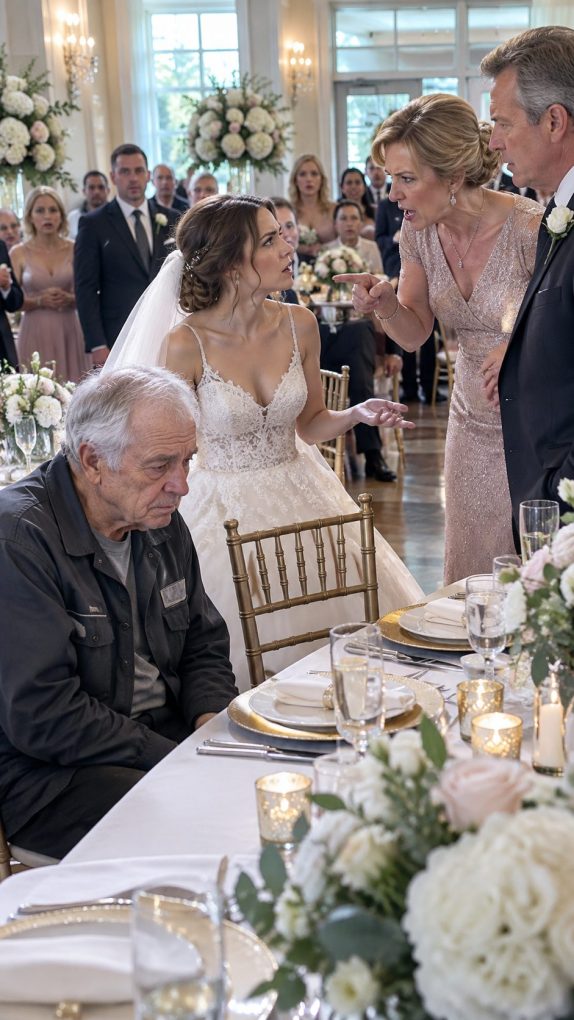
“Move your grandfather away from the head table, or we’re leaving.” My mother said it in front of our wedding coordinator, six bridesmaids, and the man who had raised me every afternoon while she and Dad worked. She kept her voice low, but Grandpa Walter heard every word.
“He’s a retired janitor, Leah,” Dad added. “Your guests don’t need to be reminded of that.”
Grandpa was standing beside the rehearsal table in his charcoal suit, the one he’d worn to Grandma’s funeral. The left cuff was fraying. I had repaired it that morning with blue thread from the little sewing kit he kept in his kitchen drawer.
“He’s sitting next to me,” I said.
Mom’s smile tightened. “Martin invited his CEO. There will be important people here tomorrow. Surely Walter can sit with the cousins.”
Grandpa looked toward the kitchen doors. “Honey, I can sit wherever you want. Don’t let an old man spoil your evening.”
He said it gently. That somehow made it worse.
When I was eight, Grandpa cleaned classrooms at Roosevelt High School in Dayton, Ohio. He picked me up after school and let me do homework in the custodians’ break room while he finished his shift. I remembered the warm radiator, the smell of floor polish, and the apple slices he saved from his lunch. He never made me feel like I was waiting for him. He made me feel chosen.
Now my father was embarrassed by the job that had kept our family fed.
“No,” I told Grandpa. “You’re not moving.”
Dad took the printed seating chart and folded it sharply in half. “Then don’t expect us to be here.”
Mom followed him out. Neither looked back when the doors closed.
My fiancé, Noah, came around the table and took Grandpa’s coat. “We’ll save your place, sir.”
Grandpa smiled, although his fingers kept smoothing that blue-stitched cuff. Later, while we packed the place cards, he slipped a small envelope into my hand. Inside was a photograph of him standing with a teenage girl in front of Roosevelt High, dated 1990.
“Who’s she?” I asked.
“Someone who had a hard year,” he said. “She turned out just fine.”
On the back, in fading ink, were the words: Thank you for not giving up on me. Evie.
Then my phone lit up with a message from Dad: We’ll attend the reception. Don’t embarrass me in front of Evelyn Grant.
Evelyn Grant. His company’s CEO.
I looked again at the girl in the photograph—and at the name on the back.
The next afternoon, Grandpa arrived at the hotel ballroom thirty minutes early. He carried a small paper bag containing peppermints and two safety pins, because he’d always believed every celebration needed an emergency kit. Noah greeted him at the entrance and walked him to the head table himself.
My parents appeared just before the ceremony. Mom kissed my cheek without looking into my eyes. Dad asked whether Evelyn had RSVP’d, then glanced at Grandpa’s chair as if it were a stain somebody had forgotten to remove.
“She’s coming,” I said. “And Grandpa stays.”
The ceremony passed in a blur of white flowers and sunlight. When I reached the aisle, Grandpa was already crying. He pressed a clean handkerchief into Noah’s palm before either of us could ask for one.
At the reception, I was halfway through my first glass of water when the coordinator, Sarah, approached. “Your father wants me to change the name cards before his guest arrives. He says there was a mistake.”
“There wasn’t.”
Sarah nodded and walked away. Minutes later, I saw Dad moving Grandpa’s card himself. I crossed the room, set it back between mine and Noah’s, and looked him in the face.
“If you move it again, I’ll ask you to leave.”
“You’d humiliate me at your own wedding?” he whispered.
“You’re doing that without my help.”
Mom gripped his sleeve. “Martin, please. People are watching.” But when Grandpa asked whether everything was all right, she turned to him instead.
“You could make this easier, Dad.”
He lowered his eyes. I watched the small movement of his hand toward the worn cuff, the way he tried to tuck the blue stitches out of sight.
Then Evelyn Grant entered with her husband. Dad straightened instantly. He was a regional director at her manufacturing company and had spent weeks telling us this invitation might help him win a promotion.
Evelyn shook his hand, thanked him for inviting her, and scanned the room. Her gaze stopped on Grandpa. She looked once at his place card, then took a step forward.
“Walter Collins?”
Grandpa raised his head. For a moment he looked as surprised as she did.
“Little Evie?” he asked.
Her hands flew to her mouth. Dad hurried to explain. “That’s my father-in-law. He used to clean a school.”
Evelyn barely seemed to hear him. She asked Sarah whether she could say a few words after the first toast. When Sarah checked with me, I nodded.
A little later, Evelyn stood, turned toward Grandpa, and spoke four words that drained the color from Dad’s face.
“You saved my life.”
The room went quiet. Dad was holding a champagne flute near his chest. His fingers loosened, and it struck the edge of his chair before breaking on the floor.
Nobody laughed.
Evelyn walked straight past him and knelt beside Grandpa’s seat so she could look him in the eye.
“Do you remember the bus pass?” she asked.
Grandpa gave a small, embarrassed smile. “I remember you missing the bus a lot.”
Evelyn turned to the guests. She explained that when she was seventeen, her mother had been hospitalized for months. Evelyn was working evenings at a diner, falling asleep in class, and close to dropping out of Roosevelt High. She often missed the last bus because she stayed after school to finish assignments.
“Mr. Collins was the custodian,” she said. “He noticed I was waiting outside in the cold. He brought me a bus pass, then another. When I told him I couldn’t afford college applications, he found the guidance counselor and helped me fill out the forms.”
