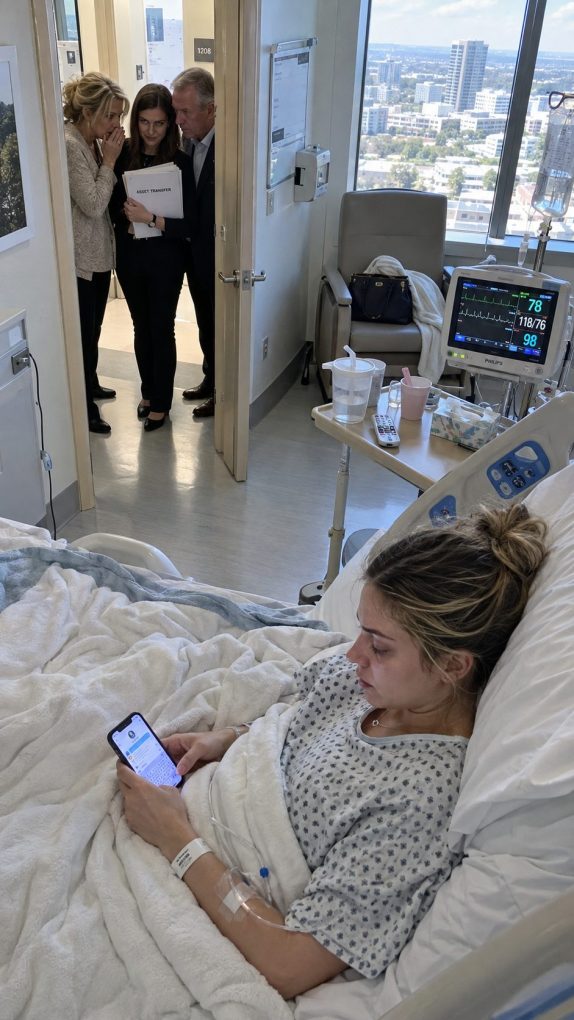
Rachel explained what the documents actually meant. Lauren and Dad had prepared a deed and a membership assignment, hoping to present them with a forged signature while I was hospitalized. Their papers did not give them ownership. I was the sole member of the company, and I had never appointed either of them to sign away my assets.
The bank had already been alerted to the attempted changes. Rachel was contacting the county recording office about the suspected forged deed and making a police report. The investigation might take months. But Lauren couldn’t turn a blue folder into a legal transfer merely because I was lying in a hospital bed.
“Why?” I asked.
Lauren’s chin trembled. “You have the house. You have the business. I do everything you tell me, and I’m still the little sister who needs your permission.”
“I gave you responsibility because I trusted you.”
“You gave me a job.”
“It was a good job, Lauren.”
Mom touched my arm. I moved my hand away.
“You knew about the signatures,” I said.
She glanced toward Dad, then nodded.
I remembered the soup she’d left beside my laptop, the quiet kindness I’d held onto whenever Lauren spoke sharply to me. Somehow the memory hurt more than their shouting.
The meeting ended when Rachel asked that any further communication go through counsel. I was discharged two days later, with instructions to rest and follow up with my doctor. There was no evidence anyone had caused my collapse. What my family had tried to do afterward was serious enough.
An independent review eventually identified $46,800 in unsupported payments routed through Lauren’s company. I removed her financial access immediately and, after the review, terminated her employment. With legal help, I sought repayment and cooperated with the authorities investigating the forged documents. Months later, Lauren signed a civil repayment agreement. The criminal investigation remained separate.
My parents had been living in my house with my permission. I arranged proper written notice and time for them to find somewhere else, rather than trying to throw their belongings onto the driveway. Dad called it cruel. I reminded him of the folder beside my hospital bed.
For a while, Mom sent me photographs of our old family dinners. In one, I was standing behind everyone, holding a serving spoon, still wearing my work badge. I looked exhausted even then.
Five months later, my office manager brought me a mug of soup on a rainy afternoon. “Eat before it gets cold,” Nora said, leaving it by my keyboard.
I laughed, unexpectedly, and had to wipe my eyes.
That evening, I went home to a quiet house. I locked the front door, set my phone face down, and sat at the kitchen table without opening my laptop.
At the hospital, I’d heard my mother ask whether I was still unconscious.
For years, I’d been awake to everyone’s needs and asleep to what they were taking.
I wasn’t going back to sleep.
