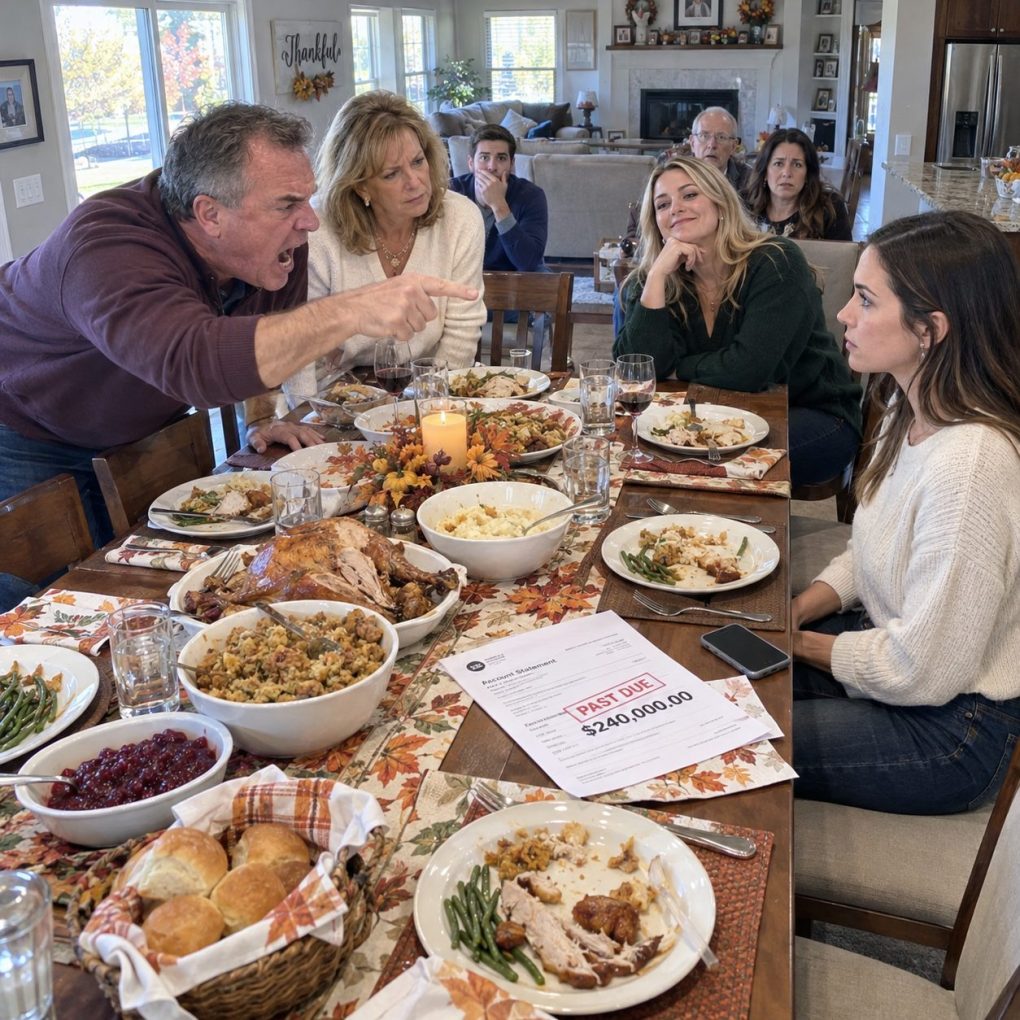
“Mr. and Mrs. Bennett asked me to help them review their finances,” he explained. “Their mortgage is current, but the bank couldn’t approve the new home-equity loan based on their present income and debt obligations.”
I looked at Dad.
He’d told everyone I was causing them to lose their house.
Now I learned he’d actually been trying to borrow more money against it.
Daniel continued carefully.
“Your parents were hoping you might consider being a coborrower.”
“No,” I said.
Dad stared at the table.
“Claire, we’re running out of options.”
I pulled my old spreadsheet from the kitchen drawer.
I’d printed it that morning.
“Thirty-one mortgage payments,” I said, sliding it toward him. “Sixty thousand, one hundred forty dollars. Another ten thousand, eight hundred in monthly transfers.”
Mom covered her mouth.
Ashley looked down at the figures.
“You never told me it was that much,” she whispered.
Dad didn’t touch the paper.
“I never asked you to add it all up.”
“No,” I said. “You just kept asking me to pay.”
The room went quiet.
I remembered Dad teaching me to balance a checkbook when I was fourteen. He’d sit beside me at the kitchen table, tapping each number with the end of his pencil.
Never spend money you haven’t earned, Claire.
I’d carried that lesson into every part of my life.
Somewhere along the way, he’d stopped applying it to Ashley.
Daniel explained that my parents needed a realistic budget, not another loan. Their mortgage remained their responsibility. Ashley would have to negotiate separately with her creditors and address her business debts through appropriate financial or legal advice.
There was no immediate foreclosure notice.
No secret obligation requiring me to save them.
Just difficult decisions they’d postponed while relying on my income.
Dad finally looked at me.
“I thought you’d always help.”
“I did.”
“You know what I mean.”
I folded the spreadsheet.
“Yes, Dad. I do.”
Ashley began crying.
“I didn’t realize you were sacrificing that much.”
I watched her wipe her face with the sleeve of the sweater I’d bought her.
“You could have asked,” I said.
She nodded, but I couldn’t tell whether she understood.
Mom reached for my hand.
“Please don’t cut us off completely.”
I let her hold it for a moment.
“I haven’t stopped loving you. I’ve stopped financing decisions I wasn’t allowed to question.”
Dad lowered his head.
No one argued.
Over the following weeks, my parents worked with Daniel to reorganize their expenses. They canceled unnecessary subscriptions, sold their second vehicle, and arranged a payment plan for overdue medical bills.
Ashley consulted an attorney about restructuring her business debts. Eventually, she sold some equipment, closed the unprofitable portion of her company, and took a regular job.
Her debts didn’t disappear.
Neither did the consequences of her decisions.
For nearly three months, Dad and I barely spoke.
Then one Saturday, he called.
“I made the mortgage payment myself today,” he said.
I was standing in my kitchen, waiting for the kettle to boil.
“I’m glad, Dad.”
He hesitated.
“Your mother showed me the spreadsheet again.”
I looked toward the window.
“I should’ve thanked you,” he said.
I didn’t know what to say.
Then he added, “And I never should’ve told you that you weren’t my daughter.”
My throat tightened.
“No, Dad. You shouldn’t have.”
We stayed on the phone for a few minutes longer, talking about ordinary things. His garden. My work. Whether the first snow would arrive before Christmas.
It wasn’t forgiveness.
Not yet.
But it was the first conversation we’d had in years that didn’t end with him asking me for something.
Six months later, I finally replaced my old car.
Nothing extravagant. Just a reliable blue Subaru with heated seats and a working defroster.
On the morning I drove it home, Mom called to ask whether I’d come for Sunday dinner.
I looked at the grocery bag on the passenger seat.
“Maybe next week,” I said.
“Okay, sweetheart.”
She didn’t pressure me.
She simply said she’d save me a piece of pie.
I hung up and sat in the driveway for a moment, listening to the engine idle.
Seven days after Thanksgiving, my family had come to my door begging me to rescue them.
I’d opened it and told them it was too late.
And it was.
Too late to keep treating my love as a line of credit. Too late to make me responsible for debts I hadn’t created. Too late to convince me that being a good daughter meant never saying no.
But perhaps it wasn’t too late for us to learn how to be a family without money standing between us.
I carried my groceries inside.
For the first time in years, there wasn’t another household’s mortgage payment waiting in my banking app.
Just my own bills.
My own plans.
And a Sunday afternoon that belonged entirely to me.
