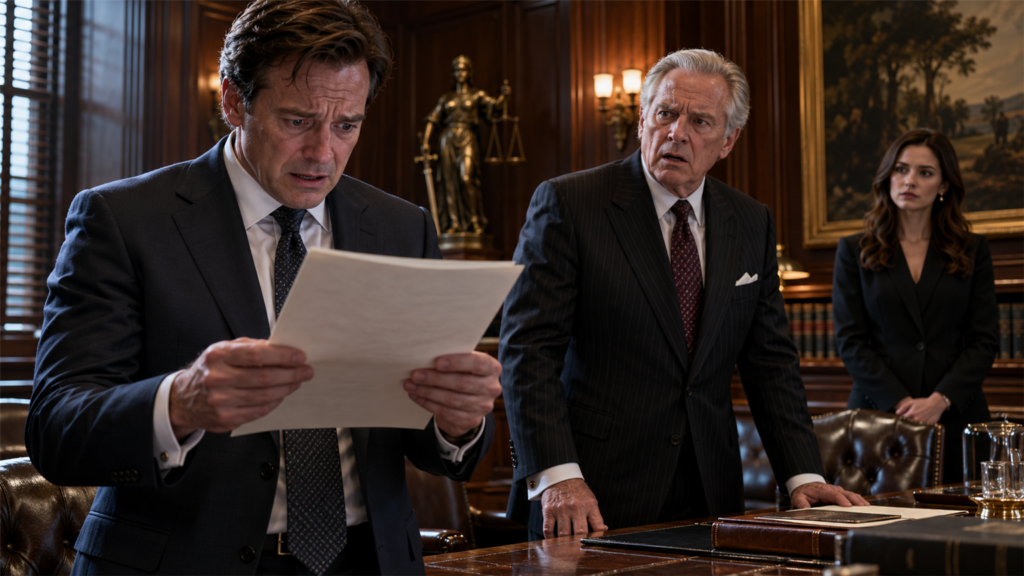
“Then remove it.”
“We can’t simply remove it. The easement is held by a separate conservation organization, and it binds future owners. Transferring the deed doesn’t cancel it.”
Jason stepped forward.
“That’s ridiculous. We’re the owners now!”
“Yes,” Richard said. “And you’re taking ownership subject to those restrictions.”
Mom lowered herself into a chair.
“But the developer offered over two million dollars.”
“That offer depended on obtaining approval for residential development. Based on this document, that development isn’t permitted.”
Dad turned toward me.
“You knew?”
I nodded.
“Grandpa showed me the easement years ago.”
His face darkened.
“And you let us spend months suing you?”
“Your attorney received the recorded documents before today’s hearing. I asked you to review them before making promises.”
Richard looked down at the folder. He didn’t deny it.
Dad slammed the papers onto the table.
“You deliberately ruined this family!”
Daniel started to speak, but I touched his sleeve.
“Dad, you wanted the land. I gave it to you. Every acre.”
He opened his mouth, then closed it.
What followed wasn’t a dramatic courtroom victory. The settlement didn’t disappear, and nobody ordered my parents to hand the farm back. They had pursued ownership, accepted a negotiated transfer, and received exactly what the recorded title allowed.
The developer withdrew his conditional offer once the easement was confirmed. Jason’s plans for a subdivision ended before construction began.
My parents still owned valuable farmland. They could continue leasing it for agriculture or sell it at agricultural value. What they couldn’t do was turn Grandpa’s pastures into fifty houses.
For months, Dad refused to speak to me.
Then the practical problems began. Property taxes arrived. The farmhouse roof needed repairs. Thomas wanted to renew his farming lease. My parents discovered that maintaining 120 acres required more than signing a deed.
Eventually, they renewed Thomas’s lease and hired someone to manage the property. Jason went back to his construction job.
I moved into a small apartment near the library, where I could walk to work. I missed the farm more than I expected, especially the smell of wet soil after rain and the sound of Grandpa’s screen door closing behind me.
One Saturday, Mom visited.
She brought a cardboard box containing Grandpa’s old blue coffee mug and several photographs.
“Your father found these in the farmhouse,” she said.
I lifted the mug. Its handle still had the small chip Grandpa had made when he dropped it beside the tractor.
Mom sat quietly while I unpacked the photographs.
“I should never have called you a thief,” she whispered.
I didn’t answer immediately.
Outside, someone was mowing the apartment lawn. The sound reminded me of summer mornings when Grandpa would come inside, leave his muddy boots by the door, and ask whether I’d made coffee.
“Did Dad ask you to bring these?” I finally asked.
She shook her head.
“He still thinks you should have given Jason the farm years ago.”
I placed the mug on the kitchen counter.
“Then he still doesn’t understand.”
Mom wiped her eyes. We talked for another hour. Nothing was completely repaired, but for once, she listened without defending him.
Later that evening, I found an old photograph of Grandpa standing beside the red barn. On the back, in his shaky handwriting, he’d written:
Some things are worth more when you refuse to sell them.
I stood by the window holding that photograph for a long time.
My parents had won the land they’d fought so desperately to take from me.
But Grandpa had protected the part of the farm he cared about most, long before any of us entered that courtroom.
And although the deed no longer carried my name, the fields would remain fields.
I think that would have made him smile.
