“That is not good for them.”
It wasn’t.
THE EMERGENCY MEETING
Oak Creek held a special membership meeting the following Wednesday.
I did not plan to attend.
Then three residents asked me to come.
Sarah said I should.
So Lauren and I walked into a clubhouse filled far beyond normal capacity.
Arthur sat at the front beside Dylan.
Neither looked happy.
A woman named Beatrice Higgins, who had once complained about my roosters, stood up first.
She had volunteered to run the cocoa stand.
“Did Caleb ever agree to the maze?”
Arthur avoided the question.
“We had advice indicating community-use rights.”
Beatrice repeated it.
“Did he agree?”
“No.”
The room shifted.
Dylan stepped in.
“We believed the HOA had a valid easement.”
Lauren stood.
“Which one?”
Dylan pulled out the same map.
Lauren held up the certified county instrument.
“This is the recorded easement.”
She displayed it on the projector.
The legal description stopped well before my field.
Then she displayed Arthur’s version.
The line had been extended.
Nobody claimed Arthur personally altered it.
We couldn’t prove that.
But the document he had relied upon did not match the county record.
One resident asked why the HOA sold tickets before settling the ownership dispute.
Another asked why revenue had been spent before the festival occurred.
Another wanted to know who authorized the landscaping crew.
Arthur tried to restore order.
It no longer worked.
For years, he had controlled meetings because most residents didn’t care enough to challenge him.
Now they cared.
Their money was involved.
THE FIVE PERCENT
Then somebody asked about the five-percent offer.
Arthur looked confused.
“What offer?”
“The five percent you offered Caleb for using the field.”
Dylan whispered something to him.
That was another bad moment for them.
If the HOA genuinely believed it already had a legal right to use my field, why offer me a percentage of ticket sales?
Lauren didn’t need to say anything.
Residents figured it out themselves.
A man near the back said:
“So you knew it was his land.”
Arthur snapped.
“We were trying to maintain positive community relations.”
Several people laughed.
Not kindly.
THE CLAIM
My civil demand ended up lower than some residents expected and higher than Arthur wanted.
We sought compensation tied to the documented crop destruction, additional harvest-related costs caused by their actions, survey expenses, repairs, and other recoverable losses.
The precise figure moved during negotiations as insurers and lawyers reviewed the evidence.
I didn’t need a fictional million-dollar verdict.
I needed to be made financially whole.
The landscaping company’s insurer accepted responsibility for part of the physical crop damage.
Oak Creek’s insurer handled other portions while reserving rights over intentional conduct.
The HOA eventually agreed to settle my remaining claim rather than litigate.
The final amount paid to me was enough to cover the documented losses and professional expenses, with additional compensation negotiated over the unauthorized entry and crop interference.
Arthur hated that.
I could live with it.
THE ACCOUNTING
Oak Creek residents demanded an independent review of the fall gala.
The numbers weren’t evidence of secret embezzlement.
They were evidence of terrible governance.
Ticket money had been treated as available before the event delivered what customers purchased.
Contracts had been signed assuming access to property the HOA did not control.
Nobody had required proof of the supposed easement.
Nobody had established a refund reserve.
The board had approved the clubhouse roof deposit because Arthur insisted the festival income made it safe.
When chargebacks arrived, the association needed cash immediately.
A temporary special assessment became unavoidable.
It was not as simple as saying every household paid for “my revenge.”
They paid because their association had obligations created by its board.
Many residents were furious anyway.
I didn’t blame them.
They hadn’t cut my corn.
But electing people to handle money means living with some consequences of what those people do.
That is why board oversight matters.
THE VOTE
Arthur tried to survive.
He blamed me.
He blamed Tommy.
He blamed Lauren.
He blamed the county for not clarifying the easement sooner.
He blamed “anti-HOA sentiment.”
What he never did was say the sentence residents wanted.
I was wrong to use land after the owner said no.
Eventually, the directors called a formal vote under Oak Creek’s governing documents.
Arthur lost the presidency.
Dylan resigned as treasurer shortly afterward.
A new board took over.
Beatrice was not elected president, which Sarah said probably saved the county from another crisis involving roosters.
A quiet accountant named Rachel Kim accepted the job instead.
Her first email to me contained six words:
Can we start over as neighbors?
I replied:
Yes.
That was the entire conversation.
THE NEW RULE
Oak Creek adopted a simple policy.
No HOA event could use property outside association ownership without a written agreement from the owner.
Amazing.
A rule explaining that you need permission before using someone else’s land.
Civilization advanced.
Rachel also sent formal notice that Oak Creek claimed no right to enter my south field under the drainage easement Arthur had cited.
I kept the letter.
Farmers keep records.
Sometimes because the tax man needs them.
Sometimes because weather is unpredictable.
Sometimes because the neighbor with a clipboard eventually forgets what everyone agreed to.
THE SOUTH FIELD
The following spring, I planted corn there again.
Same field.
Same property line.
No maze.
Arthur’s house went on the market later that year.
I heard he moved to Florida.
I never checked.
Dylan stayed another year before selling.
Tommy Rizzo still runs his landscaping company.
He and I aren’t friends.
But he buys hay from me occasionally now, which is about as close to reconciliation as two stubborn rural men usually get.
The first time he came by after the settlement, he looked at the south field.
“No mazes?”
“No.”
“Good.”
Then we loaded his trailer.
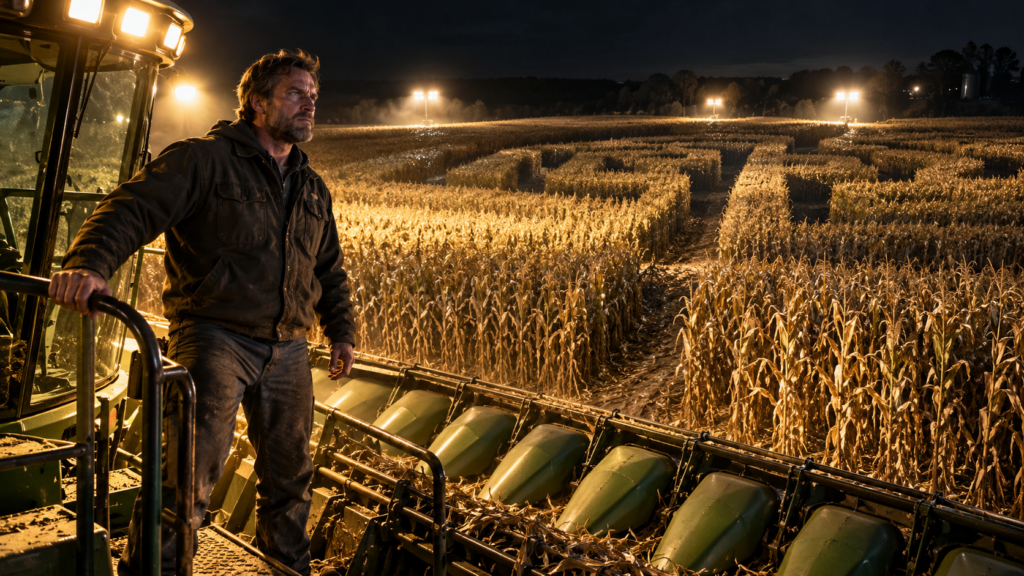
THE COMBINE
I used part of the settlement money to upgrade guidance equipment on the combine.
Not because Arthur financed some grand victory toy.
