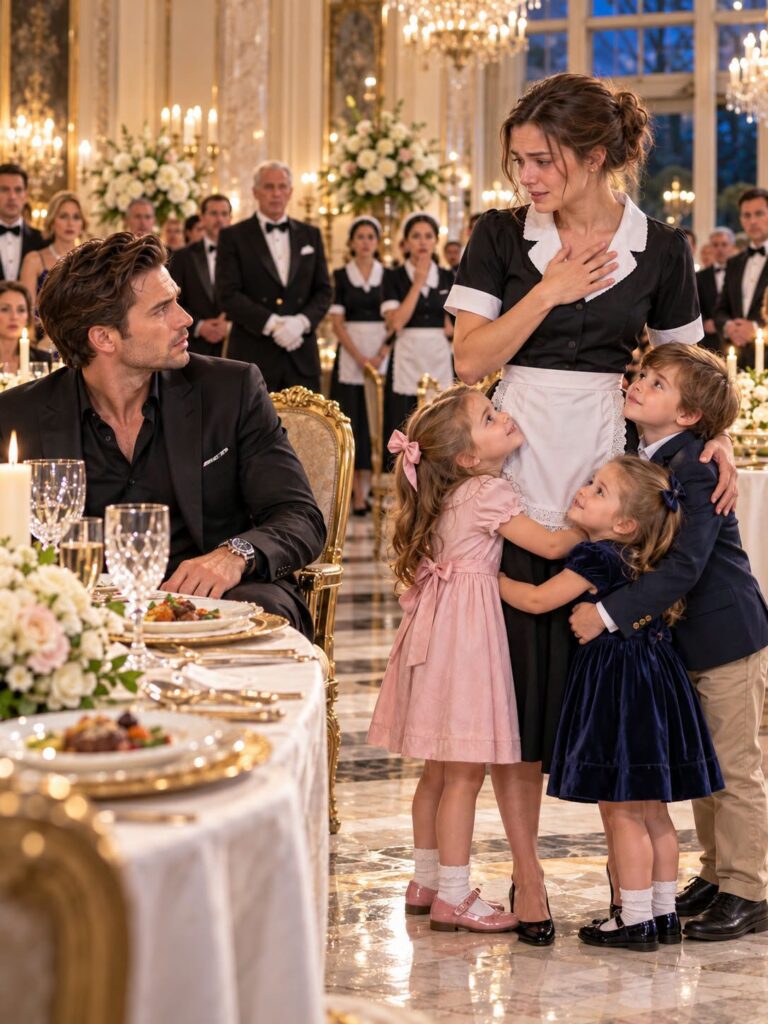
Er schaffte zwei Schritte.
Adriens Wache hielt ihn fest, bevor er den Korridor erreichte.
Der Manager sank auf die Knie und redete wirr.
Er habe nicht alles gewusst, sagte er.
Nur, dass Marco das Zimmer brauchte.
Nur, dass Geld über das Restaurant kam.
Nur, dass Celeste nach Mitternacht durch den Liefereingang hinausgebracht worden war.
Lebend.
Adrien klammerte sich an dieses Wort.
„Lebend?“
Mr. Voss nickte verzweifelt.
„Ja. Lebend. Ich schwöre. Sie lebte, als sie sie mitnahmen.“
Der Keller schien um dieses eine Wort zu kreisen.
Lebend.
Kein Beweis.
Keine Rettung.
Keine Vergebung.
Aber eine neue Chance.
Zwei Jahre lang hatte Adrien Belandi geglaubt, seine Frau habe Geld über ihre Kinder gestellt.
Zwei Jahre lang hatten seine Kinder geglaubt, Schweigen halte ihren Vater am Leben.
Zwei Jahre lang hatte Marco an Adriens Tisch gesessen und zugesehen, wie die Trauer ihn überwältigte.
Das endete im Keller des Grand Aurelia.
Nicht mit Schüssen.
Nicht mit Geschrei.
Mit einer Kellnerin, die ein weinendes Kind im Arm hielt, während ein Vater endlich begriff, dass seine Familie ihn nicht verlassen hatte.
Es war ihm gestohlen worden.
Die nächsten Stunden vergingen wie im Flug.
Das Restaurant wurde geräumt. Die Polizei traf ein, aber nicht das Revier, das Marco sonst benutzt hatte. Bundesagenten kamen mit versiegelten Haftbefehlen, denn der USB-Stick enthielt mehr als nur familiären Verrat. Er enthielt Routen, Briefkastenfirmen, Bestechungsgelder und Namen, die selbst Adriens Männer zum Schweigen brachten.
Marco Belandi wurde vor Tagesanbruch auf einem Privatflughafen außerhalb der Stadt verhaftet.
He had a passport, two phones, and a ticket to Lisbon.
He did not have Celeste.
That took nine more days.
Nine days in which the triplets spoke only to Evelyn.
Small words.
Water.
Light.
Stay.
Papa.
The first time they said that last one, Adrien left the room and stood in the hallway with one hand against the wall until he could breathe again.
Evelyn stayed because Isabella would not sleep unless she sat nearby.
She told herself each night she would go home.
Then one of the children would wake crying, and Adrien Belandi would stand helpless beside a bed worth more than Evelyn’s apartment building, and she would remember Jamie at eight years old, locked inside silence while adults asked what was wrong with him.
So she stayed one more hour.
Then another.
On the ninth day, federal agents found Celeste in a private clinic under a false name two states away.
Weak.
Drugged for long stretches.
Alive.
When Adrien saw her, he did not touch her at first.
He knelt beside the bed like a man approaching a miracle that might vanish if he moved too fast.
Celeste opened her eyes.
For a long moment, she looked afraid.
Then she saw the children.
All three of them stood at the foot of the bed, holding Evelyn’s hands.
Isabella spoke first.
“Mama.”
Celeste made a sound no one in the room ever forgot.
Adrien covered his face.
Evelyn looked away, not because the moment was ugly, but because it was too private to witness fully.
Months later, the Grand Aurelia reopened under new ownership.
Not Adrien’s.
Celeste’s.
She turned the private dining room into a community kitchen on Mondays and a legal clinic twice a month for women who needed help leaving dangerous rooms before the doors locked.
Evelyn no longer carried trays for eleven hours.
Celeste offered her money first.
Evelyn refused.
Then Celeste offered something harder to refuse: work with hours, health insurance, and a childcare stipend for staff mothers.
Evelyn accepted.
Adrien offered protection.
Evelyn told him she preferred a better deadbolt and a raise.
For the first time anyone could remember, Adrien Belandi laughed.
Quietly.
Carefully.
Like a man relearning the sound.
The triplets did not become loud children overnight.
Trauma does not leave because adults finally name it.
But they spoke.
A little more each week.
To Celeste.
To Adrien.
To one another.
And always, when frightened, to Evelyn.
People began calling her the waitress who made the Belandi triplets speak.
Evelyn hated that.
She had not made them do anything.
She had only listened without grabbing at the words when they came.
That was all children needed sometimes.
Not a miracle.
A safe place for the truth to land.
One evening, nearly a year after the night the restaurant went silent, Evelyn found Isabella at table nine, folding napkins into uneven triangles.
“What are those?” Evelyn asked.
“Mountains,” Isabella said.
“For who?”
“For words.” The little girl looked up. “So they can climb out.”
Evelyn smiled.
From the doorway, Adrien watched without interrupting.
His life was still dangerous. His name still carried weight. Men still lowered their voices when he entered certain rooms.
But at home, his children spoke.
At dinner, Celeste sat beside him again.
And on the wall of the Grand Aurelia’s old cellar, now sealed behind glass as part of the legal record and family memory, hung a small brass plaque.
It read:
HERE, SILENCE ENDED.
Under it, in smaller letters:
A WORD IS NEVER SMALL WHEN IT HAS BEEN WAITING TWO YEARS TO BE HEARD.
The city remembered the scandal.
The arrests.
The missing wife found alive.
The fall of Marco Belandi.
But Evelyn remembered something else most clearly.
A child at table nine looking up with frightened eyes.
One whispered word.
Sellar.
Not perfect.
Not even pronounced correctly.
But true enough to open everything.
The End.
