Dentro había documentos sellados en plástico. Una pequeña bolsa de terciopelo. Una memoria USB. Una fotografía de Celeste Belandi con sus tres bebés en una cama de hospital.
Y una carta.
Adrien la tomó con manos que parecían firmes solo porque el resto de su cuerpo se había petrificado.
Al principio leyó en silencio.
Luego en voz alta, porque algunas verdades son demasiado pesadas para soportarlas solo.
«Adrien, si encuentras esto, entonces no logré contactarte antes que Marco».
El hombre de la cicatriz levantó la vista bruscamente.
Marco Belandi era primo de Adrien.
Su consejero más cercano.
El hombre que había testificado que Celeste retiró dinero, fletó un avión y desapareció.
Adrien siguió leyendo.
«Ha estado moviendo dinero a través de las cuentas del puerto y usando tu nombre para proteger envíos que nunca autorizaste. Cuando lo confronté, me dijo que nadie creería a una esposa que quería libertad. Me trajo aquí porque sabía que estarías arriba para la cena de Aurelia y porque los niños estaban conmigo». La voz de Adrien flaqueó.
Evelyn abrazó a Isabella con más fuerza.
Las lágrimas de la niña empapaban su cuello.
«Les hizo verme firmar los papeles de la transferencia. Les dijo que si hablaban, su padre también desaparecería. Si no sobrevivo a esto, no dejen que los críe en silencio».
Adrien dejó de leer.
Nadie le pidió que continuara.
Nadie lo habría soportado.
La bolsita de terciopelo contenía el anillo de bodas de Celeste.
La memoria USB contenía suficientes archivos como para que el hombre de la cicatriz maldijera entre dientes.
El señor Voss intentó correr.
Dio dos pasos.
El guardaespaldas de Adrien lo alcanzó antes de que llegara al pasillo.
El gerente se desplomó de rodillas, balbuceando de inmediato.
No lo sabía todo, dijo.
Solo que Marco necesitaba la habitación.
Solo que el dinero llegaba a través del restaurante.
Solo que a Celeste la habían sacado por la entrada de reparto después de medianoche.
Viva.
Adrien se aferró a esa palabra.
—¿Viva?
El señor Voss asintió desesperado.
—Sí. Viva. Lo juro. Estaba viva cuando se la llevaron.
El sótano pareció girar en torno a esa palabra.
Viva.
No era una prueba.
No era un rescate.
No era perdón.
Sino una posibilidad.
Durante dos años, Adrien Belandi había creído que su esposa había elegido el dinero antes que a sus hijos.
Durante dos años, sus hijos habían creído que el silencio mantenía vivo a su padre.
Durante dos años, Marco se había sentado a la mesa de Adrien y había visto cómo el dolor hacía su trabajo por él.
Eso terminó en el sótano del Grand Aurelia.
No con disparos.
No con gritos.
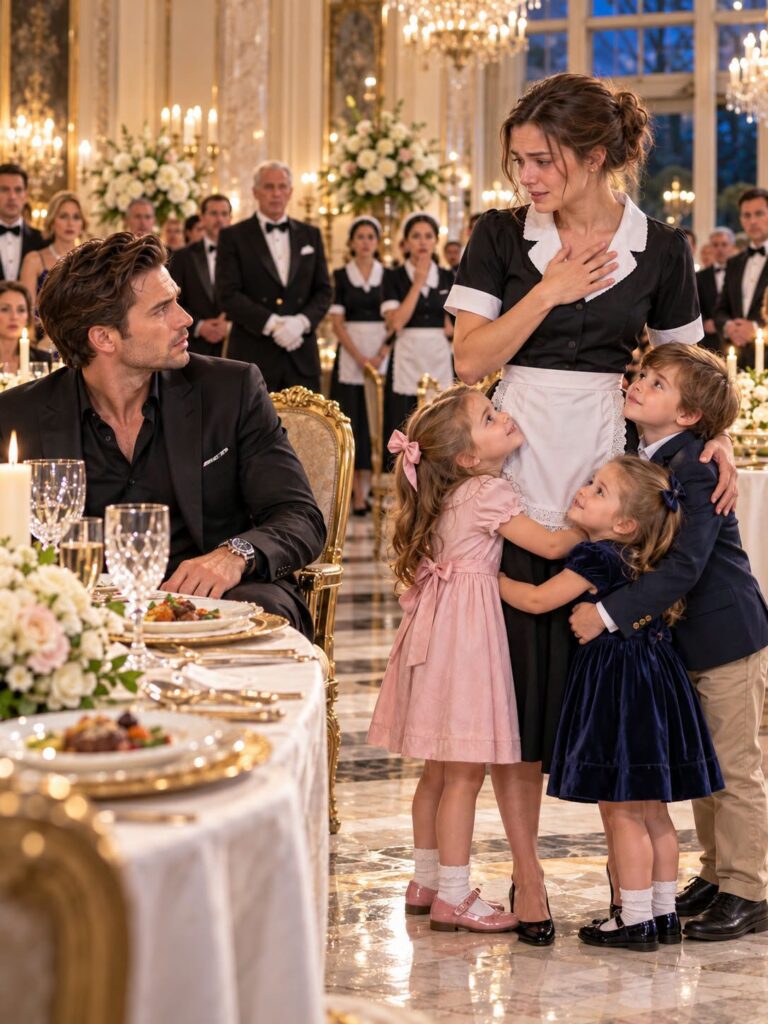
Con una camarera sosteniendo a un niño que lloraba mientras un padre finalmente comprendía que su familia no lo había abandonado.
It had been stolen.
The next hours happened quickly.
The restaurant was cleared. Police arrived, but not the local precinct Marco had used before. Federal agents came with sealed warrants because the flash drive contained more than family betrayal. It contained routes, shell companies, bribes, and names that made even Adrien’s men go silent.
Marco Belandi was arrested before dawn at a private airport outside the city.
He had a passport, two phones, and a ticket to Lisbon.
He did not have Celeste.
That took nine more days.
Nine days in which the triplets spoke only to Evelyn.
Small words.
Water.
Light.
Stay.
Papa.
The first time they said that last one, Adrien left the room and stood in the hallway with one hand against the wall until he could breathe again.
Evelyn stayed because Isabella would not sleep unless she sat nearby.
She told herself each night she would go home.
Then one of the children would wake crying, and Adrien Belandi would stand helpless beside a bed worth more than Evelyn’s apartment building, and she would remember Jamie at eight years old, locked inside silence while adults asked what was wrong with him.
So she stayed one more hour.
Then another.
On the ninth day, federal agents found Celeste in a private clinic under a false name two states away.
Weak.
Drugged for long stretches.
Alive.
When Adrien saw her, he did not touch her at first.
He knelt beside the bed like a man approaching a miracle that might vanish if he moved too fast.
Celeste opened her eyes.
For a long moment, she looked afraid.
Then she saw the children.
All three of them stood at the foot of the bed, holding Evelyn’s hands.
Isabella spoke first.
“Mama.”
Celeste made a sound no one in the room ever forgot.
Adrien covered his face.
Evelyn looked away, not because the moment was ugly, but because it was too private to witness fully.
Months later, the Grand Aurelia reopened under new ownership.
Not Adrien’s.
Celeste’s.
She turned the private dining room into a community kitchen on Mondays and a legal clinic twice a month for women who needed help leaving dangerous rooms before the doors locked.
Evelyn no longer carried trays for eleven hours.
Celeste offered her money first.
Evelyn refused.
Then Celeste offered something harder to refuse: work with hours, health insurance, and a childcare stipend for staff mothers.
Evelyn accepted.
Adrien offered protection.
Evelyn told him she preferred a better deadbolt and a raise.
For the first time anyone could remember, Adrien Belandi laughed.
Quietly.
Carefully.
Like a man relearning the sound.
The triplets did not become loud children overnight.
Trauma does not leave because adults finally name it.
But they spoke.
A little more each week.
To Celeste.
To Adrien.
To one another.
And always, when frightened, to Evelyn.
People began calling her the waitress who made the Belandi triplets speak.
Evelyn hated that.
She had not made them do anything.
She had only listened without grabbing at the words when they came.
That was all children needed sometimes.
Not a miracle.
A safe place for the truth to land.
One evening, nearly a year after the night the restaurant went silent, Evelyn found Isabella at table nine, folding napkins into uneven triangles.
