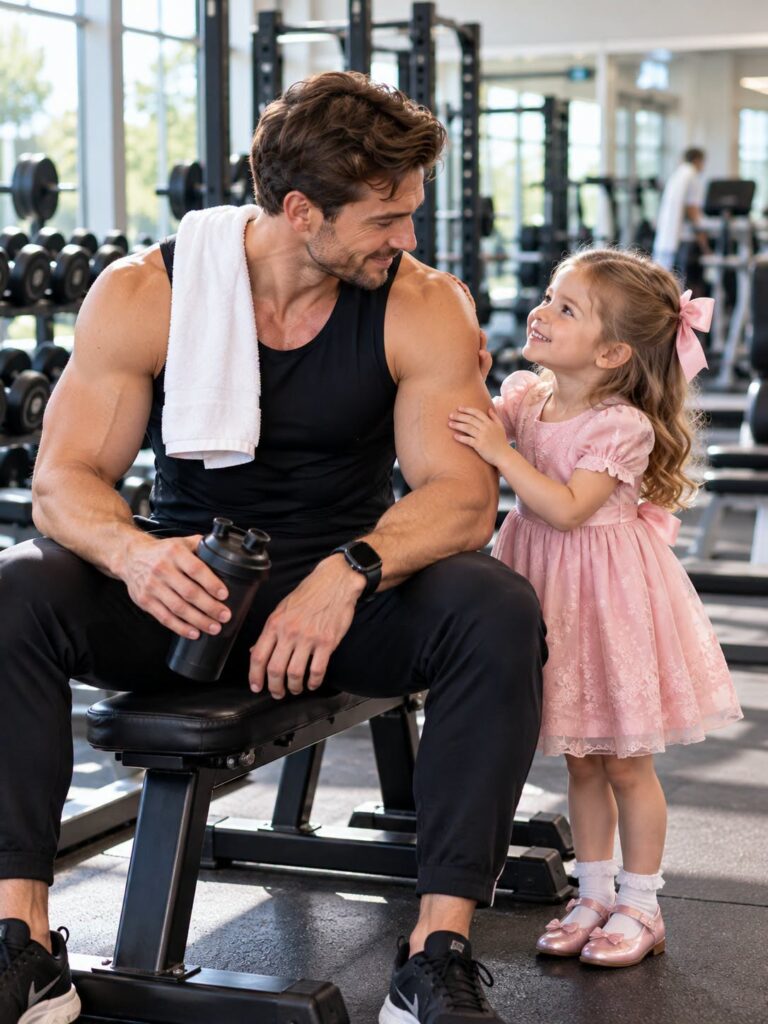
“Because children should not learn strength in houses like this.”
I gripped Mr. Buttons harder.
“But I want muscles like yours.”
His face changed.
For a second, he looked almost broken.
“No,” he said softly. “You do not.”
I did not understand then.
I thought muscles meant pull-ups and heavy bags and being able to carry groceries so your mother’s back would not hurt. I did not yet understand the cost of becoming feared. How much of yourself you had to bury. How many rooms inside you had to lock.
But Mama understood enough for both of us.
The next morning, we left the Moretti house.
Signor Moretti did not come to the courtyard to say goodbye. I was furious about that for years.
Only later did Mama tell me he watched from the upstairs window.
Our new apartment was small but bright. The kitchen window looked over a bakery. My bedroom had yellow curtains. Mama worked at the hotel, then later at the front desk, then as a supervisor. She had always been smart. She simply needed a room where no one expected her to lower her eyes.
I kept training.
Not in secret exactly, but privately. Push-ups beside my bed. Sit-ups on the rug. Running up the apartment stairs. At twelve, I joined a youth boxing program. At fifteen, I could outwork boys who laughed when I first walked in. At eighteen, I earned a scholarship to study physical therapy. At twenty-six, I opened a small rehabilitation studio for women recovering from injury, surgery, and violence.
I did not call it Moretti Fitness.
I called it Rosa Strength.
Mama cried when she saw the sign.
Years passed. The city changed. Men like Moretti either went to prison, went legitimate, or went into the ground. Rumors said Luca Moretti had stepped away from the old business after a string of betrayals. Rumors said he had become an investor, a recluse, a ghost in expensive suits. Rumors said many things.
I did not see him again until I was thirty-one.
He came into my studio on a rainy afternoon, older, thinner, leaning slightly on a black cane. His hair had gone silver at the temples. The shoulders I remembered as mountains had narrowed beneath his coat, but his eyes were the same dark, steady gray.
I was helping a client with balance work when the bell above the door rang.
For one absurd second, I was four years old again, standing in a room that smelled of rubber and iron and lemons.
He looked around at the bright walls, the resistance bands, the framed photographs of women smiling after finishing their first mile or lifting their first weight after surgery.
Then he saw the sign behind the desk.
ROSA STRENGTH.
His hand tightened on the cane.
I walked toward him.
“Signor Moretti.”
“Elena.”
No one had called me that way in years.
He glanced at my arms, then at the studio.
“You got muscles.”
I folded my arms. “Correct work.”
That almost made him smile.
Almost.
He had not come for nostalgia. Men like him did not spend energy on sentiment unless time had already begun charging interest. He had come because his body was failing in ways money could not command into obedience. Hip replacement. Nerve pain. Balance issues. Doctors had told him to work with someone patient.
“Then you came to the wrong woman,” I said.
He looked at me.
I held his gaze.
Then, slowly, he laughed.
The first few sessions were terrible. He hated weakness. Hated instruction. Hated the parallel bars. Hated that his left leg trembled after eight minutes. Hated most of all that I saw it.
“Again,” I said.
“I already did it.”
“Badly.”
“I am sixty-eight.”
“Then do it badly again until it improves.”
He glared at me.
I smiled.
Justice comes in many forms.
Weeks became months. He improved. Slowly. Angrily. Correctly. He never spoke much about the old house, but sometimes memories escaped him. The gardener. The lemon trees. The gym. My rabbit with one ear.
One afternoon, after he managed the stairs without using the rail, he sat heavily on the bench and said, “Your mother?”
“Alive. Retired. Bosses everyone at church.”
“Good.”
“She still says you saved us.”
He looked at the floor.
“I saved you from a danger I created.”
That was the most honest thing he had ever said to me.
“Yes,” I said.
He nodded once, accepting the sentence without defense.
Then he said, “Is that why you help women here?”
I looked across the studio. A young mother was learning to lift after a car accident. An older woman practiced walking without fear after a fall. A teenager who had stopped speaking after an assault was hitting a padded bag in the back room while my assistant counted softly.
“No,” I said. “I help them because strength should not belong only to people who frighten others.”
His eyes closed.
For a moment, he looked tired in the same way he had that first day, when I found him beneath the steel bar and asked a child’s impossible question.
“How can I get muscles like yours?”
I had spent most of my life answering it differently than he expected.
Not by becoming feared.
Not by learning how to make rooms go silent.
But by helping women carry groceries, laundry, children, grief, surgery scars, court dates, old shame, new hope, and their own bodies without apology.
When Luca Moretti finished his final session, he stood at the door for a long time.
The rain outside had stopped. Sunlight slid across the studio floor.
“I thought strength was what kept people away,” he said.
I picked up a towel from the bench. “Sometimes strength is what lets them come closer.”
He nodded slowly.
Then he looked toward the training mats, where a little girl from one of my mother-and-child classes was trying to do a push-up while her grandmother clapped.
“She asks many questions,” he said.
“Most children do.”
