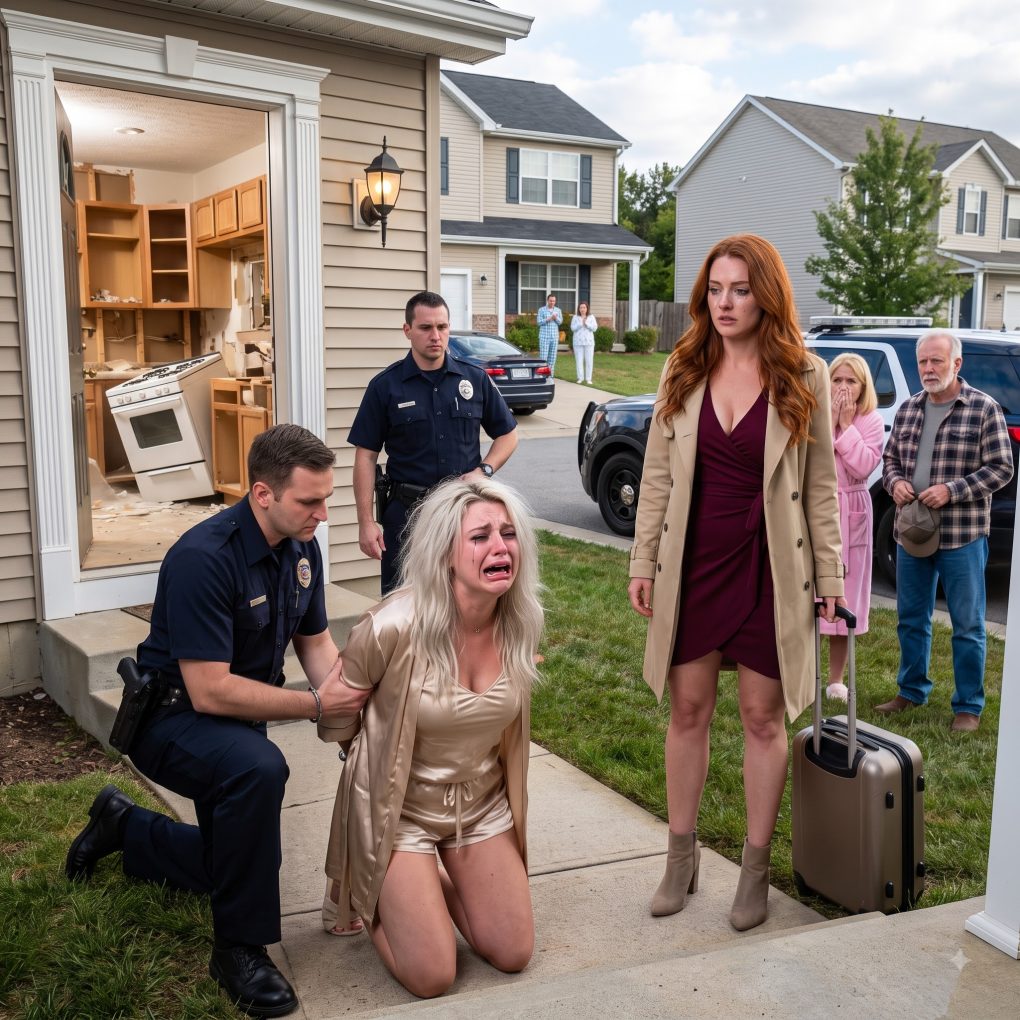
I read it twice and finally cried.
Ramirez waited a respectful minute before sliding the second envelope across the table. The top had been ripped open.
“Dana read it in the back of the squad car,” he said. “She hasn’t spoken since.”
Inside was a single sheet.
Dana, if Claire is not the one handing you this, then you went looking where you had no right to look. I set aside $73,000 for you in this box. It was always yours. All I ever wanted was for you to come to me and say, “Grandma, I’m in trouble.” You never did.
Under the letters lay old bills and a bundle of savings bonds, brittle with age. Seventy-three thousand dollars, exactly as promised.
“There’s someone who wants to talk to you,” Ramirez said quietly. “You should hear it from her.”
Through the glass, my little sister looked smaller than I had ever seen her. Mascara streaked her cheeks. She had traded the smile for something hollow.
He let me in and stood by the door.
Dana did not look up. “I was going to put it all back,” she whispered.
“Put what back?”
It came out in pieces. Her boutique in Westerville had failed eighteen months ago. She owed a hundred and forty thousand dollars, most of it to a private lender whose texts had started to sound like threats. Mark knew nothing. He believed the shop was thriving.
“I couldn’t ask you,” she said. “You always have everything together. I didn’t want you to see me like that.”
“Dana, I would have helped you.”
“You would have judged me.”
She had copied my signature from a birthday card. She bought a notary stamp online from a man who asked no questions. She filed the quitclaim deed, then used it to borrow ninety thousand dollars against my house from a hard-money lender. And when that was not enough, she told Gary and Linda that I had agreed to sell them the house in a “family deal.” They sold their home in Dayton and wired her one hundred and twenty thousand dollars as a down payment.
“And the kitchen?” I asked.
She finally looked at me, and her eyes were red. “Grandma used to say everything that mattered was behind the stove. I thought if I found cash, I could fix it all before anyone knew. The contractor started on Monday. Then your plane landed early.”
“I didn’t land early by accident,” I said.
“I know,” she said. “I figured that out when the police walked in.”
At five o’clock, the door at the end of the hallway opened, and Mark walked in, still wearing yesterday’s clothes. He looked at Dana as if he were seeing her for the first time.
“Tell me it isn’t true,” he said.
She could not.
He gave Ramirez his phone and bank records without being asked. “My parents lost their house because of this,” he said, his voice cracking.
Gary and Linda were waiting in the lobby. Gary stood when I walked out, twisting his cap in his weathered hands. He was a retired carpenter, seventy-one years old, and he could not meet my eyes.
“We thought you knew,” he said. “She showed us papers.”
“I believe you,” I said. “You don’t owe me an apology.”
The following weeks moved faster than I expected. Ramirez’s team traced the notary stamp. The recorder voided the forged deed, and once the hard-money lender saw the evidence, the lien on my house was released.
Dana pleaded guilty to forgery, identity fraud, and theft. The judge gave her fourteen months in county jail, followed by probation, and ordered counseling and full restitution. I did not ask for more. I did not ask for less.
The money in the box was Dana’s. Grandma had said so in writing. That was exactly why I made the decision I did.
I took the $73,000 to Gary and Linda and put it in Linda’s hands.
“This is Dana’s inheritance,” I told them. “This is her making things right.”
“We can’t take that,” Linda said.
“It isn’t mine to keep.”
Restitution covered the rest over time, from Dana’s wages. And Gary, stubborn Gary, showed up at my door one Saturday morning with a toolbelt and a stack of lumber.
“You’re not paying me,” he said. “A man fixes what his family broke.”
It took him nine weeks. He rebuilt every cabinet by hand, in oak.
Six months later, I visited Dana in county jail. She had lost weight and wore the orange uniform like it belonged to someone else.
“Did you give them Grandma’s money?” she asked.
“I did.”
Her jaw tightened. “I guess I deserved that.”
“It wasn’t a punishment,” I said. “Grandma left it so you could do one right thing. You just did.”
Her face crumpled. For a long time, neither of us spoke.
“I should have just asked you,” she said at last.
“Yes,” I said. “You should have.” Then, because she was still my sister: “So ask me now.”
She wiped her eyes. “Can you come back next Sunday?”
“Every Sunday,” I said.
That Thanksgiving, my new kitchen smelled like sage and butter. Gary carved the turkey while Linda argued with Mark about the stuffing. We set a plate for Dana anyway. On the refrigerator, under a magnet shaped like a lemon, hung Grandma Ruth’s letter.
The kitchen took a day to destroy and nine weeks to rebuild. My family is taking longer. But we are rebuilding it, one Sunday at a time.
