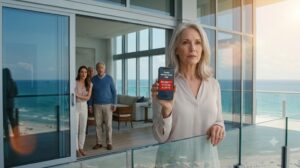
Llevaba dos días disfrutando de las únicas vacaciones tranquilas que me había permitido en todo el año cuando mi nuera me llamó y me dijo que abandonara mi propio apartamento en la playa.
No se preguntó.
Dijo.
—Sabemos que es tuya —dijo Harper—, pero mis padres están aquí y queremos privacidad. Deberías quedarte en un hotel unos días.
Debajo de mí, las olas rompían en la arena formando líneas blancas y limpias.
Detrás de mí, a través de las puertas de cristal del balcón, la madre de Harper ya estaba colgando una bata dentro del armario de mi habitación.
La observé alisarse la manga como si tuviera todo el derecho a estar allí.
Entonces dije una palabra.
“Comprendido.”
Harper se relajó de inmediato.
Ella pensó que me había rendido.
Ella no tenía ni idea de que acababa de tomar la decisión que llevaba años posponiendo.
Me levanté de la silla del balcón y entré.
Junto a mi maleta había un pequeño estuche negro.
Harper le echó un vistazo y sonrió, dando por hecho que yo estaba empezando a hacer la maleta.
Yo no lo era.
Dentro estaban las tarjetas de acceso al edificio registradas a mi nombre.
Mi nombre es Barbara Parker, y ese apartamento nunca fue una propiedad vacacional familiar.
Era mío.
Lo compré después de años de trabajar, ahorrar y anteponer siempre a los demás.
Una semana al año me pertenecía.
Sin obligaciones.
No hay emergencias familiares.
No se aceptan peticiones disfrazadas de favores.
Solo el océano, un balcón, el café de la mañana y el silencio suficiente para poder pensar con claridad.
Apenas llevaba allí cuarenta y ocho horas.
Por primera vez en meses, mis hombros dejaron de sentirse como si estuvieran permanentemente bloqueados bajo mis orejas.
Entonces Harper llamó.
Ver su nombre en la pantalla me produjo la familiar opresión en el estómago.
No porque esperara amabilidad.
Porque ya sabía lo que solían significar sus llamadas.
Algo que ella quería.
Algo que ella ya había decidido que era “razonable” antes de que me permitieran responder.
—Hola, Harper —le había dicho.
Ella se saltó el saludo.
“Barbara, tenemos que hablar del condominio.”
La forma en que pronunció mi nombre sonó como una puerta que se cierra.
—Mis padres acaban de llegar —continuó—. De forma inesperada. Quieren pasar unos días en la playa.
Esperé.
Con Harper, siempre había una segunda parte.
Y la segunda mitad siempre fue lo importante.
—Ya sabes cómo son —dijo, adoptando de repente un tono de voz artificialmente compasivo—. Necesitan espacio. Privacidad. Han tenido un año muy estresante.
La cortina transparente que tenía detrás se levantó con la brisa marina.
Luego llegó la verdadera petición.
“Así que queremos estar a solas con ellos.”
Apreté los dedos contra la barandilla del balcón.
“Y puesto que este lugar es perfecto”, continuó Harper, “deberían ir a un hotel”.
Durante varios segundos, realmente pensé que había entendido mal.
“¿Quieres que me vaya de mi apartamento?”
“Sí.”
Su respuesta fue tan natural como pedir un café.
“Just five or six days. It’s not a big deal.”
By then, her parents weren’t even waiting for permission.
Suitcases were open.
Clothes were being placed into drawers.
Her father had set his toiletries beside mine.
Her mother was organizing my bedroom closet.
My home was being occupied while I stood ten feet away.
Harper followed me down the hallway.
“There are plenty of hotels nearby,” she said. “You could stay somewhere simpler. You don’t need all this space.”
I nodded once.
“Understood.”
That pleased her.
Until she saw my phone.
I opened the condo management app.
There they were.
Temporary access passes.
One for Harper’s mother.
One for her father.
Created without my approval.
My thumb hovered over the screen.
For years, I had tolerated little things.
Unannounced visits.
Assumptions about my money.
Plans made with my property before anyone thought to ask me.
Each time, I told myself keeping the peace mattered more.
But peace bought through surrender isn’t peace.
It’s permission.
I selected every unauthorized pass.
Harper’s expression changed.
“What are you doing?”
I didn’t answer.
I tapped the screen.
Her mother appeared in the hallway clutching several dresses.
Her father stopped beside an open suitcase.
Harper stepped closer.
“Barbara.”
I kept my eyes on the phone.
She grabbed my wrist.
“What are you doing?”
Before I could answer, the condo intercom buzzed.
Everyone froze.
I pressed the button.
The concierge’s voice came through the speaker.
“Ms. Parker, building security is downstairs regarding unauthorized occupancy.”
Harper slowly released my wrist.
Her parents stared at me.
Then the concierge asked:
“Should I send them up?”
PART 2
“Yes,” I said.
Harper’s face changed so quickly that I almost admired the honesty of it.
For once, there was no polished smile hiding what she felt.
There was only anger.
“You called security on my parents?”
“No,” I said. “The building system did that automatically when I revoked unauthorized access.”
Her mother dropped the dresses onto the guest bed.
“You cannot possibly be serious.”
“I am completely serious.”
Harper stepped between me and the intercom.
“This is humiliating.”
I looked around my own bedroom.
Her mother’s robe hung beside my clothes.
Her father’s shaving kit occupied my bathroom counter.
Their suitcases blocked my hallway.
“I agree,” I said.
Harper stared at me.
I watched realization spread across her face.
She finally understood that we were discussing different humiliations.
“You’re making a scene over nothing,” she said.
I walked toward the living room.
“No, Harper.”
I stopped beside the open suitcase near the sofa.
“I spent years pretending these things were nothing.”
Her father folded his arms.
“This is family business.”
“Then why did nobody in the family ask me?”
He opened his mouth.
Nothing came out.
The elevator chimed outside my front door.
Harper’s mother rushed toward her suitcase.
“Tell them there has been a misunderstanding.”
“There hasn’t.”
Three knocks sounded against the door.
Harper turned toward me.
“Barbara, please.”
It was the first polite word she had used since arriving.
