Then Hoffman’s audit confirmed it: $50,000 had moved from Grandpa Walt’s account into Rick’s personal checking account two years earlier. Weeks later, it became Megan’s down payment on a four-bedroom house in Dublin, Ohio. My parents hired a lawyer and fought everything. They told the court I’d left voluntarily after a fight, that the folder was routine family paperwork, and that the missing money was a gift from Grandpa Walt.
The case dragged on. I started classes in August, worked twenty hours a week at the campus library, and slept in a dorm room the size of a closet. My parents never called. Not once.
Then, eight months after that night on the lawn, my phone rang on a freezing January evening. Megan.
She could barely speak. “Ethan, please. The bank froze my mortgage. Hoffman’s audit flagged the down payment as trust money, and they’re calling the whole loan. Mom and Dad say if you drop the case and tell the judge it was a misunderstanding, it all goes away.”
I stared out my dorm window at the falling snow. Eight months ago, I’d have said yes to anything just to hear my family be kind.
“Where are they now?” I asked.
“Mediation. Hoffman’s office. Friday at ten,” she said.
“I’ll be there.”
Friday morning, I walked into Hoffman’s conference room wearing the suit Carla had bought me for my college interviews. My parents sat across the table with their attorney, a smooth man named Gordon Pryce. Dad’s jaw was tight. Mom wouldn’t look at me. Megan and her husband, Mark, sat at the end, pale and exhausted.
Pryce slid a document across the table. “A simple withdrawal of your claims. Your parents are willing to forget this unfortunate conflict. After all, you left the home voluntarily. Nobody threw you out.”
Mom looked up, eyes wet. “Honey, we’re family. Families make mistakes. Don’t destroy your sister’s life over a misunderstanding.”
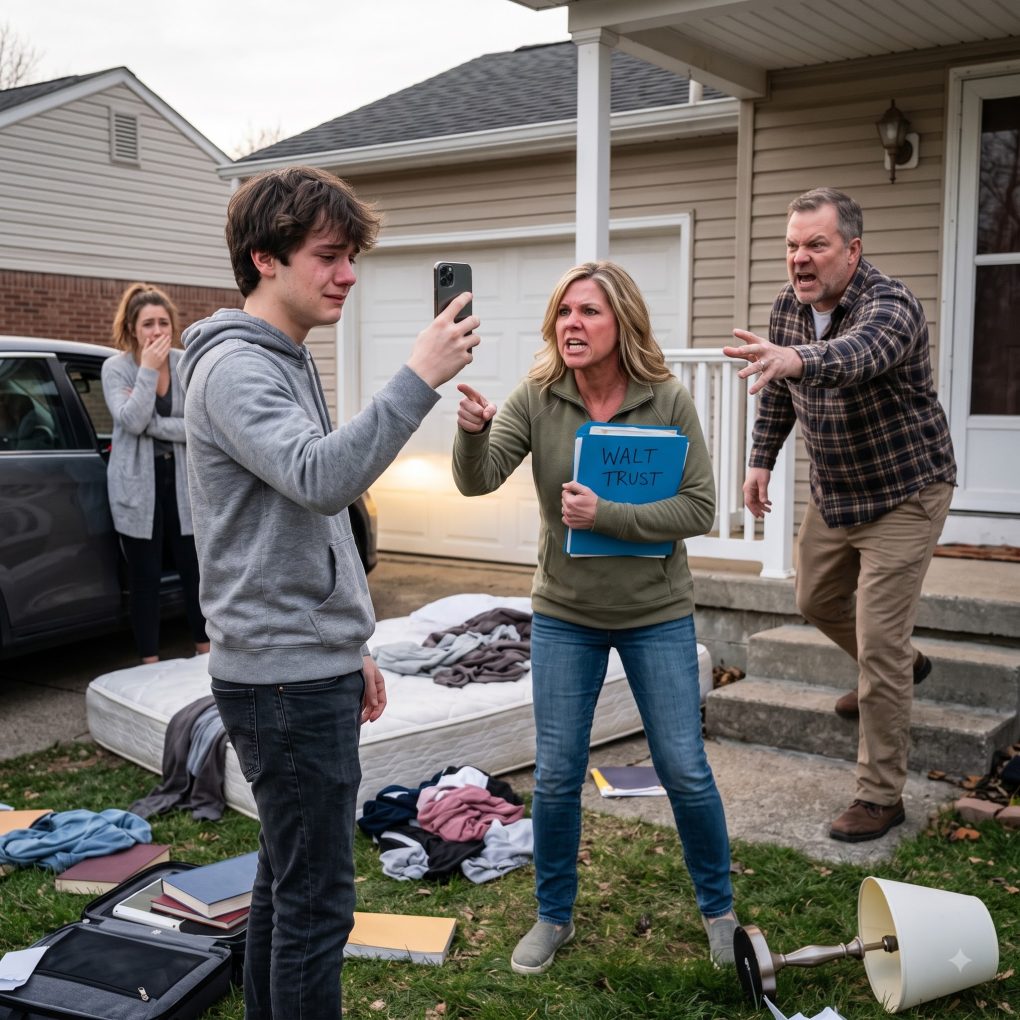
A misunderstanding. I almost laughed. Then I reached into my jacket, pulled out my phone, and found the photo I had taken eight months ago. The one I’d looked at on the worst nights. The one that had kept me going.
I set it face up on the table. “Let’s talk about voluntary.”
Everyone leaned in. The photo showed our front lawn at dusk: my mattress half-dragged across the grass, my clothes in heaps, my lamp on its side. My father stood on the porch with his arms crossed. My mother stood in the foreground, holding a thick blue folder, with “WALT TRUST” in Grandpa’s handwriting clearly visible on the tab. In the corner, the timestamp read May 9, 6:47 p.m.
Hoffman cleared his throat. “Your clients swore under oath that Mrs. Brooks never touched the trust documents, and that Ethan left of his own free will. This photograph, with its metadata, says otherwise. It also puts a timestamp on the day they locked him out, nine days before his deposit deadline. That isn’t a family misunderstanding, Mr. Pryce. That’s intent.”
Pryce stared at the picture. Then he turned slowly to my father. “Mr. Brooks. You told me he walked out.”
Every ounce of color drained from my parents’ faces. Dad’s mouth opened, but nothing came out. Mom’s hand flew to her throat. I had imagined that look a hundred nights in my dorm room. It didn’t feel like victory. It felt like finally being seen.
Megan stood up, shaking. “I was in the car that night, Dad. I watched you throw him out. I told myself it was none of my business because I didn’t want to lose the house. I’m done lying.” She turned to Hoffman. “I’ll testify. Whatever it takes.”
Within an hour, Pryce withdrew from the case, and Dad, cornered, agreed to a full settlement: the family lake cabin in Hocking Hills would be sold, the proceeds returned to the trust with interest, and the missing $50,000 restored in full. Hoffman added one more condition: my parents would sign a statement acknowledging what they’d done. Prosecutors, he reminded them, would be very interested in the alternative.
Then I asked Hoffman a question that surprised everyone, including me. “Can the trust forgive the down payment if Megan and Mark refinance with a normal loan?”
Hoffman nodded slowly. “If the cabin sale makes the trust whole, yes.”
Megan covered her mouth. “Ethan, I don’t deserve that.”
“You called Hoffman,” I said. “You opened the back door. You were the only one who did.”
By the time the cabin sold in March, Megan’s refinance had cleared, and my parents’ signed statement sat in Hoffman’s file. They never apologized out loud. Dad sent one letter, three lines long. I haven’t answered it yet.
On the first warm Saturday of April, I sat on a bench by the lake on campus and reread the page Hoffman had given me after the settlement, the last thing in Grandpa Walt’s blue folder. One handwritten page.
Ethan, if you’re reading this, someone told you that you aren’t special. They were wrong. Go be exactly who you are. — Grandpa
I folded it, looked out at the water, and for the first time in a year, I let myself smile. A real one.
