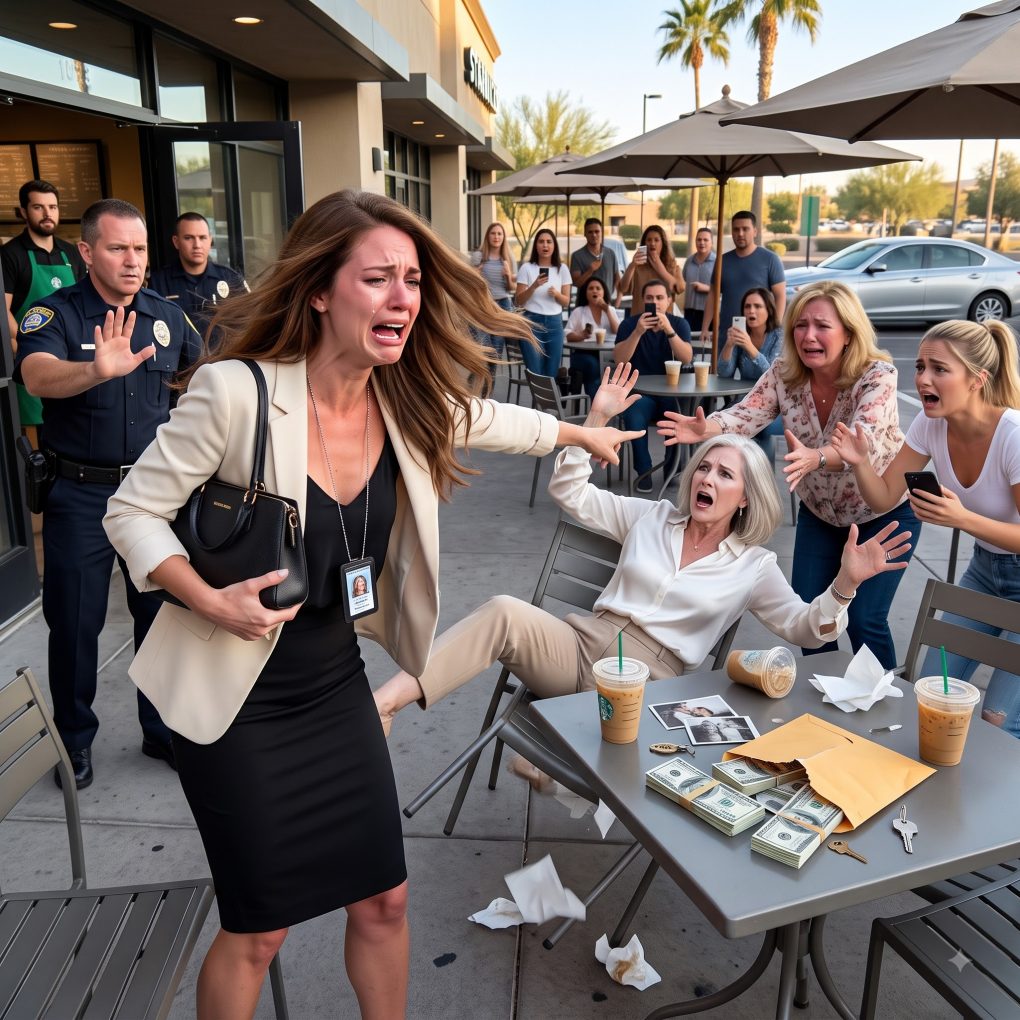
Collins turned to me. “Ms. Hargrove-Lane, would you be willing to accompany us to First Southwest Bank to open that box? With the executor of your grandmother’s estate present, of course.”
“Executor?” I said. “Mom handled Grandma’s estate.”
“Not according to this letter,” he said. “It names an attorney, Walter Dunmore.”
Two hours later, I sat in a private room at First Southwest Bank with Collins, an elderly attorney with a cane, and a bank manager who unlocked Box 417 with my brass key and Mr. Dunmore’s signature.
Inside were three things: a black ledger, a thick stack of bank statements, and a cashier’s check for $180,000.
Mr. Dunmore lowered himself into a chair. “Natalie, your grandmother came to me four years ago, frightened. She had discovered that her daughter was draining her accounts through a power of attorney. Nearly four hundred thousand dollars over eight years. Gambling debts, mostly, and a lot of Brianna’s lifestyle.”
I couldn’t speak. I just opened the ledger. Page after page of Grandma Rose’s handwriting, every withdrawal recorded, every date, every amount, every forged signature she’d caught.
“She didn’t want to prosecute her own daughter,” Mr. Dunmore went on. “She wanted proof in case she ever had to. And she wanted to protect you. She said you were the only one who loved her without asking what she had.”
“The bag,” I whispered.
“She said the bag would always stay with you, because you’d never sell it. She trusted you to keep it safe until someone forced you to open it.”
I laughed, a wet, broken sound. “She didn’t count on Brianna.”
“No,” Dunmore said gently. “She didn’t.”
The cashier’s check was the final piece. Grandma Rose had set aside $180,000 for me, drawn from her own savings, before Mom could reach it, with a letter beside it.
Natalie, my sweet girl. If you’re reading this, I’m gone, and I’m sorry I wasn’t brave enough to tell you while I lived. Do not let your mother talk you out of this. Use it for something that makes you happy. And buy your own bag, if you want one. But know that the one I gave you was always the real treasure. I love you. — Grandma Rose
I cried until I couldn’t breathe, and Mr. Dunmore let me.
The rest unfolded over the next four months. Collins’s financial crimes unit pulled records. Mom had forged Grandma’s signature on seventeen withdrawals, and she’d also been quietly diverting Grandma’s Social Security deposits into a second account. The district attorney offered her a deal: plead guilty to theft and forgery, make full restitution, and accept five years of probation. She took it. The house in Scottsdale went on the market to pay it back.
Brianna was the surprise.
She showed up at my apartment two weeks after the arrest, mascara destroyed, no bravado left. “I didn’t know,” she said. “About any of it. I swear. She told me Grandma gave her the money.”
“You still sold my bag.”
“I know.” She wiped her face. “I thought it was just stuff. I thought you were being precious about it. Natalie, I’m so sorry.”
I let her sit. I let her cry. I didn’t forgive her that night, but I didn’t slam the door.
She got a second job at a pharmacy. She refunded Marissa out of her first two paychecks. Every Sunday for three months, she dropped off coffee at my door with a short note: No pressure. Just showing up.
By spring, I started opening the door.
Marissa Cole and I stayed in touch too. She’d returned the bag the same afternoon, hand-delivering it with a card that said, Your grandmother clearly loved you very much. Over lunch one day she told me she’d worked for thirty years chasing exactly this kind of quiet fraud, and she’d never once seen it hidden in a handbag.
“Funny,” she said. “I almost didn’t inspect the lining. Something told me to.”
“Grandma Rose,” I said.
“I’m not a superstitious woman,” Marissa said, smiling. “But I’ll take it.”
I used the cashier’s check carefully. I paid off my student loans, put a down payment on a small townhouse, and set up a scholarship in Grandma Rose’s name at the community college where she’d once taught night classes. The first recipient, a single mom studying nursing, cried when I handed her the letter.
My mother wrote me from her new apartment, six months into probation. Her handwriting was shaky. I don’t expect forgiveness. I only want you to know I’m in counseling and I finally understand what I took from you, and from her. I’m sorry, Natalie.
I read it three times. I didn’t answer right away. Some apologies deserve time. But I tucked it into the ledger, next to Grandma’s letter, and told myself that one day I might write back.
On the anniversary of Grandma Rose’s death, Brianna and I drove out to the desert cemetery, the Gucci bag between us on the seat. We stood at her grave in the dry morning wind, and I opened the lining one last time.
I’d left one thing inside: Grandma’s photograph, the one of her at twenty-two, laughing in a yellow dress.
“She knew,” Brianna said softly. “She knew exactly who each of us was.”
“She did.”
“I’m trying to become the person she thought I could be.”
I took her hand. “Then keep trying.”
We stood there until the sun cleared the ridge. I thought about how close it had all come to disappearing, a $12,000 bag sold for rent money, a stranger with a bank examiner’s instincts, a hidden pocket stitched by a woman who loved me enough to plan for her own absence.
Everyone told me it was only a bag. It wasn’t. It was the last thing my grandmother ever built, a safe, small and quiet, with my name on it.
And in the end, the thing my family stole from me was the thing that finally set me free.
