Just before we stepped inside, he leaned closer.
His voice dropped so low that only I could hear.
“Elaine, there’s something important you need to know.”
I stopped.
“What is it?”
He glanced toward Daniel and Madison.
“Someone contacted our legal office two weeks ago asking whether the Caldwell family’s interest in the property could be transferred.”
My hand tightened around my handbag.
“Transferred to whom?”
Marcus hesitated.
“That’s what I was hoping you could explain.”
I felt the floor shift beneath me.
Not literally.
But in the frightening way it does when a familiar betrayal suddenly reveals a much larger shape.
“Who made the inquiry?”
Marcus’s face was grave.
“The request came through a company represented by your daughter-in-law.”
Behind us, Madison was laughing too loudly at something the concierge had said.
I looked at her through the open elevator doors.
For the first time, I understood that she had not brought me to Aspen merely to embarrass me.
She had brought me here for something much more valuable than a hotel room.
And whatever she intended to take, she had no idea what my father had left behind.
Chapter 2: The Secret Behind the Bronze Plaque 999
The first thing Madison asked when she reached the founder’s residence was how much money I had.
She didn’t ask whether I was frightened.
She didn’t apologize for leaving me without a room.
She didn’t even ask if I was comfortable.
She simply stood in the doorway, staring at the enormous living room, and said, “Elaine, exactly how wealthy are you?”
I had been sitting beside the fireplace with a cup of tea.
Beyond the windows, Aspen’s snow-covered mountains disappeared into the darkness.
The residence occupied the lodge’s oldest private wing, overlooking the valley.
Its walls were paneled in walnut, and the original stone fireplace still bore the tiny scratch my father had made while installing its mantel.
Nothing about the room was particularly fashionable.
That was why I loved it.
Madison entered without waiting for permission.
Daniel followed her, looking uncomfortable.
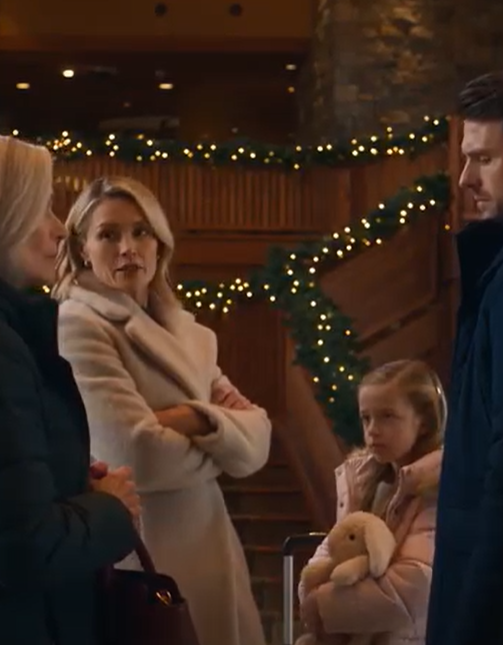
Lily remained in the hallway with her stuffed rabbit.
I stood.
“Come in, sweetheart.”
My granddaughter hurried toward me.
Madison barely noticed.
She was examining an antique grandfather clock beside the fireplace.
“This place must be worth a fortune.”
“It has value,” I answered.
“Financial value?”
“Other kinds too.”
She turned toward me impatiently.
“Elaine, don’t be difficult.”
I watched her for a moment.
“You told me to find a motel less than an hour ago.”
Madison’s expression tightened.
“That was before I knew there had been a misunderstanding.”
“What misunderstanding?”
She hesitated.
“Well, obviously, we didn’t realize you had a connection to this place.”
Daniel shifted beside the doorway.
I looked directly at him.
“You didn’t know either?”
He shook his head.
“No, Mom.”
And for the first time that evening, I believed him.
That realization didn’t make his behavior less painful.
It made it worse.
My son had been willing to abandon me when he believed I had nothing to offer.
I turned toward the fireplace.
“My father opened the original Silver Pines in 1964.”
Madison’s posture changed immediately.
“He owned this entire property?”
“Originally, it was fourteen rooms, a dining hall, and a kitchen that flooded every spring.”
I smiled faintly at the memory.
“My mother baked bread before sunrise, and my father repaired broken pipes after midnight.”
Daniel stepped farther into the room.
“You never told me that.”
“Yes, I did.”
He frowned.
“When?”
“When you were little.”
I looked at the framed photograph above the mantel.
“You used to sit on your grandfather’s shoulders while he inspected the Christmas decorations.”
Daniel stared at the photograph.
In it, a younger version of him stood beside my father, holding a crooked paper star.
He had forgotten the photograph.
He had forgotten the stories.
Somewhere along the way, he had begun to forget the people as well.
Madison approached the mantel.
“So your family still owns the resort?”
I folded my hands.
“The ownership structure is complicated.”
“Meaning?”
“Meaning that my father believed certain things should never belong entirely to one person.”
She laughed quietly.
“That sounds terribly old-fashioned.”
“Perhaps.”
My father had been called old-fashioned many times.
He considered it a compliment.
After the lodge survived a devastating winter storm in 1978, he began putting portions of the business into a trust designed to protect the employees.
Over the following decades, my husband Peter and I expanded that arrangement.
The lodge grew into a luxury destination, but its founding charter remained.
No employee could lose a home merely because an investor wanted a higher return.
And no family member could sell the property without complying with the trust’s protective conditions.
I didn’t explain all of that to Madison.
Not yet.
Instead, I asked Daniel whether Lily had eaten dinner.