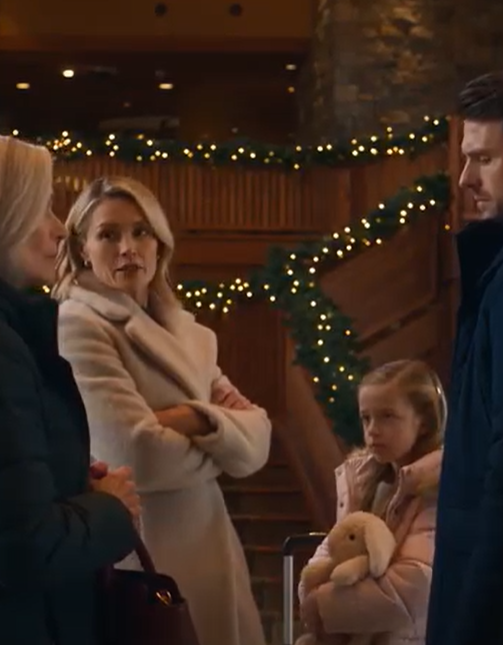
He blinked.
“What?”
“Your daughter.”
“Oh.”
Madison waved dismissively.
“We had snacks on the plane.”
It was nearly nine o’clock.
I pressed the service button beside the fireplace.
A familiar voice answered.
“Mrs. Caldwell?”
“Could someone bring a little supper for my granddaughter?”
“Certainly, ma’am.”
“And please ask the kitchen whether Mrs. Hale is working tonight.”
There was a pause.
“I believe she’s preparing tomorrow’s holiday service.”
May you like
“Wonderful.”
Madison looked annoyed.
“Elaine, we’re trying to have a serious conversation.”
“So am I.”
I glanced at Lily.
“Children need to eat.”
No one answered.
Ten minutes later, a server arrived carrying tomato soup, warm bread, sliced apples, and a small gingerbread cookie.
Lily climbed onto the sofa beside me.
“Grandma, this is the nicest room I’ve ever seen.”
I brushed a strand of blond hair from her forehead.
“Your great-great-grandfather helped build it.”
Her eyes widened.
“Really?”
“Really.”
“Did he make the fireplace?”
“He did.”
“Was he rich?”
I smiled.
“No, sweetheart.”
I looked toward Madison.
“He became successful because he remembered what it felt like to have almost nothing.”
Madison checked her watch.
“Daniel, we should go.”
My son hesitated.
“Mom, can we talk tomorrow?”
I studied him.
“About what?”
He glanced at his wife.
“Everything.”
There was a pleading quality in his voice that reminded me of the boy who used to confess when he had broken something.
But he was no longer a boy.
And whatever he had broken this time was considerably more serious than a kitchen window.
“Tomorrow morning,” I said.
Madison relaxed slightly.
“Good.”
Then she smiled.
“We can discuss how to move forward as a family.”
I said nothing.
They took Lily downstairs to their reserved suite.
But before leaving, my granddaughter ran back and pressed something into my hand.
It was a tiny paper star folded from blue construction paper.
“For your Christmas tree, Grandma.”
I kissed her forehead.
“Thank you, darling.”
After they left, I stood beside the fireplace holding that crooked little star.
Then I called Marcus.
“Bring me everything connected to the inquiry about transferring the lodge.”
His answer was immediate.
“I already have the file.”
Twenty minutes later, he returned with a leather folder and a woman I had known for nearly thirty years.
Clara Nguyen was the trust’s attorney.
She had represented the lodge through expansions, financial crises, employee disputes, and my husband’s death.
Her dark hair was streaked with gray now, and she wore reading glasses on a silver chain.
She embraced me before sitting down.
“Elaine, I wish we were meeting under happier circumstances.”
“So do I.”
Marcus placed the folder on the table.
“The first inquiry arrived seventeen days ago.”
Clara opened the documents.
“A development company called Crown Peak Capital contacted us about acquiring certain rights connected to the resort.”
I frowned.
“Which rights?”
“Potentially all of them.”
She slid a document toward me.
It proposed converting substantial portions of Silver Pines into luxury private residences.
Several employee housing buildings would be demolished.
The old dining hall would become a private members’ club.
And the small winter shelter my father had established beside the service road would be closed permanently.
I felt my stomach tighten.
“How much?”
Marcus answered.
“The proposed transaction is valued at approximately two hundred and forty million dollars.”
The number barely registered.
I was looking at an architectural drawing showing the little chapel beside the pine grove replaced by an underground parking entrance.
That chapel was where I had married Peter.
I touched the paper.
“Who proposed this?”
Clara turned another page.
“Crown Peak was introduced to our office through an advisory company called Meridian Lifestyle Partners.”
I recognized the name immediately.
Madison had mentioned Meridian during Thanksgiving dinner.
She had described it as a private consulting opportunity.
A remarkable chance to work with wealthy investors.
At the time, I had congratulated her.
Now I looked at Clara.
“Madison works for them.”
“Yes.”
Marcus’s jaw tightened.
“Her name appears on the correspondence.”
Clara handed me a second document.
It was labeled CONFIDENTIAL TRUSTEE TRANSITION PROPOSAL.
I read the first paragraph.
Then the second.
By the third, my hands were trembling.
The document claimed I was showing signs of cognitive deterioration.
According to the proposal, my family was becoming increasingly concerned about my judgment, memory, and ability to manage financial matters.
It suggested an independent medical assessment followed by a court-approved transfer of certain responsibilities if incapacity were established.
And it identified one possible family successor.
Daniel Caldwell.
My only son.
I read his name three times.
“Has any of this been filed with a court?”
“No,” Clara said firmly.
“This is only a proposal, and nothing here gives anyone authority over you.”
She leaned forward.
“But its existence concerns me.”
“Why?”
Marcus exchanged a glance with her.