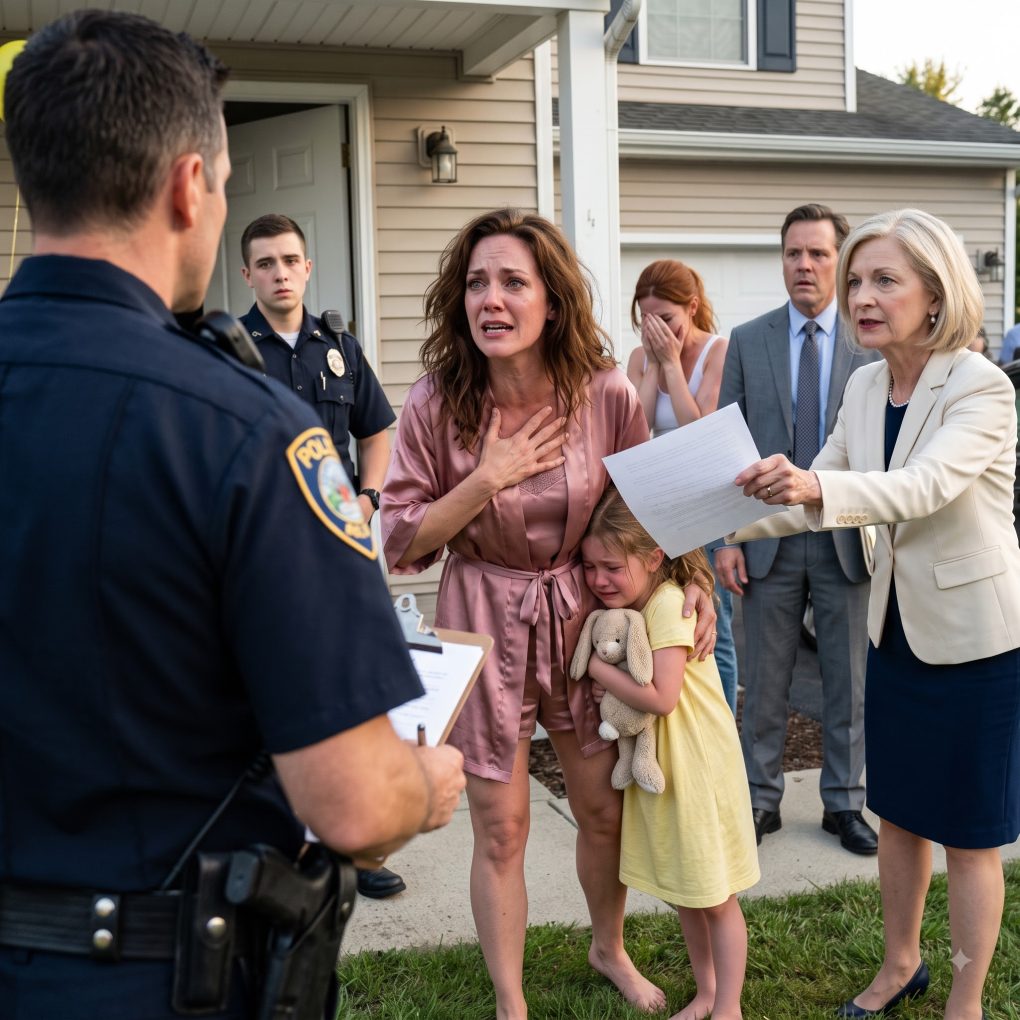
Mom spoke at last, shrill. “That’s a lie! Frank signed this house over to me!”
“Then why did the county recorder’s fraud alert go off on my phone last Tuesday?” Ruth asked. “I’m the registered contact for this address. Someone recorded a quitclaim deed using a dead man’s signature, and I’ve spent six days confirming what I already suspected.”
I finally found my voice. “Ruth, why didn’t anyone tell me about the will?”
“I sent three certified letters after the funeral,” she said gently. “Your mother signed for every one. She told me you were too grief-stricken to deal with paperwork and that she’d handle it.” Ruth’s jaw tightened. “She handled it, all right.”
She opened the box and pulled out a thick stack of bank statements. “Linda also claimed Claire stole from Frank. Let’s look at who actually did. Between his death and last month, two hundred twelve thousand dollars left his accounts through a joint account. Every withdrawal traces back to your mother, Officer. Most went to a boutique that closed last year and to credit cards in Jessica’s name.”
Jessica made a small, broken sound. “She told me it was Dad’s life insurance.”
Whitlock cleared his throat. “Officer, I paid Mrs. Bennett a forty-thousand-dollar deposit on this house. She told me her daughter was a tenant who’d already agreed to leave.”
Officer Daniels lowered his clipboard. His voice changed completely. “Linda Bennett, recording a forged deed is a felony. So is taking a deposit on property you don’t own. I need you to step away from your daughter and put the paper down.”
My mother didn’t scream. That’s what I remember most. She just looked at me, small and gray in the morning light, and said, “After everything I did for you.”
I thought about Maddie at the window in her yellow dress. “You told everyone I was having a breakdown,” I said. “You made sure nobody came to my daughter’s birthday so no one would question you when you threw us out. That’s what you did for me.”
She had no answer. Officer Daniels radioed for a detective, and by nine that morning, my mother was sitting in the back of a patrol car, not smiling anymore.
The weeks that followed were ugly, but they were honest. The county prosecutor charged my mother with forgery, fraud, and theft by deception. Her attorney negotiated a plea: eighteen months in county jail, five years of probation, full restitution, and a permanent no-contact order.
Aunt Carol was the first relative to call. She’d sent my mother $5,200 for the fake Sweet 15, and she cried on the phone for twenty minutes. “Claire, Linda told us you were having a breakdown and begged for space. We thought we were helping.” Eleven families had been told the same story.
Brooklyn, my fourteen-year-old niece, was the one who really got to me. Her mother, Jessica, brought her to my door two weeks later, and Jessica stayed on the sidewalk, eyes down, while Brooklyn walked up alone. “I’m sorry nobody came,” she said. “I didn’t know. I saw Grandma’s group text and thought you’d decided you hated us. I made Maddie a card. I’ve been carrying it around for three weeks.”
I hugged her, and Maddie came flying out of the house like she’d been waiting her whole life for it.
Jessica took longer. She told the detective everything and started paying back what she could. I told her trust is rebuilt one Sunday at a time, and that if she kept showing up, my door would be open.
Ruth cleared the title in under a month and voided the forged deed. The house with my height penciled on the pantry door belonged to Maddie and me, legally and permanently.
She also handed me an envelope in my father’s handwriting, dated the week before he died.
Claire, if you’re reading this, your mother has probably done something. I hoped I was wrong. I love her, but I know her. The house is yours so you and Maddie always have somewhere nobody can take. And make sure my Maddie always has a full house on her birthday. Love, Dad.
Three Saturdays later, I set out twenty-four chairs again. I wasn’t going to pretend the last party never happened, but I decided it wouldn’t be the last one either.
We needed thirty-one chairs. Mr. Okafor from next door brought his grandkids and a pot of jollof rice. Aunt Carol came with a cake as tall as Maddie. Ruth wore a paper crown. Brooklyn handed Maddie her card and stayed by her side all afternoon. Even Jessica came, standing near the back, until Maddie waved her over.
That night, after the last guest left, Maddie sat on the porch steps in her yellow dress, frosting on her chin, and leaned against my shoulder. “Mommy,” she said, “everybody came this time.”
I kissed the top of her head. “They did, baby. And you were never the problem. Not for one second.”
I still think about that Venmo note. One dollar, one word. It was the first time I stopped begging my mother for a place at her table, and the first time I built my own.
