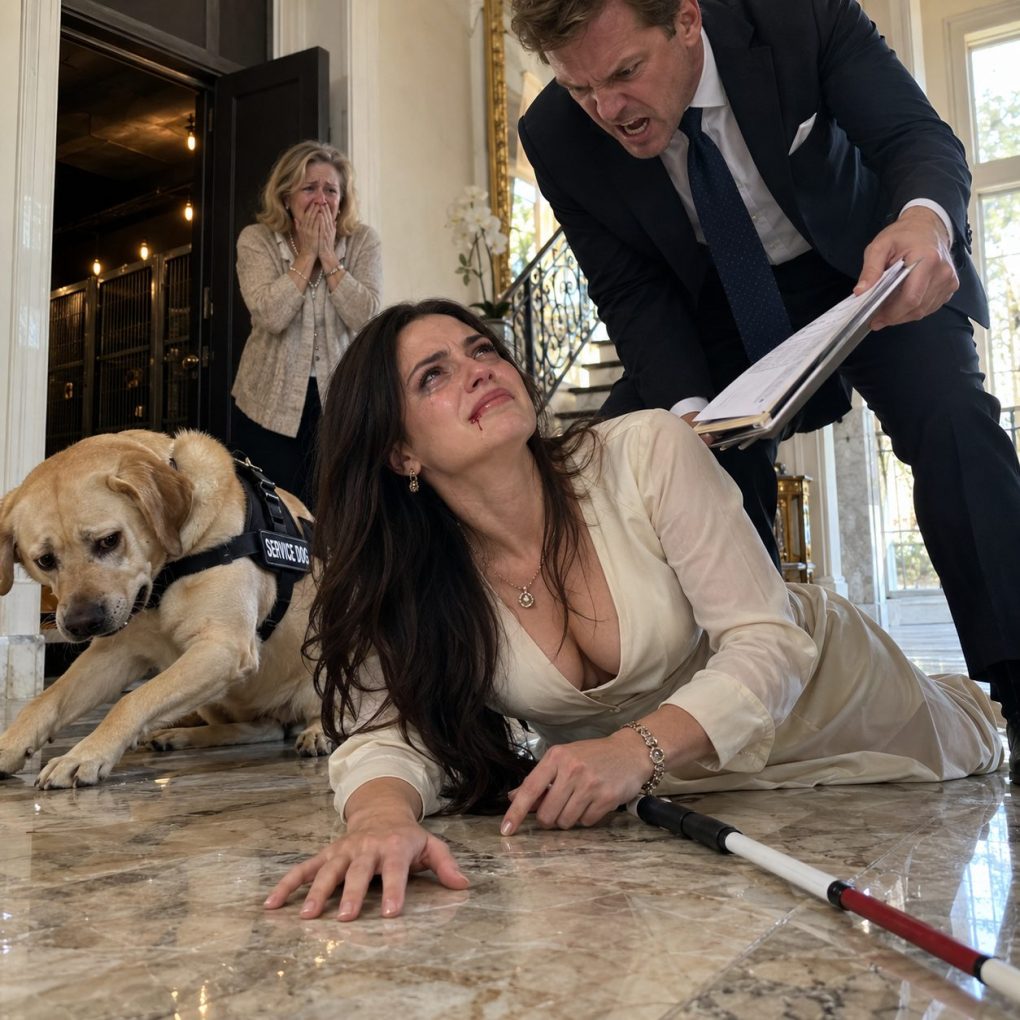
Atlas cried out.
That sound hurt worse than the floor.
“Sign,” Derek said, grinding his shoe onto my wrist. “Or Mom and Dad burn in the basement.”
I smelled gasoline.
He had poured it close enough that I could feel the wet edge beneath my palm.
“They raised you,” he whispered. “You owe them this.”
I was thirty-two, blind, and the owner of a logistics company with nine hundred employees. But on that floor, I was also the girl who had once thanked two strangers for adopting her.
Now those parents were downstairs. Derek had played me a recording of my mother sobbing behind a locked door.
He shoved a pen between my fingers.
“All your shares. The house. Everything.”
“Where’s Atlas?”
“Still breathing. For now.”
I swallowed blood. My phone had shattered when I fell. My cane lay somewhere beyond my reach.
Derek thought that left me with nothing.
“Read the last page,” I said.
He laughed. “You’re negotiating?”
“I can’t sign what I haven’t heard.”
Paper rustled. His shoe lifted just enough.
I moved my thumb beneath my bracelet.
After a threat at one of our warehouses, my security director had insisted on a separate alarm. No phone. No house Wi-Fi. One concealed button.
Derek had mocked the bracelet at Christmas.
“Pretty jewelry for a helpless girl.”
Now I pressed it.
A faint pulse touched my skin.
Signal sent.
“You always thought blindness made me helpless,” I said.
Then, beyond the kitchen, six kennel latches clicked open.
Derek stopped reading.
His breath caught as claws struck the service hallway, one set after another.
“What did you do?”
I held still. Atlas crawled against my side.
From downstairs, my mother screamed my name.
My brother had planned for my broken phone, my missing cane, and my fear. He hadn’t planned for those six doors opening—or for what my mother was about to tell me through the floor.
“Claire! Don’t sign anything!”
My mother’s voice came through the floor vent, thin and ragged. Derek grabbed my bracelet. “Call them off.”
“Get away from me.”
A dog barked behind him. Then another, farther left. He released my wrist.
The six dogs belonged to our licensed security contractor. Their handler, Luis, boarded them in the converted carriage house while his training facility was renovated. I had offered the space months earlier.
Derek knew about the dogs. He didn’t know my emergency alarm opened their kennel doors into a fenced service corridor—and notified Luis, whose apartment stood above the carriage house. The dogs weren’t loose in the neighborhood. They were coming toward the kitchen gate.
“Luis!” I shouted.
“Here, Claire.” His voice reached me through the open service window. “Stay down. Police are coming.”
Derek swore. Something metal clattered onto the floor.
“He has gasoline,” I said. “My parents are in the basement.”
“Don’t move toward him.”
I kept one hand on Atlas’s chest. His breathing was fast, but he pressed his nose into my fingers. Derek took two steps toward the front door. Luis warned him that the driveway camera was recording. The steps stopped.
“This is a family matter,” Derek shouted. “She’s confused!”
“I heard you threaten to burn them,” Luis said.
For the first time, Derek sounded afraid. “You don’t understand. I have debts.”
“Then sell your own things.”
“Dad said you’d never agree.”
My hand went cold against Atlas’s fur. “What did Dad say?”
Derek said nothing. Below us, a pipe knocked three times. Mom had taught me that signal when I was little: three knocks meant listen.
“Claire,” she called. “Your father isn’t tied up.”
A door slammed downstairs. Then she screamed. Luis called to someone on his radio. I caught the words “hostage” and “possible weapon.”
“You said both of them were trapped,” I told Derek.
“Just sign. Please.”
It was the first time he had ever begged me for anything. I heard the basement stairs creak. Slow footsteps rose toward us, steady and familiar. My father’s footsteps.
“Dad?”
“Your mother always talks too much.”
He sounded annoyed. Not terrified. Not like a man who had almost burned alive.
Luis’s voice sharpened. “Put the gun down.”
My father stopped beside the dining room door. “You should have signed, Claire.”
I pulled Atlas closer. Dad gave a small, tired sigh.
“Your brother was never the brains of this family.”
“Where’s Mom?” I asked.
“Safe, if you listen,” my father said. “Tell your guard to leave.” Luis stayed outside the service window, behind the brick wall. I heard him speaking quietly into his radio. The dogs barked in the enclosed corridor, beyond the locked kitchen gate. Their noise had brought him running. Now his voice was the thing keeping me steady. “Police are close, Claire,” he said. Dad snapped, “Then make this quick.” A pen landed beside my hand. He was still trying to finish the transfer. Even with sirens approaching, he thought fear would make me obey.
“Why?” I asked. “I would have helped you.” “With an allowance?” His anger came so fast that I knew I had touched the truth. “We took you in. Your company should have been ours.” I had founded Harbor Route after working dispatch through community college. Dad had lent me eight thousand dollars for the first office deposit. I had repaid it, with interest, eleven years earlier. After that, every holiday came with a reminder of what I owed him. I used to hear love in those reminders. On the floor, beside my injured dog, I finally heard the bill.
Derek spoke near the foyer. “You said nobody would get hurt.” “And you couldn’t even manage that,” Dad answered. “You hit her before she signed.” “You told me to scare her!” Their voices overlapped. Luis told them to keep their hands visible. Dad ordered him to shut up. I slid my fingers across the marble until I found the pen. Then I pushed it away. “I’m not signing.” For a moment, nobody spoke. I heard my father inhale through his nose, the same sound he made before punishing us as children. Then my mother called from below, “Claire, the police are at the back door.”
