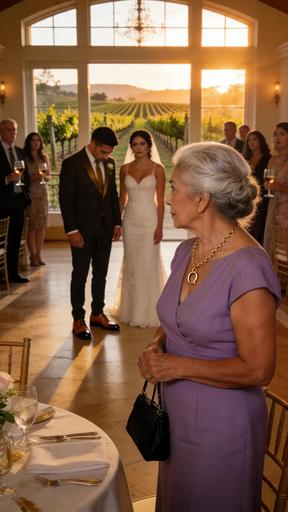
“I need you to bring the letter I gave you this morning.
There was a silence.
“Are you sure you want to do it now?”
I ran my thumb over the seal on the envelope I had in my bag.
“Completely sure.
“Understood. I’m going there.
I hung up.
For several seconds, I stared at Harold’s ring.
My husband had died four years earlier. For forty-two years we had built a life together, saving even when others spent, giving up expensive vacations, and repairing things instead of replacing them.
Harold always said that money didn’t show how much you loved someone.
But he also said that you should never allow someone to confuse your generosity with an obligation.
I had forgotten both.
The first time Amanda called me, her voice had been sweet as honey.
“Judith, Jacob has told me so many nice things about you. I would love for you to be involved in all the preparations.
I had been so excited that I spent an hour looking for the perfect dress before answering her.
Then came the folder.
Contracts, budgets, flower proposals, photographs of decorated tables and an advance bill for forty-eight thousand dollars.
Jacob had called me that very night.
“Mom, I know it’s a lot of money, but Amanda has always dreamed of getting married in Hollow Creek. It’s a beautiful place.
“And you can afford it?”
There was a pause.
“We’re doing the math.
I knew what that meant. Jacob was still paying for part of his studies and his job did not allow him to save much. He didn’t want her to start her marriage in debt.
“I can help,” I said.
“Really?”
I had heard joy in his voice. A joy I hadn’t heard for months.
“Of course, son.
That night I slept thinking that I had done something good.
I didn’t know that I had just opened a door through which all kinds of contempt would enter.
First it was the dress.
Amanda sent me a style guide with photographs of lavender, silver and white fabrics. It forbade antique brooches, turtlenecks, and any accessories that might seem too traditional.
I asked him if there was anything wrong with the photographs I had sent him.
“No, Judith. I just want everything to look modern and stylish.
I got the message.
I bought the dress she had approved.
Then came the plan of the tables.
His family was sitting near the bride and groom. His parents, grandparents, sister and several friends occupied the central places.
My name appeared on table nine, behind a column, next to the kitchen doors.
I wrote to Amanda to ask if this was a mistake.
His answer came five minutes later.
“Yes, the plan is already definitive. It works best for photographs. Thank you for being flexible.”
Flexibility.
It was a fancy word to ask a woman to accept any humiliation with a smile.
I wanted to call Jacob.
I didn’t.
I could hear beforehand his sigh and that phrase he had begun to use whenever I expressed a concern.
“Mom, don’t make a problem out of this.”
So I paid for the most expensive wine when Amanda said domestic options would look cheap. I agreed to the additional floral arrangement when she decided that the first roses were not white enough.
I paid for the photographs, the string quartet, and the hotel rooms for relatives who came from other states.
Every time I transferred money, Jacob would send me a short message.
“Thank you, Mom. I thank you very much.”
But he never asked how he was.
He never invited me to dinner without needing something.
And, little by little, I stopped feeling that I was helping my son build a life and I began to feel that I was paying to be allowed to observe it from afar.
That was why, the night before the wedding, I opened Harold’s old account book.
He wasn’t looking for an excuse to punish anyone.
I was looking to remember who I was before I became a wallet with gray hair.
I turned the pages until I found a children’s drawing.
Jacob had done so when he was seven years old. He had drawn me with a crooked cape, a wooden spoon in his hand and a huge smile. Underneath, in Harold’s careful handwriting, was a sentence:
“Save this. Someday he may need to be reminded of that.”
I sat down at the kitchen table and cried for the first time in months.
Then I took a sheet of paper.
I wrote a letter.
I folded it, put it in an envelope, and sealed it.
The next morning I handed it to Mr. Bennett with precise instructions.
