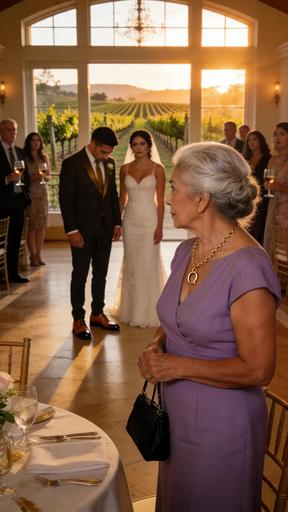
Chapter 3: The Secret Harold Took to the Grave
“Mom, tell me you didn’t know anything about this.
Jacob was looking at Patricia, but his voice seemed to be directed at everyone present.
Amanda’s mother took a half-step back.
For the first time since the reception had begun, she no longer seemed like a woman accustomed to controlling every conversation. Her lips were pursed and one hand clutched the silver purse she carried over her shoulder.
Amanda stood between her and Jacob.
“You don’t have the right to question my mother in front of everyone.
“Then explain to me why you said that envelope shouldn’t exist,” he replied.
“Because your mother is putting on a show!”
I was still holding Harold’s book.
The small envelope remained attached to the inner cover. Its paper had darkened over the years, and one corner was slightly peeled off.
I had no intention of turning that night into a public trial about my husband’s past.
But Patricia had already recognized the envelope.
And his reaction had been too quick to chalk up to simple confusion.
“Mrs. Bennett,” I said, turning to the manager, “could you ask the guests to give us a few minutes?”
He nodded immediately.
“Of course.
Some guests began to get up. Others stared, unable to turn away from a story that seemed to change by the minute.
Amanda turned to the crowd.
“There’s nothing to do with it. The family is resolving a private matter.
A man sitting near the dance floor muttered:
“Five minutes ago she told us to kick her mother-in-law out.
His wife nudged him, but it was too late. Several people had listened.
Amanda turned red.
“This is my wedding!”
“And we’re treating it with respect,” Mr. Bennett replied. But we need to resolve an issue relating to the contracts and documents presented.
Patricia took advantage of the movement of the guests to approach me.
“Judith, please. We can talk about this another time.
I looked at her carefully.
During the preparations, Patricia had been kind to me, albeit in a distant way. He called me my dear, when he needed me to approve an expense, and Mrs. Emerson when the conversation became awkward.
I had always assumed that we were simply women of different generations.
Now I wondered if I had confused education with honesty.
“Did you know my husband?” I asked.
His jaw tightened.
—I met him in some meetings.
“What meetings?”
“I don’t remember the details.
“Then why did you say this envelope shouldn’t exist?”
Patricia looked at Amanda.
Her daughter shook her head slightly.
It was an almost imperceptible movement, but I saw it.
So did Jacob.
“Mom,” he said, “answer the question.
Patricia turned to her daughter.
“Amanda, this is your fault.
The room fell silent again.
Amanda opened her eyes.
“Excuse me?”
“I told you that we should not take any more money from Judith. I told you that we should solve it in another way.
Jacob turned pale.
“What money?”
Patricia put a hand to her forehead.
“I didn’t mean to say it like that.
“What money, Patricia?” I asked.
She took a deep breath.
“Your husband made an agreement with my husband many years ago.
I felt the book become heavier in my hands.
“What kind of agreement?”
“A commercial one.
“Harold never had business partners.
Patricia did not answer.
I knew my husband’s accounts. He knew his investments, his savings and each of the businesses in which he had participated. Harold had worked as an accountant for thirty years and then managed small estates to supplement our income.
He was not a man who hid societies for fun.
And yet, Patricia’s face said that there was a part of her life that I had never known.
Who did you make that agreement with? I insisted.
Patricia looked at the doors of the living room, as if she were calculating the possibility of escape.
“With my husband, Richard.
“When?”
“More than twenty years ago.
Jacob laughed in disbelief.
“That doesn’t make sense. Amanda’s dad has always said that he built his company from scratch.
“And he did!” Patricia exclaimed. No one gave him anything.
“Then why are you so worried about a note my dad left?”
Patricia remained silent.
Amanda began to cry, but her tears didn’t elicit the compassion I would have inspired a few hours earlier.
Not because I believed that a person’s suffering stopped mattering when they made mistakes, but because I still didn’t know if Amanda was crying about what happened or the possibility of losing something.
“Mom, let’s go,” she whispered.
Patricia did not move.
I ran my fingers over the edge of Harold’s envelope.
