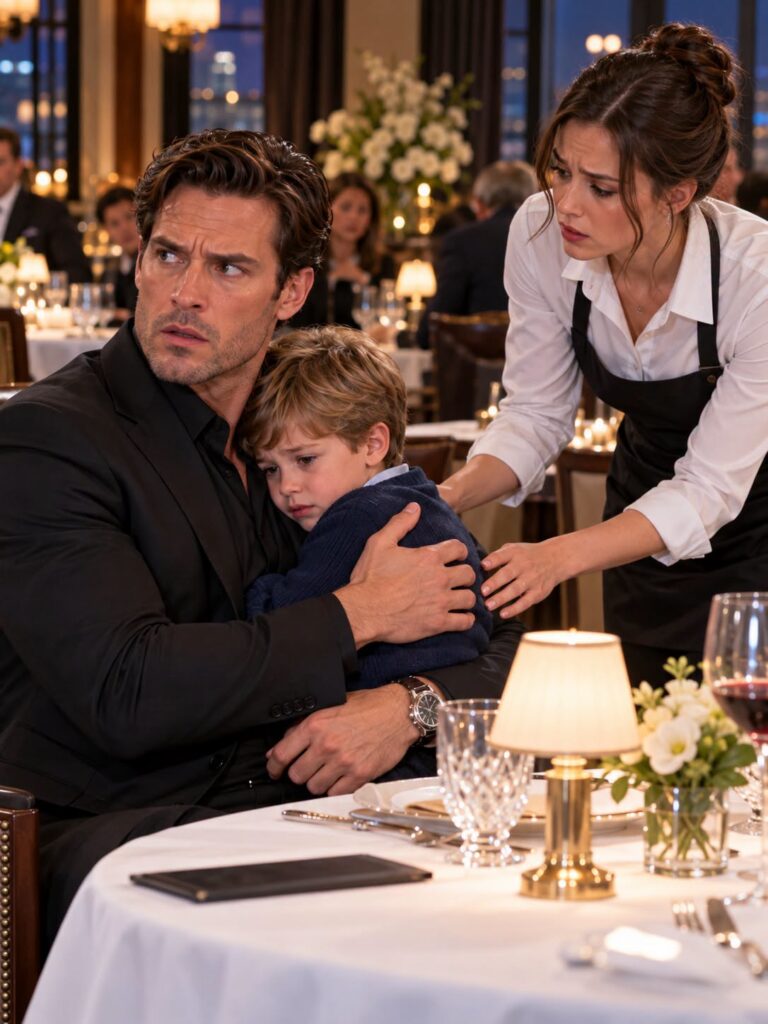
Leo needs a father more than he needs a war.
The more difficult change happened at home.
Leo began speaking again slowly.
Not because Clara possessed magic.
Because Rico finally stopped treating grief like disobedience.
He hired a child therapist.
He learned that screaming could be fear.
That refusing food could be control when everything else felt uncontrollable.
That a toddler could miss his mother without having language for death.
And he learned the hand signal.
At first, Leo would not accept it from him.
Rico tried one night from the bedroom doorway.
Thumb tucked.
Little finger raised.
Leo shook his head.
“Mama.”
“I know.”
Rico lowered his hand.
“I’m not Mama.”
Leo watched him.
“No.”
“No.”
Rico sat on the floor.
“But I can stay.”
They sat in silence for twenty minutes.
The next night, Rico tried again.
Leo stared.
Then returned the signal.
Rico cried after leaving the room.
Only Dante saw.
Neither mentioned it.
Clara kept working at Il Destino.
Not because Rico ordered it.
Because Marco apologized for nearly firing her, doubled her hours when she wanted them, and stopped treating waitstaff as replaceable furniture after Rico made it clear that anyone in the building could report a problem without fear.
Clara refused money from Rico.
He offered once.
She stared at the check.
“For what?”
“Helping Leo.”
“No.”
“For the envelope.”
“That belonged to Elena.”
“For saving my life from becoming worse than it already was.”
Clara almost smiled.
“That sounds expensive.”
“It is.”
“Still no.”
He finally asked what she wanted.
Clara thought.
“Give your kitchen staff health insurance.”
Rico blinked.
“All of them?”
“Yes.”
“You’re terrible at negotiating for yourself.”
“So I’ve been told.”
He did it.
Months passed.
Leo became attached to Clara.
Whenever she worked evenings, he demanded to sit in the corner booth and draw.
One night he handed her a picture.
Three stick figures.
One very small.
One with long hair.
One absurdly tall.
Clara pointed.
“Who’s this?”
“Me.”
“And this?”
“Mama.”
She hesitated.
“And the giant?”
“Daddy.”
Rico, standing behind her, looked offended.
“I am proportionally inaccurate.”
Leo laughed.
A full, bright laugh.
The restaurant stopped for a different reason.
Rico did not tell anyone to continue.
He just listened.
A year after Elena’s death, Rico took Leo to the cemetery.
Clara did not go.
That mattered too.
She was not replacing Elena.
Nobody could.
Rico knelt beside his wife’s grave.
Leo placed a yellow flower on the stone.
Then lifted his hand.
The signal.
Rico returned it.
Leo whispered:
“Mama knows?”
Rico swallowed.
“I think she does.”
“About bad man?”
“Yes.”
“And Clara?”
“Yes.”
Leo nodded.
Then he looked at his father.
“You mad?”
Rico smiled sadly.
“Sometimes.”
“Don’t fight.”
Those two words carried Elena’s voice inside them.
Rico looked toward the headstone.
“I’m trying.”
Years later, people still told the story about the night the entire Il Destino dining room froze while a three-year-old Moretti screamed.
They exaggerated it, naturally.
Some claimed Leo threw an entire table.
Some said Clara slapped Rico.
Marco insisted that version would eventually get someone killed.
The truth was quieter.
A child was overwhelmed.
A room full of powerful adults tried to control him.
One waitress tried to understand him.
That was all.
And then Leo raised one tiny hand.
Thumb tucked.
Little finger extended.
A gesture that had once meant:
I’m here.
That gesture connected Clara to Elena.
Elena to an envelope.
The envelope to a betrayal.
And the betrayal to a lesson Rico would spend years trying to learn.
He had spent his life believing strength meant making people obey.
Elena had died asking him to become something harder.
A man who could stop before anger decided for him.
A father who could stay beside a frightened child without demanding that the child become quiet for everyone else’s comfort.
And a leader capable of hearing bad news from someone whose shoes squeaked on the marble.
Rico never forgot that.
Neither did Clara.
Neither did Leo.
When Leo was seven, he asked Clara why she had walked toward his table that night when everyone else was afraid.
She thought for a moment.
“Because you looked like you needed somebody.”
“Weren’t you scared of Dad?”
She looked toward Rico.
He raised an eyebrow.
Clara smiled.
“Terrified.”
Leo laughed.
“Then why?”
Clara touched the tip of his nose.
“Because being scared and walking forward can happen at the same time.”
Rico carried that sentence longer than he expected.
Maybe courage had never been the absence of fear.
Maybe love wasn’t either.
Sometimes it was simply noticing that someone was drowning while everyone else complained about the noise.
And walking toward them anyway.
The End.
