Simple lies are popular because busy people like easy villains.
Roman had been ready to believe it.
That was the part he could not forgive himself for.
At nine that night, he found Elena in the small sitting room beside the nursery wing. Lucy slept on the couch with her giraffe tucked beneath her chin.
Roman stood in the doorway.
“May I enter?”
Elena looked at him.
That question mattered.
Men in Roman’s position rarely asked permission to enter rooms in houses they owned.
“Yes.”
He came in slowly and remained standing.
“I owe you an apology.”
Elena almost laughed from exhaustion.
“That’s been a popular sentence today.”
“I believed the evidence before questioning who arranged for me to see it.”
“You didn’t know.”
“I should have.”
She looked down at Lucy.
“She heard too much.”
“Yes.”
“I hate that.”
“So do I.”
For a while, only the clock spoke.
Then Roman said, “When I was a child, my father used to sit me in that chair.”
“The time-out chair?”
His eyes moved toward the hallway.
“We did not call it that. He called it thinking time. He was not a gentle man, but once, when I broke a window in anger, he made me sit there until I could name what I had actually wanted to break.”
Elena looked at him carefully.
“And did you?”
“My brother’s violin.”
Despite herself, she smiled.
Roman noticed.
“I became better at hiding anger after that. Not better at understanding it.”
Lucy shifted in her sleep and murmured, “Hands in lap.”
Roman blinked.
Elena covered her mouth.
The laugh came out anyway.
Small at first.
Then helpless.
Roman stared at her as if laughter were a language he remembered but no longer spoke fluently.
Then, impossibly, he laughed too.
Quietly.
Once.
But real.
In the weeks that followed, Daario’s empire folded faster than anyone expected because people who steal from family often assume loyalty will slow the audit. Roman did not slow it. Evan turned everything over to attorneys and investigators in ways that kept the legitimate businesses clean and made Daario’s threats useless.
The garage contractor confessed.
Mr. Voss produced ledgers.
Mrs. Bellini admitted Daario had pressured her to change staff schedules so Elena would appear near the server room at the right times.
Elena kept her job for exactly seventeen days.
Then she resigned.
Roman did not stop her.
He offered a settlement, hazard pay, legal protection, and college funds for Lucy. Elena refused the first number because it was insulting in the opposite direction—too large, too heavy, too much like ownership.
They negotiated.
Roman seemed oddly pleased by that.
Eventually, the money was placed in an independent trust controlled by Elena, with Lucy as beneficiary and no Romano name attached.
Elena took a management position at a hotel downtown.
Better hours.
Health insurance.
No armed men at breakfast.
Mostly.
Roman did not see Lucy for six months.
Then one December morning, a package arrived at the estate.
Inside was a child’s drawing.
Roman in the time-out chair.
Hands in lap.
A yellow sun above his head.
On the back, in Elena’s careful handwriting:
She asked whether you are using your words.
Roman placed the drawing in his private study.
Not hidden.
Framed.
Evan saw it and said nothing for almost ten full seconds, which for Evan was a form of mercy.
A year later, Roman hosted a charity breakfast for staff families from the businesses Daario had used in his fraud. Elena came only because Mrs. Bellini begged, and because Lucy remembered the kitchen cookies.
The breakfast room looked brighter now.
Less like a courtroom.
More like a place where people might actually eat.
Lucy marched in wearing a red dress and silver shoes.
Roman stood when he saw her.
She inspected him seriously.
“No mean face today.”
“Not today,” he said.
“Good.”
Then she looked at the small chair near the fireplace.
“Is that still your chair?”
Evan made a sound behind his napkin.
Roman looked at the chair.
Then at Elena.
Then back at Lucy.
“When necessary.”
Lucy nodded.
“Everybody needs one.”
Roman considered that.
“Yes,” he said. “They do.”
The men who had once feared him for his silence now feared something stranger: a boss who listened before punishing, audited before accusing, and occasionally paused in the middle of anger because somewhere in his house a three-year-old’s voice still seemed to say, Use your words.
Roman Belaluchcci remained dangerous.
No one sensible forgot that.
But after that Wednesday morning, the house changed.
The staff spoke more freely.
Evan laughed more often.
The breakfast room coffee was never again allowed to go cold for twenty minutes while men performed power over untouched toast.
And the little upholstered chair near the fireplace became known, quietly and permanently, as the time-out chair.
Not because Roman ever sat in it again.
Though once, during a very tense budget meeting, he came close.
It became famous because a maid’s toddler had done what no rival, lawyer, cousin, or senior man had ever managed.
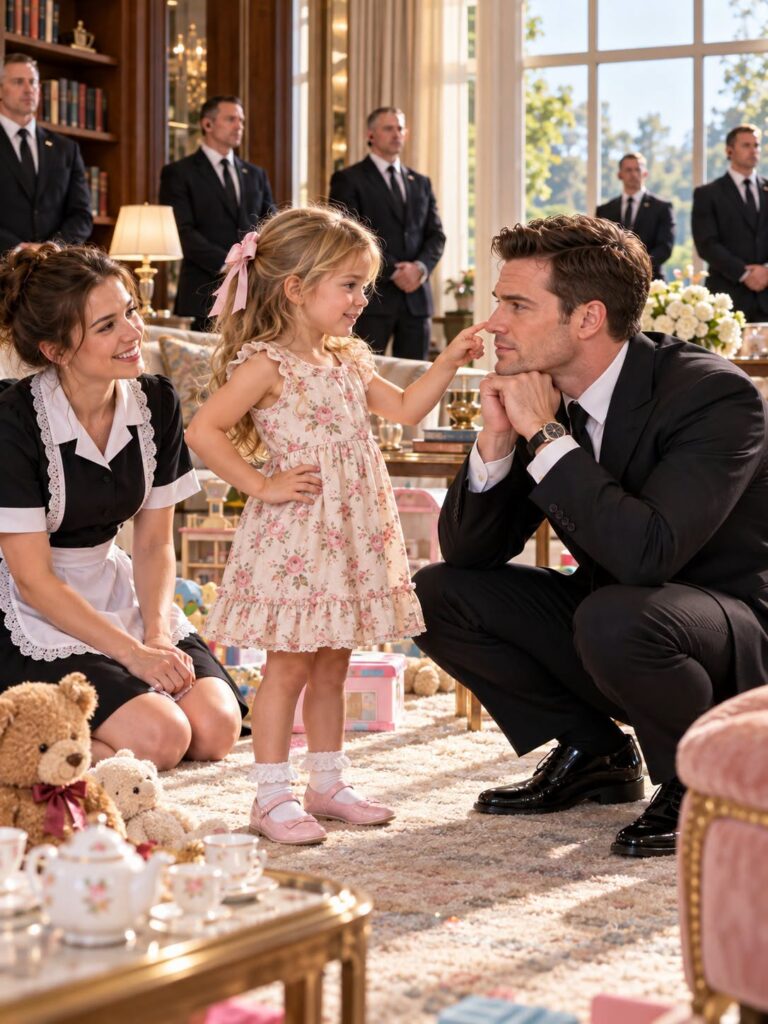
She pointed one sticky finger at the most feared man in the room and told him the truth in words small enough to get past his pride.
You’re making the mean face.
Sit down.
Use your words.
And somehow, in that ridiculous silence before the laughter began, Roman Belaluchcci heard her.
The End.
