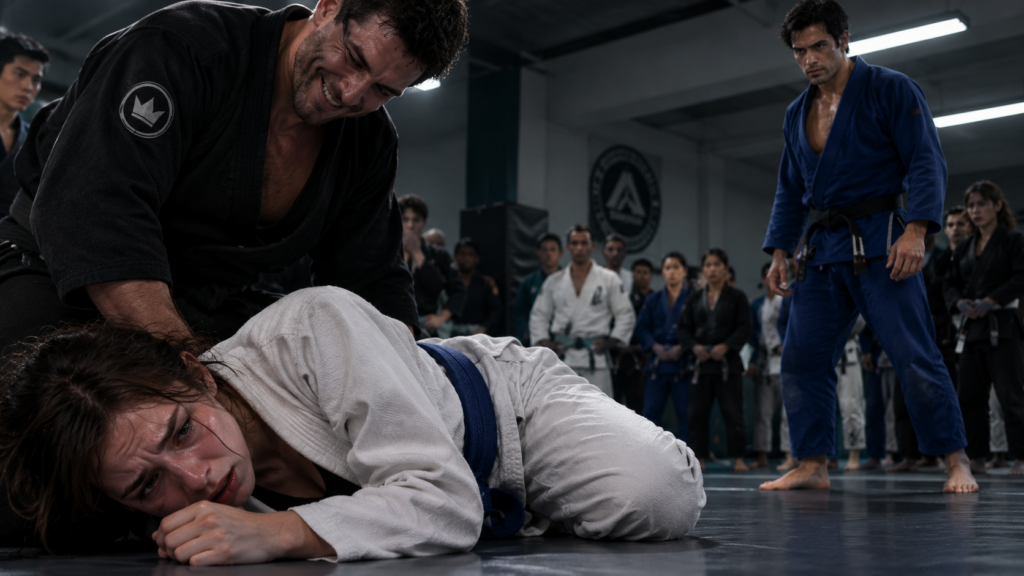
Four Seconds
My older brother drove two hours north from San Diego to help me move, and somehow he arrived at the worst possible moment.
Or maybe the best.
I didn’t see Cole come into the gym.
If I had, maybe the whole night would have gone differently.
At the time, all I could see was the ceiling of Apex Grappling, a row of humming fluorescent lights, and Derek Mason’s face above mine as he slowly crushed the air out of my body.
Derek weighed somewhere around 210 pounds.
I weighed 132 on a good day.
That difference mattered a lot when all 210 pounds of him were parked on my chest.
“Come on, Sarah,” he said, grinning down at me. “You wanted to learn how to deal with pressure, right?”
Around us, twenty people were rolling in pairs while a digital timer counted down the six-minute round.
4:51.
4:50.
4:49.
I tried to make space between us.
Derek took it away.
I turned onto my side. He flattened me.
I tried to frame against his shoulder, and his grin widened as if I had just done exactly what he wanted.
The worst thing about Derek wasn’t that he was stronger than everyone.
It was that he enjoyed proving it.
I’d been training Brazilian jiu-jitsu at Apex for eleven months, long enough to know the difference between a hard round and a dangerous one. Good upper belts could make you feel completely helpless without hurting you. They could pin you, choke you, bend your limbs into positions that made surrender inevitable, then release the instant you tapped.
That was supposed to be the deal.
You trusted your training partner with your body.
They trusted you with theirs.
Derek treated that trust like weakness.
He was a second-degree black belt with cauliflower ears, a thick neck, and the permanent smirk of a guy who had spent years realizing nobody wanted the trouble of confronting him.
He rarely rolled with people his own size.
He liked white belts.
He liked women.
He especially liked smaller men who looked nervous.
Whenever somebody complained, Derek called it “tough love.”
Whenever somebody got hurt, he said they needed to toughen up.
And because he and the owner of Apex had been friends for nearly fifteen years, the complaints never went anywhere.
Most people learned the unofficial rule.
If Derek pointed at you, you rolled with Derek.
That evening, the instructor had barely called, “Six-minute rounds,” before a heavy hand landed on my shoulder.
“Let’s go, Sarah.”
It wasn’t a question.
I remember glancing toward Coach Martin.
He was standing near the timer, talking to another black belt.
I hoped he would intervene.
He didn’t even look at me.
So I swallowed the knot in my stomach and stepped onto the mat.
I wish I could say I did it because I was brave.
The truth was more embarrassing.
I didn’t want everyone to think I was afraid.
That was the whole reason I had started training in the first place.
At twenty-six, I had spent most of my life becoming very good at avoiding things.
Arguments.
Conflict.
Risk.
Attention.
When somebody cut in front of me at the grocery store, I said nothing.
When my boss dumped someone else’s work on my desk, I said, “Sure.”
When a drunk guy followed me for half a block after a concert, yelling things I still didn’t like remembering, I froze so completely that my friend had to grab my hand and drag me into a crowded restaurant.
That incident bothered me for months.
Not because anything happened.
Because something could have happened, and I had discovered that under pressure my body simply stopped listening to me.
Cole was the one who suggested jiu-jitsu.
“Confidence comes after evidence,” he told me. “Give yourself evidence.”
That sounded exactly like my brother.
Short. Practical. No inspirational speech attached.
Cole was six years older than me and had spent most of his adult life in the Navy. For the last decade, he had been part of a world our family understood mostly through absence.
Missed Christmases.
Phone calls from strange numbers.
Messages that said, Won’t have service for a while. Love you.
He wore a Trident on his uniform, but he almost never talked about what came with it.
Our mother told people he worked “in the Navy.”
Cole preferred it that way.
He was the quietest person I knew.
Not shy.
Quiet.
There was a difference.
Shy people sometimes wanted to speak but couldn’t.
Cole simply didn’t waste words.
He had driven up from San Diego that Friday because I was moving out of my Long Beach apartment after accepting a new job in Sacramento. I’d told him I could hire movers.
He said movers cost money.
I told him gas cost money.
He said, “See you Friday.”
That was Cole.
The plan was for him to pick me up after my last evening class at Apex, then we’d spend Saturday packing my apartment and loading a rental truck.
Instead, he arrived ten minutes early.
And walked into the gym just as Derek started dismantling me.
By the time I realized my brother was there, I was already fighting to stay conscious.
Derek trapped my arm.
Then his forearm pressed across my throat.
Pressure exploded through my neck.
I tapped.
Once.
Twice.
Three times.
Hard.
Nothing happened.
I tapped his shoulder.
Still nothing.
For half a second, I thought maybe he hadn’t felt it.
Then Derek looked directly at me.
And smiled.
That was when I knew.
He felt everything.
Panic hit me so fast it erased every lesson I had learned.
My technique disappeared.
My thoughts disappeared.
There was only pressure and the primitive animal need for air.
I slapped at him again.
Tap.
Tap.
Tap.
My lungs burned.
A roaring sound filled my ears.
The fluorescent lights above Derek’s shoulder began to blur.
Somewhere far away, I heard somebody say his name.
“Derek.”
Not loudly.
Nobody moved.
He pulled tighter.
