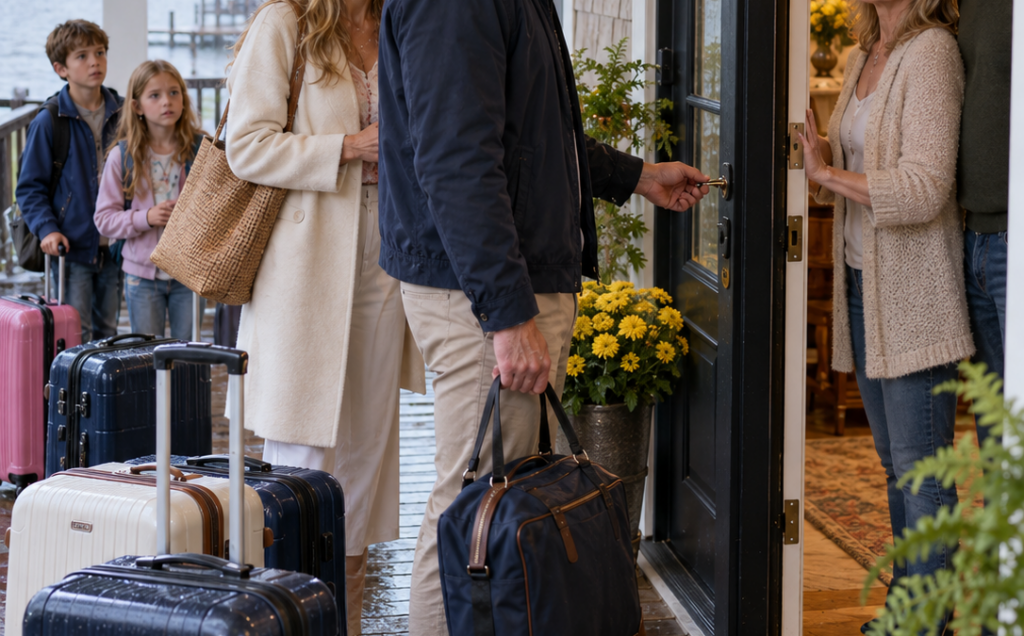
They had lost something too.
I called Mrs. Henderson.
“They’ve gone.”
“I’m sorry they came to your door.”
“No damage.”
Her voice softened.
“Your son looked shocked.”
“He was.”
Pause.
“We’ll take good care of the house.”
That nearly broke me.
“Thank you.”
After we hung up, I cried.
Not because I regretted selling.
Because I loved the house.
I cried for George repainting the porch in ancient shorts.
For the children’s height marks.
For the winter after he died when I left his coat hanging until spring because removing it made death feel too official.
And because during my final years there, I had slowly stopped walking through my own home as though I owned it.
Patrick and Megan’s future plans had begun occupying the rooms before they did.
At noon, my realtor called.
“Patrick contacted me.”
“I assumed he might.”
“He asked whether the sale was a mistake.”
“It wasn’t.”
“I told him that.”
Afterward, I unmuted my phone.
Forty-seven messages.
Patrick began angry.
Then confused.
Then pleading.
One message read:
Where are we supposed to live?
I stared.
Patrick and Megan owned their own house.
Twenty minutes from the lake.
They had owned it for twelve years.
I typed:
Go home.
Then another message appeared.
The kids thought we were staying at the lake this weekend.
I deleted my reply.
Ben and Lily mattered.
So I wrote:
Your belongings are safe. I’ll send the storage information again. Please tell Ben and Lily I love them. I’ll explain my part when you’re ready for them to call.
No answer.
That evening, Ruth arrived carrying groceries.
She looked around my apartment.
“One bedroom.”
“Yes.”
“Balcony.”
“Yes.”
“No staircase.”
“No staircase.”
She smiled.
“You picked well.”
“It smells like fresh paint.”
“Fresh beginnings usually do.”
We made sandwiches.
She watched me eat half.
“You’re allowed to miss the house.”
“I know.”
“And still be angry.”
“I know.”
“Those things can exist at the same time.”
That became one of the most important lessons of the entire mess.
Boundaries did not require me to stop loving people.
Leaving a place did not require me to stop loving what happened there.
I could grieve George’s house.
And still be relieved it was no longer being treated as Patrick’s inheritance while I was alive.
Both were true.
Part 4: Megan finally admitted they had been planning their life in my house without ever asking me.
Megan called that evening.
My first question was about the children.
“They’re confused.”
Then:
“Ben cried when somebody else opened the door.”
That hurt.
“I’m sorry he saw it that way.”
“You should be.”
Ruth looked up from across the kitchen.
I walked onto the balcony.
Cold air.
Wet pavement below.
“I’ll talk to them.”
“You can talk to us first.”
“All right.”
Megan did not hesitate.
“How could you sell it without discussing it with Patrick?”
“I owned it.”
“That isn’t what I asked.”
“It’s the answer.”
Sharp breath.
“Patrick grew up there.”
“And I lived there.”
“We had plans.”
I went still.
“I know.”
“What?”
“I found the folder.”
Silence.
“What folder?”
“Your renovation plans.”
“It was just ideas.”
“You had contractor estimates.”
“People get estimates.”
“On properties they own.”
The silence changed.
Finally:
“Patrick told me it would be ours.”
“When?”
“Eventually.”
“Did he tell you I agreed?”
No answer.
“Did you ask me?”
“No.”
A car horn sounded below.
I watched red taillights disappear at the intersection.
“When I die, Megan, you may grieve me.”
My voice shook despite myself.
“You may remember the lake.”
“But I was still living in that house.”
She whispered:
“You think I wanted you dead?”
“I don’t know what you wanted.”
“That’s cruel.”
I closed my eyes.
“I know what cruel feels like.”
She hung up.
I stood on the balcony until Ruth opened the door.
“You’re freezing.”
“I thought saying it would make me feel better.”
“Maybe tomorrow.”
It didn’t.
The next morning, I checked the storage unit.
Every box remained sealed.
Patrick’s trophies.
George’s mother’s quilt.
Fishing rods Ben loved even though he had never caught anything substantial.
I had photographed everything.
Inventoried it.
Protected their belongings more carefully than Patrick had protected my feelings.
The remodeling folder sat in an envelope.
I felt no satisfaction.
Just fatigue.
Monday, Patrick asked to meet.
We chose a café halfway between us.
He came alone.
Unshaven.
Red eyes.
For years, he ordered expensive food without checking prices.
That morning, just coffee.
He held the cup between his hands.
“Did you need the money?”
“No.”
“Then why sell?”
“I wanted to leave.”
He frowned.
“You never said that.”
“I did.”
“When?”
“The stairs were difficult.”
“You complained about the stairs.”
“Yes.”
“The upkeep was becoming too much.”
“You complained about the upkeep.”
“Yes.”
He stared.
“I thought you were complaining.”
“I was telling you about my life.”
That stopped him.
For years, I had described reality.
Patrick heard inconvenience.
Maybe because admitting my age, loneliness, and physical limitations would require him to see me as a person instead of a stable piece of family infrastructure.
“I also needed you to understand that the house was mine to sell.”
He rubbed his forehead.
“I know it was legally yours.”
“Then why tell Megan it would be yours?”
“Dad always said he wanted it kept in the family.”
“George said he wanted us close.”
“That’s not the same thing.”
Patrick looked at me.
“He loved that place.”
“Yes.”
“You knew I loved it.”
“Yes.”
“That should have mattered.”
“It did.”
I let that sit.
“For years.”
The Hendersons had offered before.
I turned them down because Patrick wanted the house kept.
“I didn’t know you were serious about selling.”
“I was serious about staying then.”
He frowned.
“I changed my mind.”
“Because of the cruise.”
“The cruise made me look at what was already happening.”
He stared into his untouched coffee.
Then said:
“I shouldn’t have texted you like that.”
“No.”
“Megan wanted the trip with her parents.”
