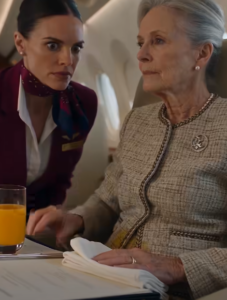
Para cuando la jefa de cabina se inclinó sobre mi asiento de primera clase con aquel vaso de plástico, yo ya sabía que había confundido mi silencio con debilidad.
Lo que ella no sabía era que la carpeta mojada que tenía en el regazo no era una pila de papeles de vacaciones, y que el pequeño estuche de cuero a mis pies no era un bolso.
Había pedido agua.
Eso fue todo.
La cabina aún estaba medio iluminada, esa extraña luz azul de la mañana se filtraba por las ventanas ovaladas mientras todos se acomodaban en la suave impaciencia previa al despegue.
Estaba en el asiento 3A, con las rodillas juntas, la falda de tweed bien estirada, mi carpeta federal abierta sobre la mesita plegable mientras revisaba la última página de un informe que había llevado conmigo a través de tres aeropuertos y una noche sin dormir.
Victoria bajó por el pasillo como si fuera la dueña del avión.
Su bufanda estaba anudada a la perfección.
Su sonrisa nunca llegaba a sus ojos.
“El servicio completo de bebidas comienza una vez que alcanzamos la altitud deseada”, dijo, colocando un zumo de naranja delante de mí.
—Pedí agua, cariño —respondí.
No alcé la voz.
A los sesenta y tres años, aprendí que el volumen rara vez hace poderosa a una persona.
Solo le indicaba a la sala que tenías miedo de ser ignorado.
Un hombre sentado al otro lado del pasillo dejó escapar un pequeño suspiro de fastidio.
Una mujer que estaba detrás de mí susurró algo sobre retrasos.
Victoria los oyó, y observé cómo su expresión se agudizaba al sentir el placer de tener público.
Luego inclinó la taza.
No resbaló.
Inclinado.
El zumo de naranja se derramó en una lámina brillante y pegajosa sobre mi regazo, sobre mi chaqueta, sobre el lomo de mi carpeta y sobre la carcasa negra del aparato electrónico que estaba junto a mis zapatos.
El aroma cítrico se elevó de inmediato, dulce y humillante, impregnando la lana y el papel.
Algunos pasajeros se quedaron sin aliento.
Alguien murmuró: “¡Oh, Dios mío!”.
Victoria se llevó la mano al pecho en una actuación tan impecable que casi merecía aplausos.
—Oh, lo siento mucho —dijo en voz alta.
“Debes haberlo golpeado.”
Miré hacia abajo y vi la mancha naranja que se extendía por el sello en relieve de la página superior.
Ese sello había sobrevivido a un retraso por una tormenta en Atlanta, a una conexión cancelada en Chicago y a un recuerdo que no me gustaba tocar.
Mi esposo, Paul, una vez se paró en nuestra cocina y me dijo que no dejara que las personas poderosas me enseñaran a disculparme por ocupar espacio.
Victoria dejó caer un fajo de servilletas en mi regazo.
No entregado.
Abandonó.
Entonces se inclinó lo suficiente como para que solo yo pudiera oírla.
Deberías haber tenido más cuidado.
La cabina quedó en silencio, de esa manera tan desagradable en que la gente se queda callada cuando se siente aliviada de que la crueldad esté dirigida a otra persona.
Detrás de mí, el hielo tintineaba en un vaso de plástico.
The younger attendant at the galley curtain stilled, her fingers white around a stack of safety cards, eyes darting away when mine found hers.
I folded one napkin once.
Then twice.
My fingers were steady, though the juice had begun to seep cold against my skin.
The leather of the credential case by my shoe had darkened to a sticky shine.
“I need to speak with your captain,” I said.
Victoria blinked, then smiled again, smaller this time.
“You can file your complaint after we land.”
“I need to speak with your captain now.”
She straightened, smoothing her perfect scarf.
“Ma’am, we are preparing for departure.”
“I suggest you clean yourself up and stop escalating.”
There it was.
The word people use when they have already chosen not to listen.
I pressed the call button once.
Its little amber light glowed above me, calm and exact.
Victoria stared at it as if I had slapped her.
“Turn that off,” she said.
“No.”
Several heads turned.
The man across the aisle shifted, uneasy now, his phone half-raised and then lowered again as if he didn’t want to be caught caring.
Orange seeped into the spine of the report, creeping toward the signature line.
Victoria took one step closer, voice tightening.
“I said you can speak to someone after we land.”
I reached slowly into the soaked folds of my binder, careful not to tear the page stuck to my sleeve.
Her eyes followed my hand.
So did everyone else’s.
My fingers closed around the small leather credential case that had fallen half-open beneath the orange-stained report.
I lifted it just enough for the gold badge inside to catch the cabin light.
Victoria’s smile disappeared.
From the front of the plane, the cockpit door clicked open.
PART 2
The man stepping from the cockpit was Captain Daniel Reeves, and the moment he saw my credential case, every muscle in his face changed.
He did not look frightened.
He looked alert.
There is a difference, especially among professionals who understand exactly what a federal badge can mean aboard an aircraft.
Victoria turned toward him so quickly that her polished expression barely had time to reorganize itself.
“Captain, we have a disruptive passenger,” she said.
I almost admired the speed of the lie.
Captain Reeves looked from Victoria to my soaked jacket, then to the orange-stained federal seal across my binder.
“What happened here?” he asked.
Victoria answered before I could open my mouth.
“She became upset about beverage service and started demanding access to the cockpit.”
“I demanded to speak with the captain,” I said.
“That is not the same thing.”
Captain Reeves met my eyes.
“May I see your credentials, ma’am?”
I held the leather case out carefully.
He took it without ceremony.
His gaze moved across my photograph, name, division, and authorization markings.
Then he handed it back with both hands.
