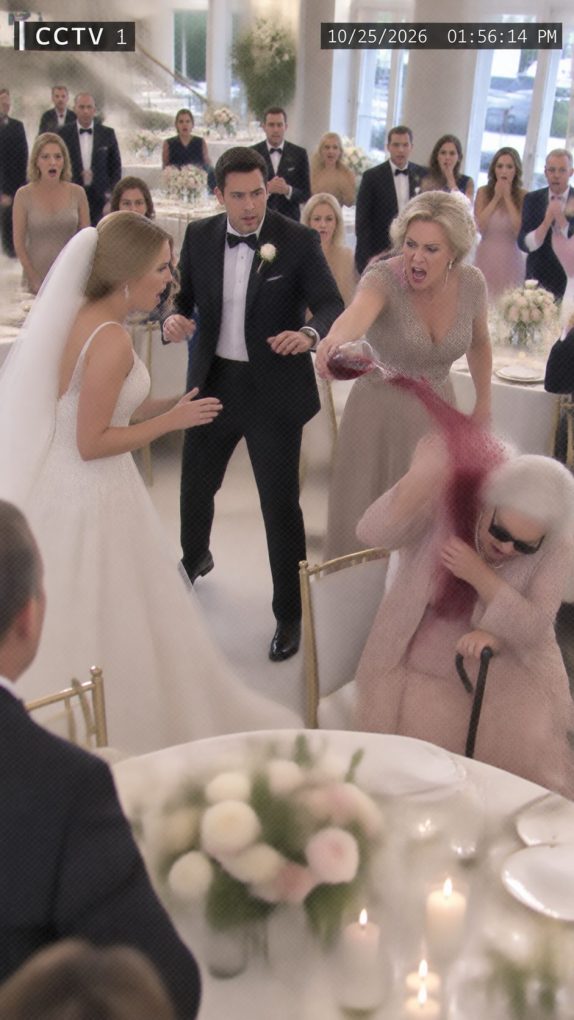
El vino tinto manchó el vestido blanco de mi madre antes de que nadie comprendiera lo que Caroline Whitmore había hecho.
Mamá estaba de pie junto a la mesa de la fiesta de compromiso, con una mano apoyada suavemente en mi brazo y su bastón blanco plegado bajo la silla detrás de ella. Había perdido la mayor parte de la vista cinco años antes, después de que una enfermedad de la retina progresara más rápido de lo que los médicos esperaban. Odiaba la lástima, rechazaba la ayuda a menos que la necesitara y había pasado toda la noche sonriendo cortésmente mientras mi futura suegra hacía comentarios sobre “limitaciones”, “apariencias” y si mis padres se sentirían cómodos en una boda a la que asistirían “personas importantes”.
Entonces, mamá, sin querer, cogió el agua de Caroline en lugar de la suya.
Caroline le arrebató el vaso.
“Una familia como la suya nos avergonzaría”, dijo.
Mamá se quedó quieta.
Pensé que eso era lo peor.
Entonces Caroline cogió su copa de vino y se la arrojó al pecho de mamá.
Veintitrés invitados guardaron silencio.
Miré a Nathan, el hombre con el que se suponía que me casaría en seis semanas.
Durante tres años, le había prometido que, con el tiempo, dejaría de permitir que su madre decidiera todo: dónde pasaríamos las vacaciones, en qué barrio viviríamos, qué tipo de boda tendríamos, incluso si el bastón de mamá debía aparecer en las fotografías.
Este era el momento.
Seguramente.
—Nathan —dije.
Miró a su madre.
Luego me miró.
Y suspiró.
“Claire, por favor, no le des más importancia de la que tiene.”
Lo miré fijamente.
“Tu madre acaba de tirar vino a la mía.”
“Mamá estaba frustrada.”
Caroline cruzó los brazos.
Nathan bajó la voz.
“Simplemente discúlpate por haber reaccionado de forma exagerada y podremos dar por terminada la velada.”
Algo dentro de mí se calmó por completo.
Me quité el anillo de compromiso.
Lo colocó junto a su copa de champán.
Y dijo: “No habrá boda”.
Nathan se rió de verdad.
“¿Estás terminando tres años con una copa de vino?”
“No.”
Miré el vestido manchado de mi madre.
“Lo termino porque finalmente entiendo en quién te conviertes cuando elegirme te cuesta algo.”
Mi padre había presenciado todo el intercambio desde el otro extremo de la habitación.
Thomas Bennett tenía sesenta y siete años, hablaba en voz baja y solía vestir como un hombre que regresaba de una ferretería. La familia de Nathan sabía que era dueño de “algunas empresas manufactureras”. Nunca les había interesado lo suficiente como para averiguar más.
Papá acompañó a mamá al baño, la ayudó a encontrar un chal limpio, luego regresó y me hizo una pregunta.
¿Estás seguro?
“Sí.”
Él asintió.
Sin discurso.
Ninguna amenaza.
Simplemente sacó su teléfono.
Antes de medianoche, Nathan me llamó diecisiete veces.
Respondí al dieciocho.
His voice sounded nothing like it had at dinner.
“What did your father do?”
“I don’t know.”
“My parents’ attorney says the financing commitment disappeared.”
Then Nathan’s father grabbed the phone.
“Tell Thomas to reverse it. We close Monday.”
That was when Dad stepped into my apartment carrying Mom’s ruined dress in a garment bag.
He heard the shouting.
And calmly said, “There is nothing to reverse. I never signed.”
Nathan went silent.
Dad looked at me.
Then added, “Their hotel expansion depended on a twelve-million-dollar bridge guarantee from my holding company.”
I stared at him.
“You were financing them?”
“I was going to.”
He placed the garment bag on a chair.
“Because I thought they were going to be your family.”
Then his expression hardened.
“Tonight they made it clear they never intended to treat yours like one.”
The next morning, Dad’s attorney explained exactly what had happened. Whitmore Hospitality was trying to acquire and renovate a historic hotel outside Boston. Their lender required additional support before releasing the final construction financing because costs had increased and two investors had withdrawn. Dad’s holding company had issued a nonbinding term sheet indicating it was willing to consider a limited guarantee.
Nothing had been finalized. No guarantee agreement had been executed, no collateral had been pledged, and no lender had the right to force Dad’s company to proceed. Whitmore Hospitality had simply begun behaving as though the closing was inevitable because weeks of negotiations had gone well.
That confidence explained Nathan’s panic. His father, Richard, had already signed contracts with architects, ordered imported fixtures, and publicly announced the redevelopment timeline. Losing Dad’s support did not automatically bankrupt the company, but it created an immediate financing gap they now had to solve themselves.
Nathan arrived at my apartment before noon. He brought flowers for Mom and an apology that lasted almost seven minutes. Most of it concerned the financing. He said Caroline had been under pressure, the wine was “an emotional mistake,” and my father was punishing hundreds of employees for one family argument.
I asked him whether he believed I should have apologized the night before. He looked away. That was the only answer I needed.
Mom refused the flowers. She was not dramatic about it. She simply said, “I don’t want an apology purchased because the price of insulting me changed overnight.” Nathan’s face reddened. For the first time, I saw how much he depended on people accepting polished words as evidence of character.
Caroline called next. She did not apologize at all. She accused my parents of hiding their wealth to “test” her family. Dad had hidden nothing. Nathan knew he owned Bennett Industrial Holdings; he simply never bothered asking what that meant. The company manufactured commercial refrigeration components and had investments across several regional businesses.
Richard’s response was more practical. He requested a formal meeting with Dad and offered additional fees, stronger indemnities, and a larger equity interest in the hotel project. Dad listened to the proposal and declined. He told Richard the decision was not revenge; his company had discretion not to enter a new risk relationship with people whose judgment he no longer trusted.
