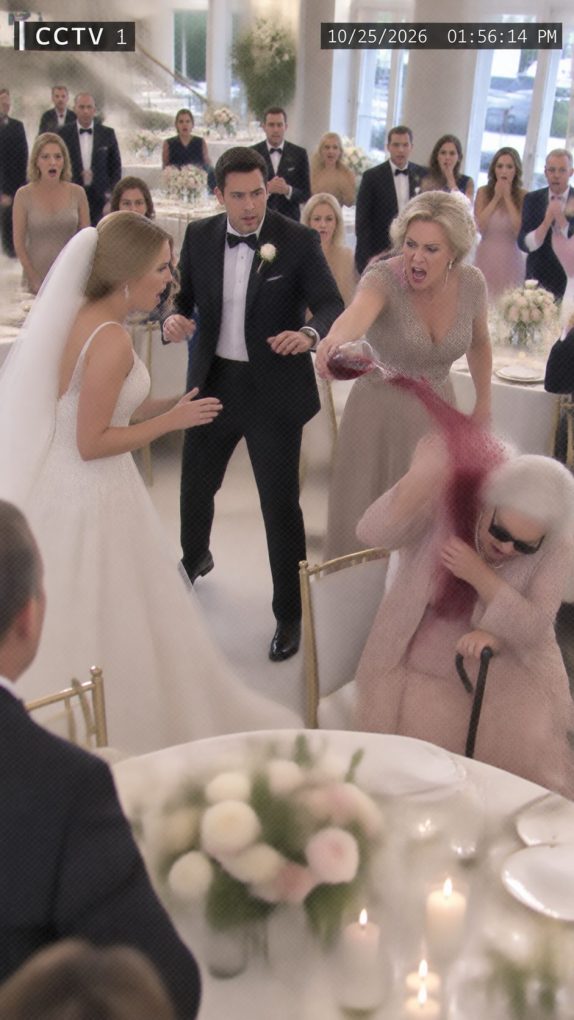
Le vin rouge a taché la robe blanche de ma mère avant que quiconque ne comprenne ce que Caroline Whitmore avait fait.
Maman se tenait près de la table des fiançailles, une main posée délicatement sur mon bras, sa canne blanche repliée sous la chaise derrière elle. Elle avait perdu la majeure partie de sa vue cinq ans plus tôt, suite à une maladie de la rétine qui avait progressé plus vite que prévu. Elle détestait la pitié, refusait toute aide sauf en cas de nécessité, et avait passé toute la soirée à sourire poliment tandis que ma future belle-mère faisait des remarques sur les « limitations », les « apparences » et se demandait si mes parents seraient à l’aise à un mariage en présence de « personnes importantes ».
Puis, par erreur, maman a pris la bouteille d’eau de Caroline au lieu de la sienne.
Caroline arracha le verre des mains de son interlocuteur.
« Une famille comme la vôtre nous fera honte », a-t-elle dit.
Maman resta immobile.
Je pensais que c’était le pire.
Caroline prit alors sa bouteille de vin et la jeta sur la poitrine de sa mère.
Vingt-trois invités se turent.
J’ai regardé Nathan, l’homme que j’étais censée épouser dans six semaines.
Pendant trois ans, il avait promis qu’un jour il cesserait de laisser sa mère décider de tout : où nous passerions les vacances, dans quel quartier nous habiterions, quel genre de mariage nous aurions, et même si la canne de maman devait apparaître sur les photos.
C’était le moment.
Sûrement.
« Nathan », dis-je.
Il regarda sa mère.
Puis à moi.
Et il soupira.
« Claire, s’il te plaît, n’en fais pas toute une histoire. »
Je le fixai du regard.
« Ta mère vient de jeter du vin sur la mienne. »
«Maman était frustrée.»
Caroline croisa les bras.
Nathan baissa la voix.
« Excusez-vous simplement d’avoir surréagi, et nous pourrons terminer la soirée. »
Quelque chose en moi s’est apaisé parfaitement.
J’ai enlevé ma bague de fiançailles.
Il l’a posé à côté de son verre de champagne.
Et il a dit : « Il n’y aura pas de mariage. »
Nathan a vraiment ri.
«Vous mettez fin à trois ans de relation autour d’un verre de vin?»
“Non.”
J’ai regardé la robe tachée de ma mère.
« Je mets fin à notre relation parce que je comprends enfin qui tu deviens quand me choisir te coûte quelque chose. »
Mon père avait observé tout l’échange depuis le fond de la pièce.
Thomas Bennett avait soixante-sept ans, une voix douce, et s’habillait généralement comme un homme qui rentre d’une quincaillerie. La famille de Nathan savait qu’il possédait « quelques entreprises de fabrication », sans jamais chercher à en savoir plus.
Papa a accompagné maman aux toilettes, l’a aidée à trouver un châle propre, puis est revenu et m’a posé une question.
« Êtes-vous certain ? »
“Oui.”
Il hocha la tête.
Pas de discours.
Aucune menace.
Il a simplement sorti son téléphone.
Avant minuit, Nathan m’avait appelé dix-sept fois.
J’ai répondu à la dix-huitième.
His voice sounded nothing like it had at dinner.
“What did your father do?”
“I don’t know.”
“My parents’ attorney says the financing commitment disappeared.”
Then Nathan’s father grabbed the phone.
“Tell Thomas to reverse it. We close Monday.”
That was when Dad stepped into my apartment carrying Mom’s ruined dress in a garment bag.
He heard the shouting.
And calmly said, “There is nothing to reverse. I never signed.”
Nathan went silent.
Dad looked at me.
Then added, “Their hotel expansion depended on a twelve-million-dollar bridge guarantee from my holding company.”
I stared at him.
“You were financing them?”
“I was going to.”
He placed the garment bag on a chair.
“Because I thought they were going to be your family.”
Then his expression hardened.
“Tonight they made it clear they never intended to treat yours like one.”
The next morning, Dad’s attorney explained exactly what had happened. Whitmore Hospitality was trying to acquire and renovate a historic hotel outside Boston. Their lender required additional support before releasing the final construction financing because costs had increased and two investors had withdrawn. Dad’s holding company had issued a nonbinding term sheet indicating it was willing to consider a limited guarantee.
Nothing had been finalized. No guarantee agreement had been executed, no collateral had been pledged, and no lender had the right to force Dad’s company to proceed. Whitmore Hospitality had simply begun behaving as though the closing was inevitable because weeks of negotiations had gone well.
That confidence explained Nathan’s panic. His father, Richard, had already signed contracts with architects, ordered imported fixtures, and publicly announced the redevelopment timeline. Losing Dad’s support did not automatically bankrupt the company, but it created an immediate financing gap they now had to solve themselves.
Nathan arrived at my apartment before noon. He brought flowers for Mom and an apology that lasted almost seven minutes. Most of it concerned the financing. He said Caroline had been under pressure, the wine was “an emotional mistake,” and my father was punishing hundreds of employees for one family argument.
I asked him whether he believed I should have apologized the night before. He looked away. That was the only answer I needed.
Mom refused the flowers. She was not dramatic about it. She simply said, “I don’t want an apology purchased because the price of insulting me changed overnight.” Nathan’s face reddened. For the first time, I saw how much he depended on people accepting polished words as evidence of character.
Caroline called next. She did not apologize at all. She accused my parents of hiding their wealth to “test” her family. Dad had hidden nothing. Nathan knew he owned Bennett Industrial Holdings; he simply never bothered asking what that meant. The company manufactured commercial refrigeration components and had investments across several regional businesses.
