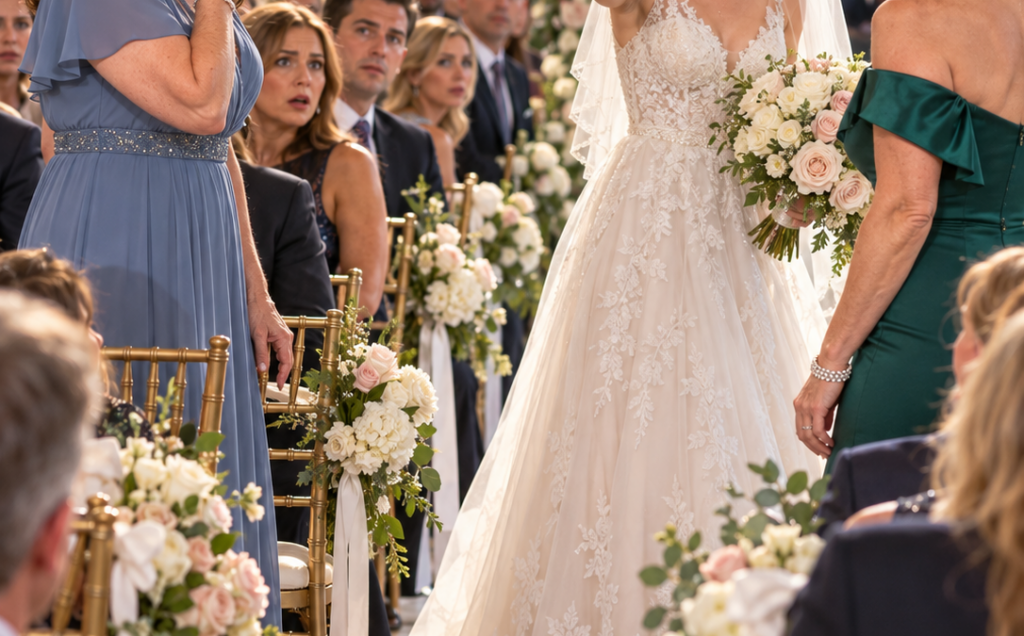
At my stepdaughter’s wedding, her biological mother assigned me the last row with a card labeled “Guest.” Then she leaned close and whispered, “Real mothers sit up front.” I swallowed my tears, determined not to ruin Hannah’s day. But when the bride reached the aisle, she suddenly stopped and stared…
The card on the front pew said MOTHER OF THE BRIDE.
Beneath those gold letters was a name that made my stomach tighten.
Crystal Dunn.
Not mine.
I stood in the quiet church, clutching the little beaded purse I’d spent forty minutes choosing because it matched my dusty-rose dress. Hannah had loved that color since she was eight years old. Back then, she’d called it “sunset pink” and insisted on painting her bedroom walls that shade.
I had painted those walls myself.
Now, twenty years later, I couldn’t even find my name among the reserved seats at her wedding.
I checked the first row. Then the second. Then the third.
Nothing.
Finally, in the very last row, beside the double doors, I found a plain white card.
GUEST.
Just one word.
No Laura. No Stepmother. Not even Family.
I was still staring at it when a familiar perfume drifted over my shoulder.
“Oh, good,” Crystal Dunn said. “You found your seat.”
I turned.
She looked magnificent in a champagne-colored gown, her blond hair swept into an elegant twist. At fifty-one, Crystal had the kind of appearance that made people assume her life had always been effortless.
I knew better.
“Crystal,” I said carefully, “there seems to be a mistake.”
She glanced at the card in my hand.
“No mistake. I approved the seating myself.”
My throat tightened.
“Hannah knows about this?”
Crystal smiled, but there was nothing warm about it.
“Laura, sweetheart, today is Hannah’s wedding. Let’s not make everything about you.”
I had spent twenty years listening to that particular tone. The soft voice, the carefully chosen words, the insult delivered so politely that anyone overhearing would think she was being kind.
“I’m not trying to make anything about me,” I said. “I just thought I’d be sitting with the family.”
“You are sitting with the family. We’re all in the same church.”
Then she leaned closer.
“Real mothers sit up front. I’m sure you understand.”
For a moment, I couldn’t speak.
Behind us, an usher was arranging programs on a table. Sunlight streamed through the stained-glass windows, scattering colored patches across the old wooden floor.
Everything was beautiful.
Everything was exactly the way Hannah had dreamed.
And I suddenly felt like a stranger at the wedding of the little girl I had raised.
Crystal straightened her shoulders.
“Now, if you’ll excuse me, I have photographs to take.”
She started walking away.
“Crystal.”
She stopped.
“I don’t want Hannah upset today.”
“Neither do I,” she replied. “That’s why I suggest you take your seat quietly.”
Then she disappeared through the side door.
I looked down at the card again.
GUEST.
Such a small word.
It shouldn’t have been able to erase twenty years.
But standing there, I felt every one of those years pressing against my chest.
I met Hannah when she was seven.
Her father, Daniel, had been divorced for almost two years when we started dating. He was a quiet man with kind brown eyes, the sort who fixed other people’s broken porch steps without waiting to be asked.
Hannah was different.
She was all sharp elbows, stubborn opinions, and enormous blue eyes that seemed to question everything.
The first time I visited their house, she watched me from the staircase.
“Are you going to marry my dad?” she asked.
Daniel nearly dropped the coffee mugs he was carrying.
“Hannah!”
“What?” she said. “I want to know.”
I crouched so we were at eye level.
“I don’t know yet.”
She studied me.
“Good. Because I already have a mom.”
“I know,” I said. “I’m not here to replace her.”
Hannah considered that answer for a moment.
Then she nodded.
“Okay. Do you like pancakes?”
It wasn’t exactly an invitation into her heart.
But it was a beginning.
Crystal had left Daniel after falling in love with a man she met through her real estate business. The relationship ended six months later, but by then the divorce was final.
For the first few years, Hannah visited her mother every other weekend.
Sometimes Crystal canceled because of work.
Sometimes because she was traveling.
Once, she forgot Hannah’s tenth birthday entirely.
I remember that birthday because Hannah waited beside the telephone until nearly nine o’clock.
Daniel tried to distract her with cake.
I suggested opening presents.
She shook her head.
“Mom said she’d call.”
At nine-fifteen, Hannah quietly went upstairs.
I found her sitting on her bedroom floor with her knees against her chest.
“She probably got busy,” she whispered.
I sat beside her.
“Maybe.”
“Do you think she forgot?”
I wanted to tell her no.
I wanted to give her the comforting lie that adults sometimes offer children because the truth feels too cruel.
Instead, I said, “I don’t know, sweetheart. But I know your birthday matters.”
She leaned against me.
That was the first night she let me hold her while she cried.
A year later, Daniel and I married in a small ceremony at the courthouse.
Hannah wore a lavender dress and carried three white daisies.
Afterward, she announced that she wasn’t calling me Mom.
“That’s completely fine,” I told her.
“But can I still ask you questions?”
“Of course.”
“Even embarrassing ones?”
I laughed.
“Especially those.”
She smiled.
And somehow, without either of us making a grand announcement, we became a family.
I wasn’t there when Hannah was born.
I didn’t hear her first word or watch her take her first steps.
But I was there for everything that came afterward.
I was there when she broke her wrist roller-skating.
When her first boyfriend broke her heart.
When she got her driver’s license and came home shaking because she’d accidentally turned down a one-way street.
