“What else did you send?”
He listened.
Then looked at me.
“She sent them your bank statement.”
My stomach tightened.
Three weeks earlier, Sarah had used my home office.
Her printer was supposedly broken.
I had left a bank statement beside my printer while I went to make coffee.
One small act of trust.
That was all access required.
Through the phone, I heard Sarah say clearly:
“She promised us that money.”
Jason’s answer came immediately.
“No.”
He looked at me while he said it.
“She planned to give us the money.”
His voice shook.
“That is not the same thing.”
I had never heard him make that distinction.
He ended the call and sat on the porch step.
For several minutes, he said nothing.
Then he looked up.
“Can you tell the lender it was a misunderstanding?”
There it was.
The hardest question of the day.
If I softened the truth, perhaps the closing could survive.
If I said there had simply been confusion about timing, maybe the lender would accept replacement documents.
Maybe Jason would still get the house.
Maybe his marriage would not explode.
He looked ten years old and forty at the same time.
I sat beside him.
“If I lie for Sarah now, what does she learn?”
He stared at the gravel.
“That you’ll fix it.”
“And what do you learn?”
His eyes filled.
“That you’ll fix it for me too.”
Wind moved through the pines.
“I don’t know how it got this far.”
“You avoided small fights.”
He looked toward me.
“Because each one felt easier than the argument.”
I paused.
“I did too.”
For the first time in years, we were completely honest with each other.
Later that afternoon, the lender’s fraud specialist called.
I told the truth.
The $60,000 belonged to me.
I had intended to make a gift.
The gift had not been completed.
I withdrew that intention after discovering unauthorized use of my cabin.
I did not sign their gift letter.
I did not authorize anyone to submit my bank statement.
Jason listened.
He did not interrupt.
When the call ended, he stood.
“I’m going home.”
At the doorway, he stopped.
“Mom?”
“Yes?”
“Has Sarah always treated you like this?”
“No.”
Hope appeared on his face.
Then I finished.
“It became worse every time nobody stopped her.”
His eyes closed.
He left.
At 11:18 that night, Sarah sent me one message.
You destroyed our future over a stupid cabin.
I took a screenshot.
Did not reply.
The lender suspended the mortgage file the following morning.
By noon, Jason called.
“She admitted everything.”
“The signature?”
“Yes.”
“The bank statement?”
“Yes.”
His voice shook.
“She said she knew you would eventually give us the money, so it didn’t matter.”
That sentence said everything.
My no was temporary.
My consent was assumed.
My money was already theirs.
Then Jason said:
“I asked whether she had told her parents they could use the cabin whenever it was empty.”
I waited.
“She said yes.”
Silence.
Then:
“I told her to leave.”
The mortgage purchase collapsed within days.
The lender would not proceed after receiving documents it could no longer trust.
The seller would not keep waiting.
Sarah blamed me.
Of course she did.
According to her version, I had snatched away a promised gift because I disliked her family.
Then Larry called.
“I need to tell you something.”
His voice sounded ashamed.
“Brenda knew Sarah did not have your permission.”
I gripped the phone.
“What?”
“Before we went to the cabin, Brenda asked her.”
He hesitated.
“Sarah said, ‘Diane won’t say no once we’re already there.’”
I closed my eyes.
Larry continued.
“Brenda laughed.”
Then he sent screenshots from Brenda’s phone.
Photographs.
My cherry table.
The brass lamps.
The blue blanket chest.
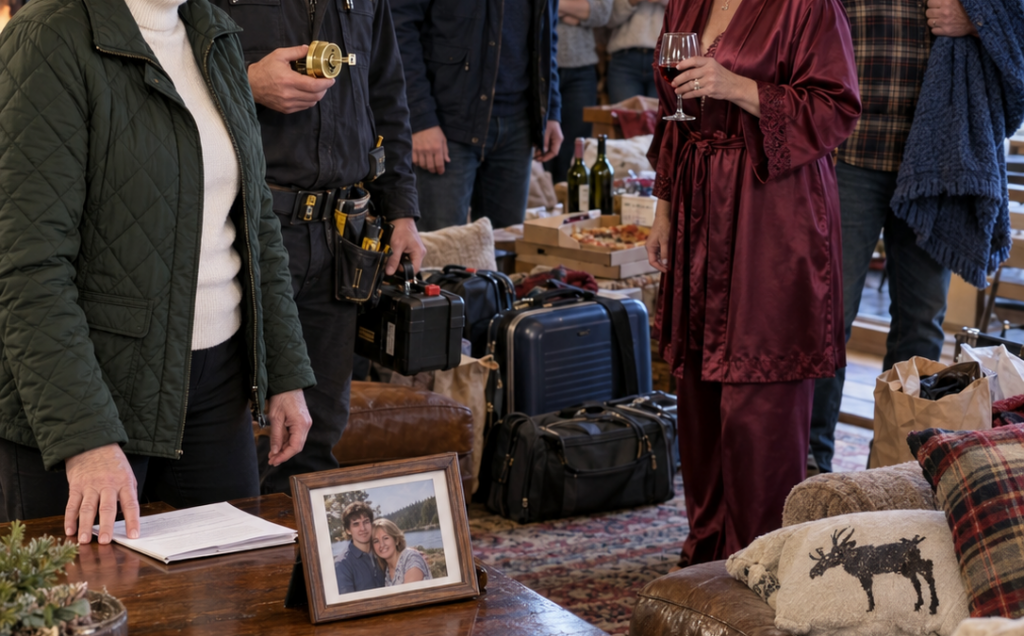
A framed photograph of Jason.
Under each picture were comments.
This would look good in Sarah and Jason’s new house.
Save this one.
Maybe Diane won’t want these later.
They had been inventorying my life.
Not metaphorically.
Literally.
Part 4: Jason finally apologizes for something deeper than failing to stop one weekend at the cabin
Jason came to my townhome that evening.
He placed his phone on my kitchen table.
The screenshots were still open.
“I’m sorry.”
For years, I had imagined him saying those words.
In my imagination, they brought relief.
In reality, they hurt.
“What are you sorry for?”
His forehead tightened.
“All of it.”
“That’s too easy.”
He looked at me.
“Tell me.”
He stared down at his hands.
“I’m sorry I let Sarah speak for me.”
I waited.
“I’m sorry I let her call your help controlling when I knew how much you did for us.”
His voice started breaking.
“I’m sorry I stayed neutral.”
I looked at him.
“Neutral?”
He swallowed.
“I acted like staying neutral meant I wasn’t doing anything wrong.”
My eyes filled.
He forced himself to continue.
“I made you pay for peace that only existed for me.”
That was the sentence.
Not the cabin.
Not the money.
Not even the forged document.
For years, Jason had avoided choosing sides whenever Sarah pushed against me.
He thought silence kept everyone together.
What silence really did was assign the cost to the person least likely to create conflict.
Me.
I covered my mouth.
Jason bent forward.
His shoulders shook.
I moved around the table.
Put a hand on the back of his neck the same way I had when he was a child with a fever.
“I thought if I kept everybody calm, nobody would leave.”
“And what happened?”
His voice was barely audible.
“I almost lost you anyway.”
We sat together until the tea went cold.
Within two weeks, he hired an attorney and filed for legal separation.
There were no dramatic scenes.
No police cars.
No public confrontation.
Sarah’s consequences were quieter.
The home purchase was gone.
The lender retained documentation involving the forged gift letter and unauthorized bank statement.
Her parents’ story about the cabin was undermined by their own messages.
