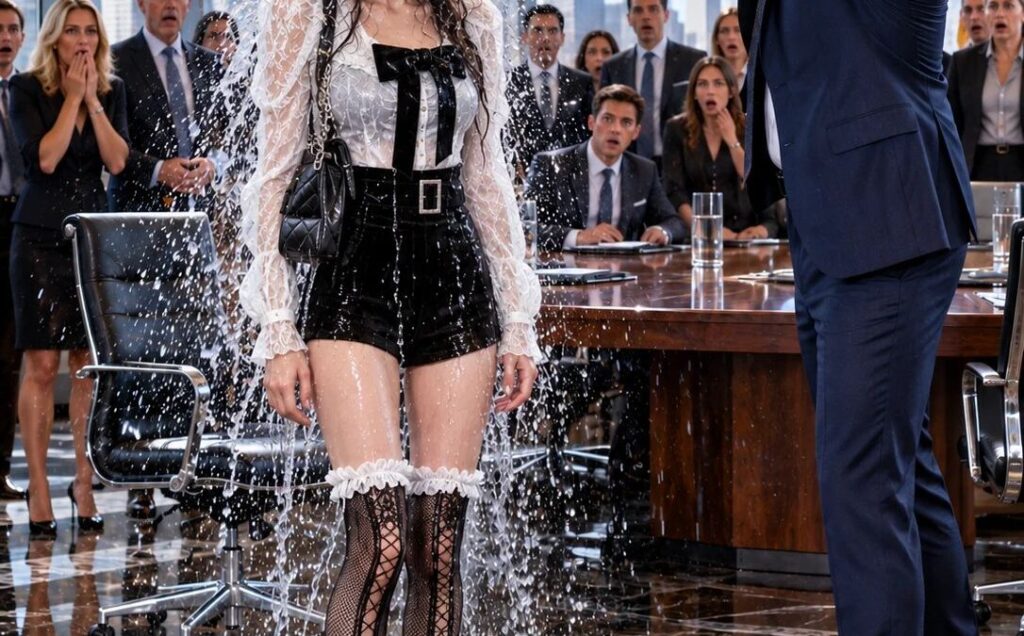
People could also behave better after power was removed because they had no other choice.
The difference was not hers to judge.
She hoped, for his mother’s sake, that he had learned something true.
One afternoon, near the anniversary of the incident, Isabel returned to the regional floor alone.
No entourage.
No disguise.
Just Isabel.
She stood near the photocopier area, looking at the plants, the chairs, the framed sentence.
A young receptionist named Ana approached nervously.
“Señora Fuentes?”
Isabel turned.
“Yes?”
Ana held a small envelope.
“This came for you. No sender.”
Camilo would hate that.
Isabel accepted it anyway.
Inside was a printed photograph.
The phone footage.
A still image.
Water pouring over Isabel’s head.
Her eyes open.
Julián holding the bucket.
The office frozen around them.
On the back, someone had written:
I took the video. I am sorry I did not stop him. I was afraid. Thank you for making fear less normal here.
No name.
Isabel held the photograph for a long time.
Then she walked to the framed sentence and tucked the photograph behind it, hidden but present.
Not displayed for spectacle.
Kept as memory.
A company should remember where it almost lost itself.
That evening, Isabel stood in her penthouse overlooking Bogotá.
The city lights spread beneath her like fallen stars.
In her closet, designer suits hung in quiet rows. Silk blouses. Italian shoes. Handbags that cost more than some salaries. The costume of power waited there, polished and obedient.
But on one chair near the window lay a thrift-store black blazer.
Clean now.
Dry.
Pressed.
Still cheap.
Still worn.
Still carrying, in some invisible way, the weight of cold water and a room full of silence.
Valeria had once asked why Isabel kept it.
Isabel had answered honestly.
“Because I need to remember who people become when they think no one powerful is watching.”
But that was only half the truth.
She also kept it because of who she had become.
Before the bucket, Isabel Fuentes had owned Altavista.
After it, she began to lead it.
Years later, business schools would teach the Altavista case.
They would discuss anonymous reporting systems, executive accountability, performance incentives, crisis transparency, workplace culture, and leadership ethics.
They would use charts.
Timelines.
Policies.
They would call it a transformation.
A governance correction.
A landmark in corporate responsibility.
But employees who had been there told it differently.
They spoke about the sound of water hitting plastic.
A bucket carried across a silent office.
A woman in a cheap blazer who did not step back.
A cruel man who thought worth could be measured by clothes.
And the moment everyone learned that the most dangerous person in the room is not always the one shouting.
Sometimes it is the one standing quietly, soaked to the skin, finally seeing everything clearly.
Isabel never forgot how cold the water felt.
She never wanted to.
Because the cold had woken something.
Not revenge.
Not pride.
Responsibility.
The kind that cannot be delegated to reports.
The kind that walks the floors.
Learns names.
Reads complaints.
Asks who is afraid.
And listens long enough for the answer to become dangerous.
Julián Mena had poured a bucket of water on a woman he thought was nobody.
He believed he was teaching her place.
Instead, he revealed his own.
And in doing so, he washed the polish off an empire, exposed the rot beneath it, and forced the woman who owned everything to finally see the people who had been holding it up all along.
The End.
