The obituary ran in four newspapers.
Within hours, relatives I’d never heard of were calling about funeral arrangements.
Dad flew in from San Francisco the next morning, already dressed in black, already calculating.
Mom arrived separately, making sure the society photographers captured her grief.
My uncles came together, a united front of entitlement.
At the funeral, they all performed beautifully.
Dad’s eulogy about family values and maternal love would have been touching if I hadn’t heard him call her a stubborn old fool on the phone the week before.
The tears, the memories they shared, the touching anecdotes, all of it rang hollow as a bell.
Samuel announced the will reading for the following week.
The vultures circled immediately, but I just waited, trusting whatever grandma had planned.
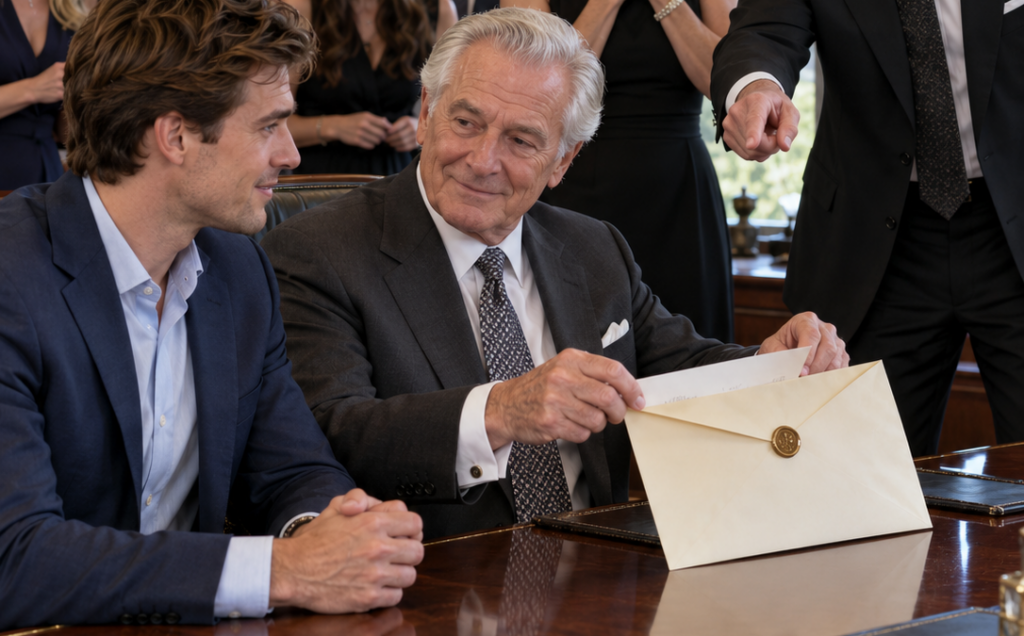
The conference room at Samuel Parker’s law firm could have been a stage for a play about greed.
Every seat was taken, and people stood against the walls like they were afraid to miss a single word.
Dad sat in front with his personal lawyer, a sharp-faced woman who kept checking documents on her tablet.
Mom had brought her financial adviser, a nervous man who kept adjusting his tie.
Uncle Charles cracked his knuckles repeatedly, while James sweated through his shirt despite the cool temperature.
Samuel entered precisely at 200, carrying the same leather portfolio from that day 8 months ago.
He set it down carefully, adjusted his glasses, and looked at each person in the room with the steady gaze of someone who’d seen every kind of family drama in his 40-year career.
“Before we begin,” Samuel said, his voice carrying the authority of law and experience, “I want to remind everyone that Mrs. Miller executed this will 8 months ago while in full mental capacity, witnessed by three medical professionals and two independent attorneys. Any attempts to contest it will be met with the full resources of this firm.”
Dad’s lawyer started to speak, but Samuel raised his hand.
“Please hold all questions until I finished reading the complete document.”
He opened the portfolio and pulled out the first document.
“The last will and testament of Margaret Maggie Miller, dated February 15th of this year. To my son Henry, I leave my complete collection of family photographs stored in albums in the study. Every birthday, every Christmas, every family gathering you missed while building your fortune. Perhaps looking at them will help you understand what you traded for your success.”
Dad’s face went from expectant to confused to furious in 3 seconds.
“Photos. That’s it?”
Samuel continued without acknowledging the outburst.
“To my son Charles, I leave my personal recipe book, including the recipes for every meal you claimed you could improve, but never once cooked for me. May you finally learn that talking about doing something and actually doing it are different things.”
Charles stood up so fast his chair fell backward.
“This is insane. Where’s the money?”
“To my son James, I leave my antique deck of playing cards. The ones my father used to teach me that gambling with family love is the only bet you’re guaranteed to lose.”
James’s face turned purple.
“She’s mocking us. This whole thing is a joke.”
“To my daughter-in-law, Linda,” Samuel continued steadily, “I leave my collection of costume jewelry. 25 pieces that look expensive but are worth nothing, much like the affection you showed me over the years.”
Mom gasped, her hand flying to the real pearls at her throat.
“How dare she?”
The room erupted in angry voices, threats, accusations flying like shrapnel.
Samuel waited patiently for the noise to die down, then pulled out a second envelope.
“To my grandson, Ethan Miller, I leave my 1950 Cadillac coupe purchased with the first profit from my business. It still runs because it was maintained with care, not money. Like love, it only needed consistent attention to last.”
I felt every eye in the room turn to me with hatred so pure it could have burned through steel.
“That’s all?” Dad shouted. “Where’s the 60 million? The oceanfront property, the shipping company, the investment portfolios?”
Samuel pulled out a thick document.
“Ah, yes. The estate valued at 60 million. I have here a complete financial disclosure also executed 8 months ago.”
The room went silent as death.
“Four years ago, upon receiving her diagnosis, Mrs. Miller began liquidating her assets. She sold the shipping company to her employees for $1, with the provision that all profits for the next decade go into their retirement funds. She liquidated all investment portfolios and properties, converting everything to cash.”
“60 million in cash,” Charles breathed. “Where is it?”
Samuel smiled.
Then the first real emotion he’d shown.
“Distributed as follows.”
“35 million was used to establish the Miller Foundation for Childhood Cancer Research, focusing on pancreatic cancer that affects children.”
“10 million funded full college scholarships for 250 first generation students from working families.”
“6 million was distributed among 15 food banks and homeless shelters in California and Oregon.”
“3 million went to Doctors Without Borders.”
The silence was so complete I could hear the air conditioning humming.
“The oceanfront mansion,” Samuel continued, “was sold to the California State Parks for $1 to be converted into a public beach access and nature preserve. By Mrs. Miller’s specific instruction, it will be named the Ethan Miller Preserve, honoring the only family member who understood that the best views shouldn’t be reserved only for those who can afford them.”
“No,” Dad whispered. “She couldn’t have. We’re her children. That money was ours by right.”
Samuel pulled out one final document.
“There is one more bequest. $1.5 million remains in a trust with Mr. Ethan Miller as the sole trustee. This money can only be used for one specific purpose: to pay for medical care and support for any family member who becomes ill and has no one else to turn to.”
