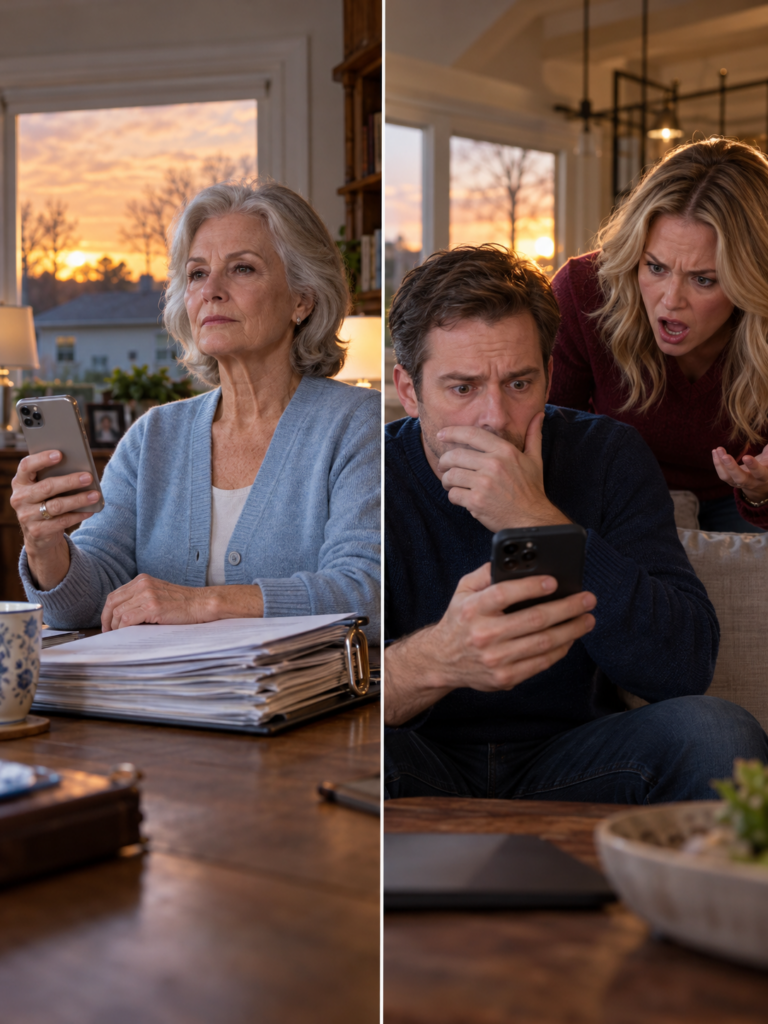
From the kitchen, Heather shouted, “She has a savings account named after herself!”
Daniel stared at me.
“You have a what?”
I started laughing.
Heather appeared in the doorway holding a dish towel.
“It’s true.”
Daniel looked between us.
“This family got weird while I wasn’t paying attention.”
“You weren’t paying attention for several years,” Heather said.
He pointed at her.
“Too soon.”
She smiled.
Maybe there are families that repair themselves with grand speeches.
Ours did it with awkward apologies, canceled subscriptions, dry turkey, small choices, and a savings account with a ridiculous name.
Nothing that happened erased Heather’s message.
Nothing erased Daniel’s assumption.
Nothing erased the years when they accepted my help too casually.
But I did not need the past erased.
I needed it understood.
There was a time when I thought forgiveness meant pretending an injury no longer mattered.
Now I understood it differently.
Forgiveness meant the injury no longer got to decide everything that happened next.
Late that Christmas Eve, after everyone left, I walked through the house turning off lights.
The kitchen was clean.
Daniel had kept his promise.
There was one wineglass beside the sink.
I washed it myself.
Not because anyone had left me the work.
Because it was one glass and I felt like washing it.
I dried my hands.
Then I walked into the little office.
The folder marked DANIEL was still in the bottom drawer.
I had not opened it in months.
I pulled it out.
For a moment, I considered throwing everything away.
Then I changed my mind.
Those records were not weapons.
They were history.
History did not have to be destroyed just because peace had arrived.
I placed the eight-hundred-dollar check inside the front pocket.
Then I wrote one line on a small yellow note.
“Christmas Eve — returned by Daniel.”
I smiled.
Richard would have teased me for documenting even this.
Then I closed the folder and put it away.
The house was quiet again.
I walked through the hallway and paused in the kitchen.
Almost exactly one year earlier, I had stood in that room with a towel over my shoulder and a cooling pot of soup on the stove.
My son had volunteered my home to thirty-two people.
My daughter-in-law had told me to keep the kitchen moving while the real family enjoyed the night.
And one sentence had finally forced me to see something I had spent years avoiding.
I had confused being indispensable with being cherished.
The two can look remarkably similar from the inside.
People call you.
People need you.
People ask where you are.
People panic when you stop.
For years, I mistook that panic for proof of love.
Sometimes it was.
Sometimes it was only proof that I had been carrying something they did not want to carry themselves.
The difference became clear only when I put it down.
When I stopped the payment, I was afraid I might lose my son.
Instead, for a while, he was angry.
Then embarrassed.
Then forced to look at his own choices.
Heather was angry too.
Then defensive.
Then honest.
And I had to look at myself just as carefully.
I was not a helpless woman they had stolen from.
I had participated in the pattern.
I had offered too quickly.
Stayed silent too long.
Expected people to notice sacrifices I worked hard to hide.
Then felt wounded when they believed the story I was performing.
I’m fine.
I don’t mind.
Don’t worry, sweetheart.
I’ve got it.
Those are loving words.
But repeated carelessly, they can become dangerous ones.
Because eventually people stop asking whether you are fine.
They stop wondering whether you mind.
They stop worrying because you told them not to.
And one day, if you are not careful, you may discover that everyone believes you exist exactly as you presented yourself:
Endlessly available.
Endlessly capable.
Endlessly giving.
That was the part I had needed to change.
Not my love.
Not my generosity.
The assumption that love had to be proven through exhaustion.
I turned off the kitchen light.
Before going to bed, I checked my phone.
The family chat had one new photograph.
Heather had taken it before leaving.
I was sitting at the dining table, laughing at something Marie had said.
Daniel was beside me.
Ellie was on my lap.
Mason stood behind us making antlers over Daniel’s head.
There was no apron around my waist.
No tray in my hands.
No sink full of dishes behind me.
I was simply there.
Heather had written beneath the photograph:
“Merry Christmas from all of us.”
I looked at those words for a long time.
All of us.
I did not need her to say “real family.”
I did not need an apology attached.
I did not need anyone to know what I had paid for in the past.
I did not need my name in the captions describing their house.
I had finally learned that love given freely did not require a receipt.
But neither did it require surrender.
The next morning, Christmas Day, I woke late.
Sunlight had already filled the bedroom.
My phone contained messages from Daniel, Heather, both grandchildren, Marie, and half the relatives in the family chat.
I answered them slowly.
Then I made coffee.
While it brewed, I opened my banking app.
The balance in the account labeled LINDA made me smile.
I deposited Daniel’s check using my phone.
Eight hundred dollars.
The same amount that had once left my account every month so quietly that no one thought about it anymore.
Now it came back once.
Voluntarily.
That mattered more than the amount.
I poured my coffee and stood at the window.
A year ago, Daniel’s text had arrived after I canceled the payment.
Mom, what did you do?
At the time, I had thought the answer was simple.
I stopped paying part of your mortgage.
But that had never been the full answer.
What did I do?
I stopped confusing access with love.
