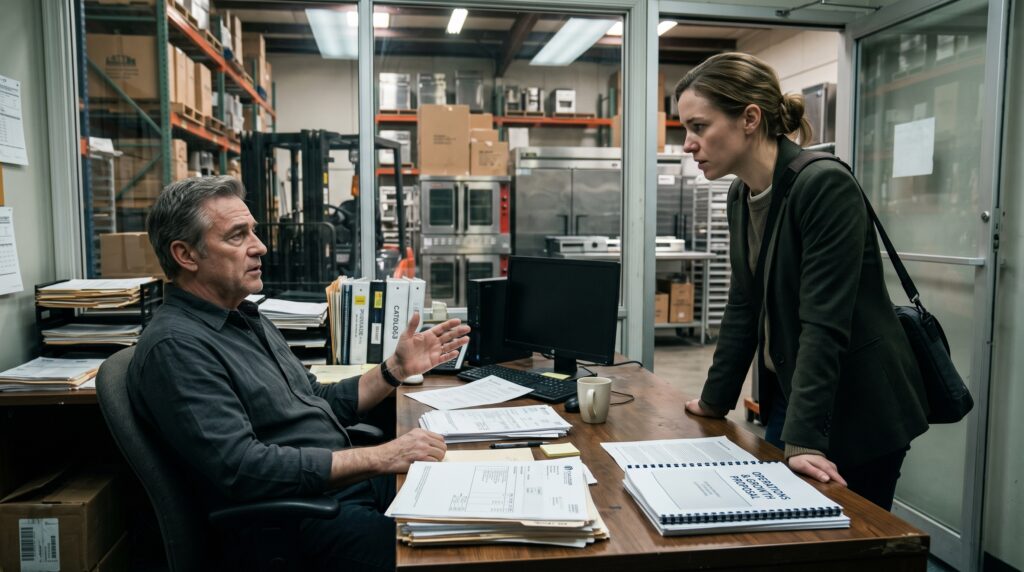
My father told me I was lucky to have the job three days before he handed my incompetent younger sister a title, a company SUV, and a paycheck three times the size of mine. I had spent four years rebuilding his business from the inside out. Nights, weeks, Thanksgiving mornings, Christmas afternoons, without a single day off that didn’t get interrupted by a call I was the only one who could answer.
I had just walked across a stage to collect my MBA diploma. I had prepared a 12-page business case with salary benchmarks, performance data, and revenue projections. I slid it across his desk with steady hands. He didn’t read past the first page.
Two weeks after I resigned, a competitor called and said, “We’ve been watching Harrove Kitchen Supply for a while now. Everyone in the industry keeps saying the same thing. That was you holding it together.”
They offered me 50% more than I’d been making. I didn’t take revenge by making noise. I took it by going completely quiet at exactly the moment they needed me most.
If you were in my position, would you have stayed? And wherever you’re listening from right now, what time is it there?
I didn’t walk into Harrove Kitchen Supply expecting red carpet treatment. My father had built the company over 22 years, selling commercial kitchen equipment and catering supplies to restaurants, hotels, and event venues across Middle Tennessee. It was a solid regional business with a good name and a mess underneath.
When I joined right out of college, nobody was handing me a corner office. I started in the warehouse in Nashville, learning the product catalog by touch. steam table pans, hotel pans, chafing racks, reachin cooler seals, the difference between a genuine NSF certified prep table and a knockoff that would fail a health inspection in 6 months.
I went on delivery runs. I helped set up demo kitchens at trade shows. I answered phones when our single customer service rep called out sick, which was often. I learned what the actual work cost us in time and labor because nobody else had bothered to find out.
My father had a gift for making clients feel like old friends at a golf course. He remembered names, birthdays, the names of people’s dogs. Restaurant owners loved him. Hotel purchasing managers asked for him by name.
What he could not do and had never needed to do because other people had always absorbed it was manage the machinery underneath those handshakes. Inventory was tracked in a spreadsheet that three different people updated independently and none of them could reconcile. Orders were promised based on stock levels nobody had physically verified.
We lost a $34,000 hotel account in my second month because we committed to a delivery timeline we had no actual capacity to meet.
I stayed because my father made a promise that sounded reasonable at the time. If I learned the business, if I put in the work and proved myself, he would bring me in as operations director. Someday, he said, there could be partial ownership, not charity earned.
I believed him because I wanted to and because my mother’s health had been unsteady that year. Nothing catastrophic, but enough to make stability feel like something worth protecting.
The other reason I stayed, the one I didn’t say out loud for years, was my younger sister, Tiffany. Tiffany was four years younger than me and had always existed in a different atmosphere inside our family.
Growing up, she was the one people described as vibrant, magnetic, the one who filled a room the moment she walked in. I was described as capable.
When Tiffany dropped out of her first college major, my parents called it finding herself. When she transferred schools, they called it growth. when she cycled through three different jobs in two years after graduating, marketing coordinator, social media manager, assistant event planner. They called it exploring her options.
When I worked through spring breaks and skipped vacations to save money and get ahead, they said that was expected. It was just who I was.
By the time we were adults, the math was obvious, even if nobody said it plainly. Tiffany was loved for being Tiffany. I was valued for being useful.
My parents covered her rent when she moved to a more expensive apartment. They quietly absorbed her credit card balance one year without mentioning it.
When I asked for help with my student loans during a particularly tight stretch, my mother said, “You’ve always been so good at figuring things out.”
And she meant it as a compliment.
I didn’t hate my sister for any of it. I directed the resentment inward at myself for keeping score.
The company needed systems. That was the simple version of the problem. Nothing was connected. Orders, inventory, vendor timelines, delivery schedules. Each existed in its own silo, managed by whoever happened to be standing closest to that particular fire on any given day.
I started small.
I built out a master inventory count from scratch, physically walking every shelf in the warehouse over three weekends with a clipboard and a barcode scanner we borrowed from our shipping department. When I was done, we discovered we had been routinely underelling stock we had and overselling stock we didn’t.
Fixing that alone saved us from three vendor disputes in the following quarter.
I pushed for real inventory software. My father resisted at first. He’d been doing it this way for 20 years, he said, and the company was still standing. I showed him what the errors were costing us in rush freight fees and lost accounts. He agreed to a trial.
Within 60 days, we had full visibility into stock levels across our two warehouse locations for the first time. Shrinkage dropped by 40%. Back orders that used to blindside us were now flagged a week in advance.
Vendor management was the next problem.
We had no formal contracts with most of our suppliers, just handshake agreements and relationships my father had built over years. That worked fine when the market was stable, when supply chains got erratic, and they did badly during a stretch of national shortages in commercial cooking equipment. We had no leverage and no protection.
