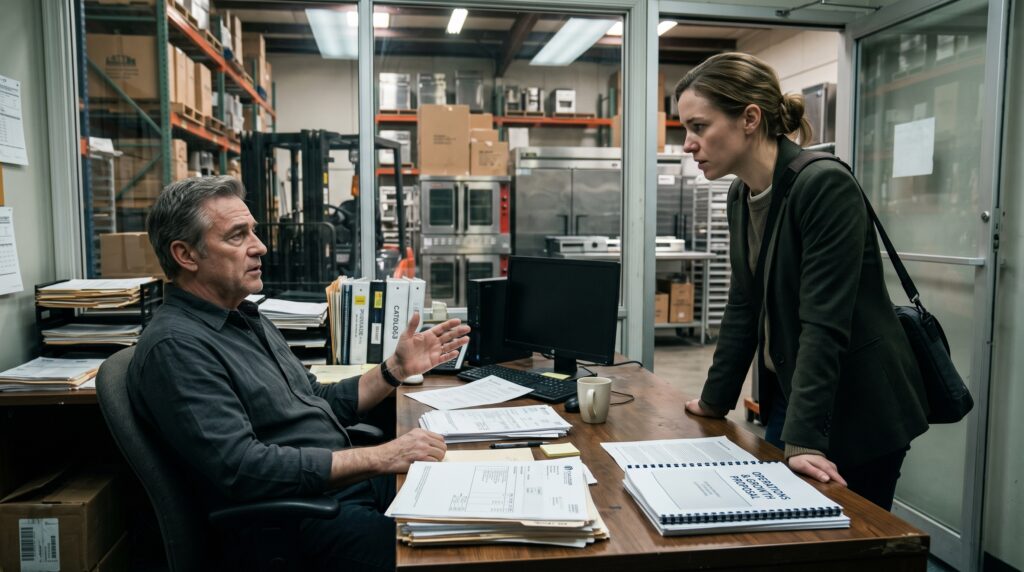
We had been having some version of this conversation for 2 years. I nodded and left his office. I sat in my car for 15 minutes before I was ready to drive.
3 days later, my father sent a companywide email with the subject line.
Exciting news. Harrove grows its leadership team.
I was in the middle of a vendor call when the notification came through. I finished the call then read the email.
My father was announcing a new position, director of brand development and client experience, and introducing the person who would fill it.
The announcement included a photo of my sister, Tiffany, smiling in what looked like a newly purchased blazer and a paragraph describing her background in marketing, client relations, and brand strategy. It mentioned her energy, her vision, and her commitment to taking Harg Grove to the next level.
The all hands meeting was the following morning in the warehouse.
My father stood at the front with Tiffany beside him and he talked about growth and evolution and the importance of investing in the right people at the right time.
Tiffany gave a short speech that included the phrases elevating our brand narrative and reimagining the client touch point.
Several of the warehouse staff exchanged looks they thought nobody noticed. I stood near the back with my arms folded, feeling something colder and quieter than anger.
I waited until after the meeting. I followed my father into his office and closed the door.
I asked flatly what Tiffany’s compensation package was.
He looked at his desk. That’s internal.
I told him I managed our operating budget. He knew I would eventually see the numbers. He might as well tell me now.
He said her role requires external relationship investment. Client-f facing positions carry different market rates.
I asked him to tell me the number.
He told me her base salary was three times mine. She also had a company vehicle and a monthly expense allowance for client entertainment.
I didn’t say anything for a long moment.
He filled the silence.
This isn’t about you. This is a strategic hire. Tiffany brings something different to the table. Your operations, she’s growth, their different functions.
I said, “You told me three days ago there was no room in the budget.”
He said, “This is an investment.”
I said, “In someone who has never set foot in a commercial kitchen.”
His voice shifted.
I need you to be a team player here. I need you to support your sister instead of making this harder than it needs to be. Honestly, this attitude is exactly why I can’t move forward on your compensation. Leadership isn’t just competence, it’s also temperament.
I picked up the folder with my 12-page business case from his desk. I thanked him for his time and walked out.
I spent that evening at my kitchen table with a legal pad, writing down everything I was certain of. the company’s systems, the accounts I personally managed, the institutional knowledge that existed nowhere in writing.
I was not doing it as leverage. I was doing it to be sure that what I was about to decide was real and not just emotion.
By midnight, I was certain.
I submitted my resignation the next morning. Two weeks notice, a genuine offer to document my processes and assist with the transition. No accusations, no drama.
I sent it to my father, our HR coordinator, and kept a copy for my records. My hands were steady when I hit send.
My mother called within the hour. She was crying before I finished saying hello. She talked about loyalty, about how this would affect the family, about what people would say.
I told her I was leaving a job, not the family.
She told me it wasn’t that simple when the job was family.
My father called that afternoon. His voice was controlled but tight like something wounded too many turns. He said I was being impulsive. He said the outside world would not treat me the way he had.
He said I would regret throwing away what I had built.
I told him what I had built was exactly the reason I was leaving.
Tiffany sent a text.
You’re really going to do this over a salary conversation? Kind of embarrassing honestly.
I did not reply.
I spent my final two weeks doing exactly what I said I would do. I documented every process I had created in enough detail that someone who had never run an inventory system could follow the steps without calling me.
I updated access permissions, created handover notes, trained two junior employees on the quoting system.
I did not slow down. I did not cut corners. I wanted the record of my exit to be as clean as the record of my work.
On the third day, Anton, our warehouse operations lead, found me during a shift change. He had been with Harrove for 6 years and knew the delivery routes better than anyone else in the building.
He said he’d heard I was leaving and he wanted to know if it was really true.
I told him it was.
He nodded for a long time looking at the floor.
You’re the only one who knows what this place actually runs on, he said. Not the logo, the actual thing.
He didn’t ask me where I was going. He just said, “I’m going to think hard about my own situation.”
Key, who managed our key account relationships, came by my office the next afternoon and shut the door. She had a way of building client trust that was entirely her own. She remembered details nobody else tracked, small commitments that seemed minor until the client discovered she had followed through.
“They call us because of the relationship,” she said.
But they stay because we actually deliver. If that changes, they’ll notice faster than anyone thinks.
She didn’t say she was leaving. She didn’t have to.
