I renegotiated agreements with our top 12 vendors, building and price lock clauses, delivery guarantees, and breach penalties. Three vendors pushed back. I walked away from two of them and found better terms elsewhere. The third came back with a contract I could actually sign.
Customerf facing systems needed work, too.
Our quoting process was manual and slow. A hotel purchasing manager would call in, describe their needs, and wait 2 to three days for a quote while someone in our office pulled numbers from memory and a scattered price list.
I standardized our quoting templates, connected them to live inventory data, and cut turnaround to same day for standard orders. We started winning accounts we had been losing purely on response speed.
The revenue numbers reflected all of it. When I joined, Harrove Kitchen Supply was doing about $6 million a year. By the end of my second year, we crossed 9 million. By my fourth year, we were consistently between 13 and 14 million annually.
We landed a multi-year contract with a regional hotel group that had previously split their supply budget across four vendors. We won a university dining services agreement that gave us guaranteed baseline revenue for 3 years.
None of that was luck. It was the direct result of processes that worked.
Through all of it, my compensation did not move in proportion to any of it. I received cost of living adjustments. I received one bonus during year three, a single payment that did not reflect the performance it was supposed to recognize.
Every time I raised the subject of a formal review, the answer was the same.
Things are good right now, my father would say. Let’s make sure this new contract tread is stable. Let’s get through the quarter.
The goalpost was always a few months away.
I enrolled in an MBA program at night during my third year at the company. I won’t pretend it was a purely rational decision. Part of it was the degree itself. Part of it was a quiet desperation to prove something, to create evidence that even my own family couldn’t dismiss.
Classes ran from 6:00 to 9:30 on Tuesdays and Thursdays. I drove to campus straight from the warehouse, still in workclo, still answering texts from drivers who had questions about delivery windows.
I wrote my capstone project about supply chain resilience using Hargrove’s own data as a case study. My professor said it was one of the more practically grounded papers she’d read from a working student.
The physical cost surprised me though it shouldn’t have. I started getting headaches that didn’t respond to anything I could buy at the pharmacy. My sleep was fragmented in a way that stopped feeling like stress and started feeling structural.
I missed my best friend’s engagement party because of refrigeration unit shipment from our primary vendor was delayed and I was the only person who had the vendor rep’s direct line and the standing to push.
I missed a weekend trip I had planned for 8 months because a large hotel client had a lastminute equipment failure and expected us to source replacements within 4 hours.
I went to urgent care once for chest tightness that turned out to be acid reflux and stress. The doctor asked about my schedule. I gave her a summary. She looked at me for a moment before writing anything down.
My MBA graduation was a Thursday evening in May. My parents came. My father took photos.
On the drive to dinner afterward, he took two client calls and put both on speaker because he wanted us to hear how well the relationship was going.
Nobody asked how I felt. I was not sure I would have known what to say.
I gave myself two weeks after graduation before bringing it up. I wanted to be calm. I wanted to be data driven, not emotional.
I pulled industry salary benchmarks for operations directors and supply chain managers at comparable regional distributors across Tennessee and the broader Southeast. I documented my actual weekly hours averaged over four years.
I built out a summary of every KPI we had improved. On-time delivery rates, inventory accuracy, vendor contract compliance, customers response times, revenue growth. I attached a brief note on the cost of key person dependency, the risk Harrove carried if institutional knowledge walked out the door unprotected.
It was the same kind of document I would have put together for a vendor negotiation, clear, factual, professional.
I asked my father for 20 minutes. He gave me 10.
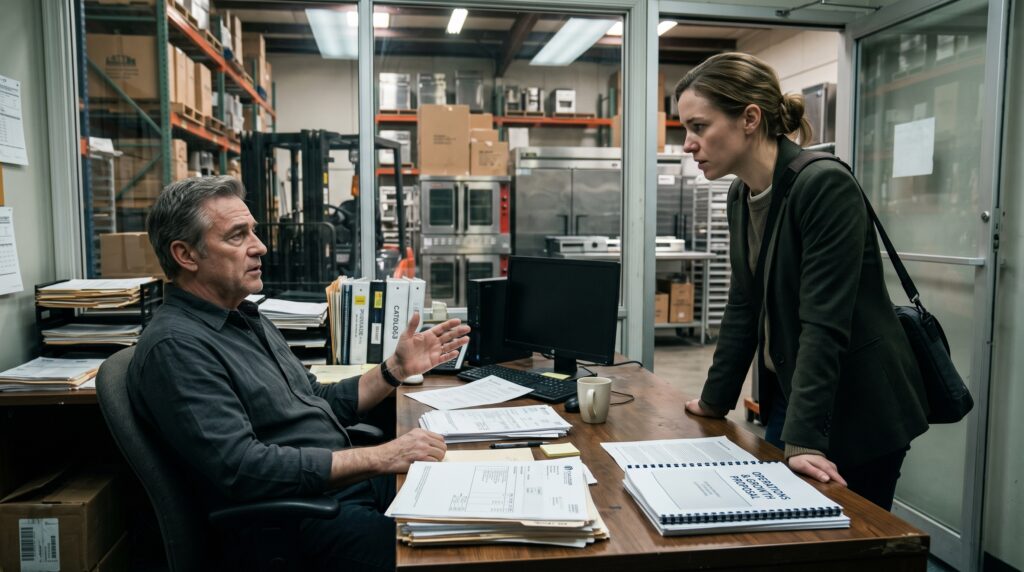
He was at his desk with his laptop open and his reading glasses pushed up on his head. And he waved me in the way you wave someone in when you are mostly already somewhere else.
I thanked him for his time. I told him I wanted to talk about my compensation. I presented the benchmarks. I walked through the revenue numbers. I pointed out the gap between what the market paid for the role I was performing and what I was currently being paid to do it.
He sighed before I finished the second page.
You’ve got to understand something, he said. You’re not working for some faceless corporation. You’re working for family. The security of that is worth something. You know this business. You know our clients. you couldn’t walk into any other company and be as valuable as you are here.
I told him I understood that and I showed him the benchmarks again.
He pushed the folder back across the desk.
I hear you, he said, but I need you to trust me on the timing. Things are in a good place right now. I don’t want to disrupt that. Give it until the end of the year.
I asked what would be different at the end of the year.
He said we’ll have more room.
