county job.
Hale had never served with Boone. He had inherited the battalion years later, along with its traditions, photographs, and stories.
But he had met him.
“Boone comes to the memorial every few years,” Hale said. “Retired, works contract security around Fort Moore now.”
“What does that have to do with me?”
“Last October, he asked why we still read your citation.”
I stared at him.
“He said the formation should focus on Ruiz and Cole, which I actually agreed with in principle. Then he said your part had become exaggerated.”
“What did you say?”
“I told him the citation was an official record.”
Hale rubbed his thumb over the coffee lid. “He said official records are written by people who need stories.”
There it was again.
Not the exact sentence.
Close enough.
“What happened next?”
“I told him if he had evidence the record was wrong, he could submit it through proper channels.”
“And?”
“He said it wasn’t worth reopening old business.”
Old business.
Daniel had a daughter in middle school by then.
Megan’s father still went to her grave every Sunday.
My left hand still did not close.
Old business.
Hale watched my face. “What did you find?”
I told him about the route warning.
I did not tell him everything, only enough to explain why Boone’s comments now mattered.
Hale listened without interruption.
When I finished, he said, “You need to report it.”
“To whom?”
“I can connect you with the installation Inspector General’s office.”
“I am not accusing Boone of causing the attack.”
“Then don’t accuse him of that.”
“I don’t want another circus.”
“Then make it boring.”
I almost smiled.
“Paperwork,” Hale said. “Dates. Documents. Statements. Let people whose job it is to review records do that. No speeches.”
No speeches.
He remembered.
That afternoon, I filed a request for a formal review concerning the accuracy of the post-incident administrative record.
Not the medal.
Not heroism.
Not blame for the explosion.
One question only:
Had a documented route concern been removed or omitted after the attack, and if so, why?
Three days later, I received a voicemail from a Georgia number.
The voice was older, but unmistakable.
“Mara. Victor Boone. I hear you’ve been digging around in old paperwork.”
I listened without moving.
“You need to understand something about deployments. People remember things differently after trauma.”
A pause.
“I’m not your enemy.”
Another pause.
Then his voice hardened.
“But if you turn this into some campaign to blame me for those kids dying, I will defend myself.”
He hung up.
I replayed the voicemail once.
Then I saved it.
Because Boone had just given me something more useful than an apology.
He had confirmed he was afraid.
Part 5
The Inspector General’s office occupied a building so ordinary it almost made me laugh. Beige walls, plastic chairs, framed photographs of commanders, a water cooler with paper cups stacked upside down beside it. Fifteen years of memory had taught me to expect important truths to live in dramatic rooms, but most of them live under fluorescent lights beside malfunctioning printers.
The investigator assigned to the matter was a civilian named Rachel Kim. She wore reading glasses on a chain and asked questions without putting emotion into them, which I appreciated.
“What are you alleging?”
“That a route concern I submitted before the October 1 mission was excluded from the final administrative record.”
“Are you alleging deliberate concealment?”
“I’m asking you to determine that.”
“Are you alleging the route concern would have prevented the attack?”
“No.”
She looked up.
“Important distinction.”
“I know.”
Rachel asked about Boone, Captain Nolan, Owen, the operations sheet, the email chain, and the conference-room comment. When I described hearing Boone say the Army needed a face, she stopped typing.
“You believe the comment relates to the missing record?”
“I don’t know.”
“Then why mention it?”
“Because if a man spends years telling people the official story was manufactured, I think it matters if he also helped decide which documents reached the official review.”
Rachel typed that almost word for word.
Outside, Marcus Hale waited beside his truck.
“I didn’t need an escort.”
“I know.”
“You’re terrible at pretending this is accidental.”
“I know that too.”
I handed him the copy of my intake receipt.
“That’s it?”
“For now.”
He nodded.
Across the parking lot, Specialist Reddick was picking up litter along the sidewalk with two other soldiers.
“You gave him trash detail?”
Hale looked offended. “Absolutely not.”
I raised an eyebrow.
“He volunteered.”
That surprised me.
Reddick noticed us, hesitated, then approached.
“Ma’am.”
“Specialist.”
He held a black trash bag in one hand. “I wanted to tell you something.”
Hale started to leave.
“Stay,” I said. “You’re already involved in everything apparently.”
Reddick looked uncomfortable. “People online think you asked to get me punished.”
“I didn’t.”
“I know.”
“How?”
“Sergeant Major told my platoon sergeant you specifically asked not to have a formal disciplinary action over the tray.”
I looked at Hale.
He shrugged.
Reddick shifted the bag. “My mom cleans rooms at a hospital.”
That was not where I expected the conversation to go.
“She’s done it twenty years,” he continued. “When I was a kid, I hated when people talked down to her. I’d get mad enough to fight somebody.”
His face reddened.
“And then I did the same thing to you because I thought you worked cleaning tables.”
He stared at the pavement.
“It’s worse now that I understand that part.”
“Yes,” I said.
He nodded once.
I did not comfort him.
Some lessons should remain uncomfortable long enough to become useful.
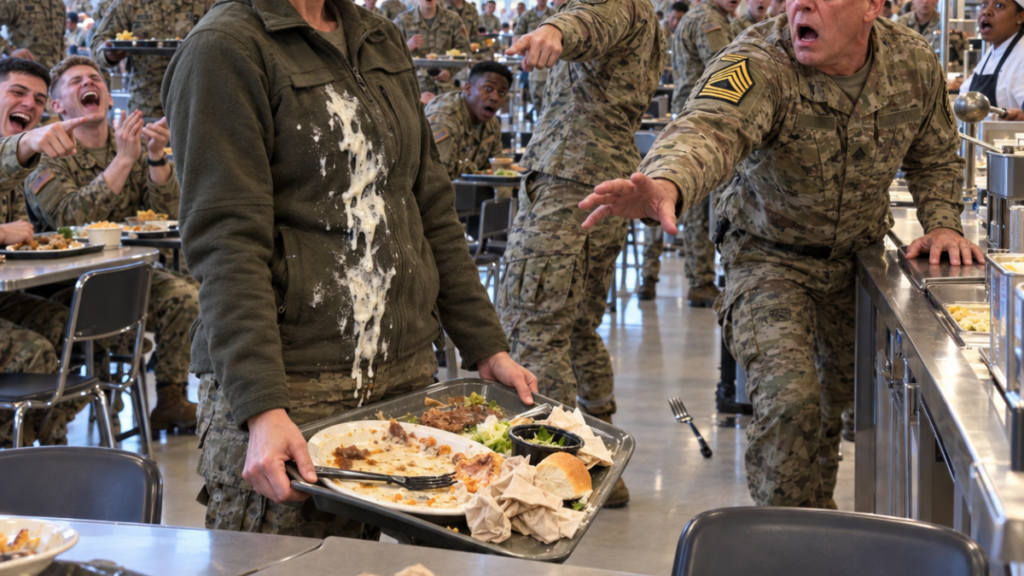
The viral video kept spreading anyway. News sites turned a forty-one-second encounter into whatever story fit their audience. Some made Reddick a symbol of a supposedly ruined generation; others turned me into a saint I did not recognize.
A television producer emailed asking whether I wanted to “confront the soldier who disrespected an American hero.”
I deleted it.
Another outlet wanted to interview me beside my old portrait.
