Nobody named Victor Boone in the lesson.
They did not need to.
Boone wrote once more.
A short email.
No apology this time.
He said, “I understand why you don’t want contact.”
I did not respond.
Forgiveness is not always a reunion.
Sometimes it is simply reaching the point where another person no longer gets to determine the temperature of your day.
I did not hate Boone.
I also did not owe him a path back into my life.
The medal case stayed on my kitchen table for another six months.
Then one Sunday morning, I moved it.
Not to the closet.
To a narrow shelf in the living room beside a framed photograph Owen had mailed me.
The picture showed our patrol team three weeks before the attack.
Daniel stood in the back making rabbit ears behind Morris.
Megan was squinting into the sun.
I was in front, young and annoyed at whoever had ordered the photograph.
Nobody looking at it would know what happened later.
I liked that.
Once a month, usually before work, I drove to the battalion headquarters at about 0550.
Marcus was gone, but somebody kept polishing the plaques.
Sometimes Reddick.
Sometimes the staff duty soldier.
Sometimes someone I did not know.
I never asked.
I would stand in front of the memorial and read every name.
Not only Daniel.
Not only Megan.
Every name.
One morning, a new private came through the side door while I was there.
He paused behind me.
“Excuse me, ma’am.”
I stepped aside.
He approached the display, pulled an index card from his pocket, and began reading.
Apparently somebody still made newcomers do it.
When he finished, he looked at my portrait.
Then at me.
Then back at the portrait.
Recognition started.
I saw it.
The pause.
The narrowing eyes.
The silent comparison.
For years, that exact moment had been the thing I feared most.
I expected my body to tighten.
It did not.
“Are you—”
“Mara Ellis.”
He nodded.
“Yes, ma’am.”
He looked confused about what to do next.
So I helped him.
“What company?”
“Bravo, ma’am.”
“First day?”
“Yes.”
“Nervous?”
“A little.”
“Good. Means you’re paying attention.”
He smiled.
I pointed toward Daniel and Megan.
“Remember those two.”
“Yes, ma’am.”
“And remember the others.”
He nodded again.
I walked toward the exit.
Behind me, the private called, “Staff Sergeant?”
I turned.
“Thank you.”
I almost asked what for.
Instead I said, “Take care of your people.”
Outside, sunrise was spreading orange above the motor pool roofs.
I reached my truck and unlocked the door.
My left hand was visible.
I noticed that only because once upon a time I would have hidden it before crossing the parking lot.
The fingers were still curled.
The scar was still there.
Nothing miraculous had happened to it.
Nothing miraculous had happened to me either.
I had simply stopped treating survival like evidence against myself.
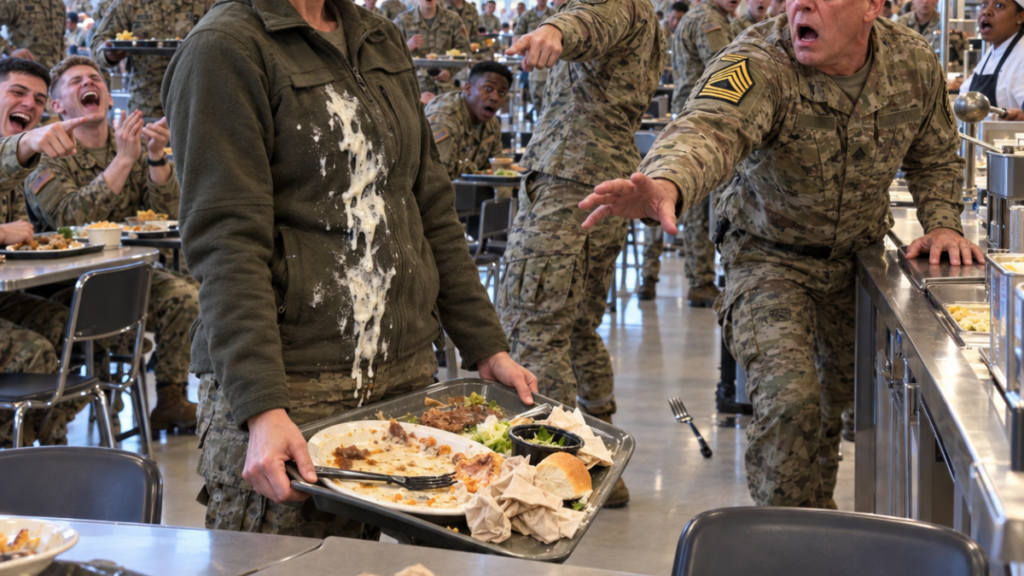
The day Specialist Evan Reddick dropped his tray on my table, I thought the worst thing that could happen was being recognized.
I was wrong.
The worst thing had already happened years earlier, when I heard one man reduce my life to a convenient story and decided the safest response was to erase myself from it.
His lie about the route warning eventually cost him his job.
His lie about me cost him nothing.
That part was mine.
I had paid for it by skipping memorials, hiding my medal, entering post on visitor passes, avoiding old friends, and spending twelve years believing absence was humility.
It was not.
Daniel did not need me invisible.
Megan did not need me ashamed.
Their families did not need a ghost guarding their memory.
They needed names spoken correctly.
They needed records that were honest.
They needed people willing to remember who they had been before one terrible morning turned them into plaques.
Sometimes I still sit at the table beside the trash station.
Lorraine sometimes joins me if she is on break.
We talk about books, weather, rent, bad knees, food-court coffee, and whether the Cowboys have any chance of making the playoffs.
Nobody salutes.
Most people do not know who I am.
That is fine.
Being unknown and hiding are not the same thing.
I know that now.
And when I leave, I carry my own tray to the trash.
Not because anybody expects me to.
Because there was never shame in carrying a tray.
The shame was believing some people were born to carry everyone else’s.
I set it on the stack square.
Then I walk out with both hands where the world can see them.
THE END!
