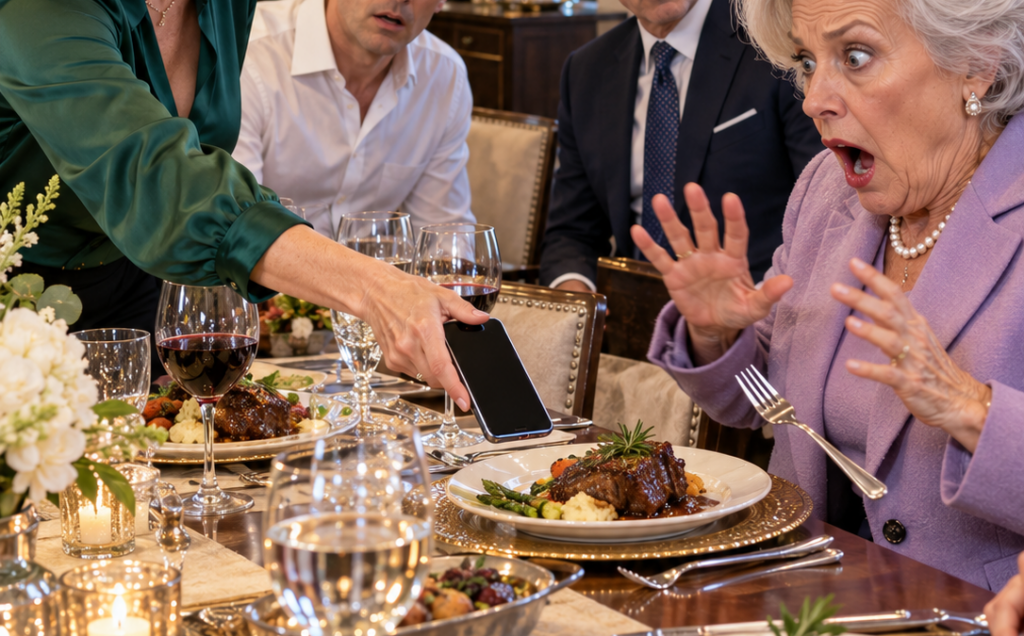
“I brought a real meal so my son doesn’t starve,” my mother-in-law announced, humiliating me in front of my husband’s boss. She proudly served her famous short ribs, unaware I owned the catering company that made them. Then I placed my phone beside her plate. Her fork suddenly dropped…
“My mother-in-law stood in my dining room, looked at the dinner I had spent two days preparing, and announced, ‘I brought some real food so my son won’t go hungry.’”
Then she opened the first aluminum container.
The smell of rosemary, garlic, red wine, and slow-braised beef filled the room.
I knew that smell.
I knew the pomegranate seeds scattered across the short ribs. I knew the roasted potatoes with crispy sage, the broccolini dressed in lemon, and the little chocolate desserts tucked into the last container.
I knew every dish because they came from my catering company.
My mother-in-law had just brought my own food into my home to prove that I couldn’t cook.
And she had no idea.
Five years of insults had brought us to that moment. Five years of being told I wasn’t good enough for her son, that my parents were beneath her, and that the food I’d learned to make at my grandmother’s side wasn’t suitable for respectable company.
But instead of arguing, I reached into my apron pocket, took out my phone, and opened a customer account.
Fourteen orders.
Three years of Thanksgiving dinners, Christmas feasts, birthday parties, and family celebrations.
All purchased from my business.
All delivered without labels, exactly as she’d requested.
Every order included the same instruction:
Please make it look like I cooked everything myself.
I placed the phone beside her plate.
My mother-in-law glanced at the screen.
Then she dropped her fork.
And for the first time since I’d known her, Eleanor Vance had nothing to say.
My name is Nadia Kostas Vance. I’m thirty-four years old, and I’ve been married to Bennett Vance for five years.
We live in a modest Craftsman bungalow in University City, just outside St. Louis. It has a red front door, a little porch that needs repainting, and a kitchen that’s smaller than I’d like.
But it’s ours.
Bennett is an attorney. He’s thoughtful, hardworking, and the kind of man who remembers to warm up my car on freezing mornings.
His mother is another story.
Eleanor Vance is seventy-one, a widow, and a woman who has spent most of her life making certain everyone knows exactly where they stand in relation to her.
Usually, somewhere below.
She lives in a beautiful brick colonial in Brentwood, with white columns, perfect hedges, and furniture nobody is allowed to sit on without permission.
Eleanor has never forgiven Bennett for marrying a woman whose parents owned a diner.
My parents, Nicholas and Maria Kostas, operated the Acropolis Diner in Toledo, Ohio, for thirty-one years.
My father worked the grill six days a week. My mother made pies before sunrise and knew nearly every regular customer by name.
They weren’t wealthy people.
But they were generous, hardworking, and proud.
They helped put both their children through college without ever making us feel guilty about the sacrifices.
Eleanor referred to them as “the diner people.”
“How are the diner people?” she’d ask at family gatherings. “Still flipping hamburgers?”
I’d smile politely.
“They’re doing well, Eleanor. Thank you for asking.”
She’d make a little humming sound, as though she’d been generous enough to inquire.
Her favorite target, however, was my cooking.
The first time I prepared dinner for her, Bennett and I had just become engaged.
I wanted everything to be perfect.
I made lemon-oregano lamb, Greek roasted potatoes, fresh salad, homemade tzatziki, and baklava using my grandmother’s recipe.
It took me nearly two days.
Eleanor took one bite of the lamb.
Then she set down her fork.
“Well,” she said, “it’s certainly very ethnic.”
Bennett looked uncomfortable.
I waited for her to say something else.
Instead, she pushed the potatoes around her plate.
“The salad has rather a lot of onions.”
Then she examined the baklava.
“I don’t care for sticky desserts.”
She didn’t touch it.
On the drive home, Bennett squeezed my hand.
“I’m sorry. Mom can be difficult.”
“Does she always treat people like that?”
He sighed.
“She has high standards. You know how she is about cooking.”
I didn’t.
But I was about to learn.
Every Thanksgiving, Eleanor hosted a magnificent dinner.
Her turkey was golden and perfectly seasoned.
The mashed potatoes were smooth as silk. Her green beans had crispy shallots, and her pies looked like they’d come straight from a magazine.
She always announced that she’d been cooking since before dawn.
Everyone praised her.
Bennett used to tell me that his mother’s cooking was legendary.
Then Eleanor would look across the table at me.
“Nadia, perhaps you should take notes. This is how we do Thanksgiving in America.”
Or she’d point toward the small bowl of tzatziki I’d brought.
“How charming. You can put your little dip over there with the appetizers.”
Nobody touched it.
At Christmas, she criticized my spanakopita.
At Easter, she questioned why I used lemon in so many dishes.
At Bennett’s birthday dinner, she suggested that I learn to roast a chicken before attempting anything more complicated.
I endured it because Bennett loved his mother.
And because I believed that eventually, if I was patient enough, she might accept me.
What Eleanor didn’t understand was that cooking wasn’t merely something I enjoyed.
It was my profession.
Four years earlier, I’d started a catering business called Saffron & Salt.
I began in a rented commercial kitchen with one assistant, a used delivery van, and twelve thousand dollars in savings.
The first year nearly broke me.
I catered retirement luncheons, graduation parties, bridal showers, and small weddings.
I worked eighteen-hour days and often came home too exhausted to eat.
But my father’s voice was always in my head.
Do the work properly, Nadoula. Even when nobody is watching.
